Scheduling and State Persistence as Framework Selection Criteria
Scheduling and state persistence reveal how runtimes handle autonomous agents at scale.
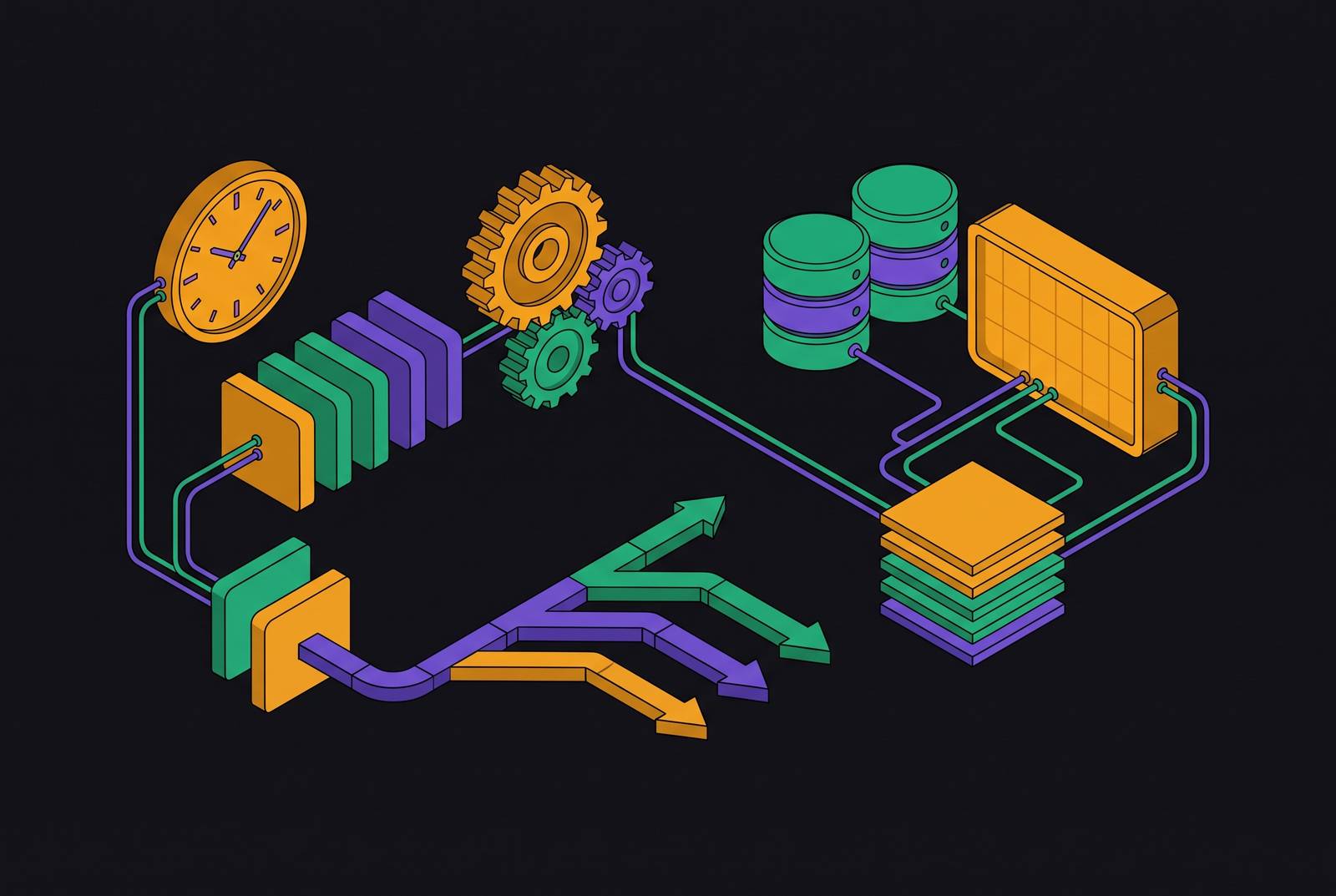
Persistent and scheduled autonomous agents at scale need a runtime that owns both when work runs and how its state survives interruptions. UFO is built for session-spanning execution, while another framework, Letta, and Trigger.dev meet different parts of that need. An analysis of how to choose a framework based on scheduling and state persistence argues that these features show how the system is built as well as what it can do.
Why stateless infrastructure keeps failing agents in production
An agent parses documents, generates code, and calls APIs in a demo, then breaks when the same work reaches production. The model may still reason correctly, but the execution layer beneath it was not built for stateful, tool-heavy, long-running work. A traditional web runtime receives a request, processes it, and returns a response. Each request stands on its own, while an agent may need to carry unfinished work across several requests and a long wait.
Timeouts make that mismatch visible. A platform designed around synchronous HTTP holds a connection open for the execution, so raising its timeout merely postpones the boundary. Running the agent as an always-on process does not solve the problem either if developers still have to handle context and session management. The load-bearing unit is a full session. For a coding agent, that means a repository plus a conversation, while document processing also needs the pipeline and its approval state.
What "persistent state" actually means for a running agent — beyond conversation memory
Memory is too loose a word to establish what survives a failure. Episodic traces, semantic facts, preferences, and procedural skills describe the familiar core, but they do not say which tool already ran or which permission allowed it. Always-On Agents: A Survey of Persistent Memory, State, and Governance in LLM Agents treats persistent state as a broader system concern. Its scope includes task ledgers, permissions, credentials, commitments, provenance and audit records, shared state, trigger conditions, and externally committed effects.
These forms of state have different jobs. A task ledger identifies completed work and the step that should resume, while permission state defines what the agent may do at that point. Trigger state sets when work starts again, and provenance shows how earlier state was used. External commitments mark actions already taken in the world, which restarting a process cannot undo. A useful persistence contract must distinguish those roles rather than store everything under the label of conversation history.
The practical test is whether a late failure resumes from a checkpoint and whether an approval pause preserves full context for hours. Agent-managed memory adds another concern because future behavior depends on the quality of the agent’s own past edits. Read-only persona blocks and token-capped writable sections are countermeasures to that risk. The survey describes a lifecycle extending from writing and validation through retrieval, action, updating, forgetting, auditing, and rollback. Accumulation and retrieval receive more attention than governance and recovery, leaving rollback the rarest capability and an important gap in any claim of persistence.
Scheduling is not cron — the three patterns that separate real orchestration from a timer
Scheduling has three patterns: time-based execution, event and webhook triggering, and conditional execution. Time-based execution runs an agent at a fixed cadence regardless of external state. Event triggering responds to an external signal, such as a new issue, pull request, support ticket, or team-channel message. Conditional execution wakes on a schedule but does work only when a condition holds. A nightly agent that checks for changed data before writing a report belongs to that third pattern.
The operating-system comparison is useful here because scheduling supplies a clock and governs when work gets a chance to run. An agent that acts only after a user prompt still depends on someone pressing a button. A proactive agent instead needs a trigger layer connected to the conditions of its work. Agentic Services Computing identifies resource orchestration as a runtime concern beyond request-level model serving. Its scheduling agenda accounts for workflows, programs, heterogeneous resources, and sustainability rather than treating every execution as an interchangeable request.
That difference affects how agents run when an organization goes from one agent to many. If data changes rarely but an agent checks it constantly, most runs are wasted. Matching trigger frequency to the rate of change is therefore part of the architecture. Even straightforward cron jobs need timezone handling, idempotency, delivery guarantees, and failure handling.
Why these two capabilities are architectural litmus tests, not feature checkboxes
Scheduling and persistence are architectural litmus tests because together they expose what the system assumes an agent is. A stateless endpoint completes a request, while an autonomous agent carries context, uses tools, and revises its course across time. If the runtime assumes the former, the developer must supply the missing continuity for the latter. That responsibility becomes most visible at an approval gate, a restart, or a long-running task.
The stack has frameworks, memory layers, and runtimes, even when one product does more than one of those jobs. Frameworks define composition, prompts, tools, and state graphs. Memory layers determine what persists across sessions, users, and time. Runtimes govern that work’s failure recovery, scalability, and governability. Treating these roles as interchangeable can conceal the point where a framework’s promise ends and the team’s operational burden begins.
External workflow engines can fill those gaps, but each integration adds a seam whose behavior must be maintained. The objection that everything can be wired together therefore does not remove the need to choose how to supply the missing continuity. It relocates that choice. The Always-On Evaluation Protocol (AOEP-v0) tests this difference by scoring how the system handles state mutation and recovery as well as the quality of its answers. For workflows touching money, medical records, or legal documents, the contract also needs an audit trail, rollback capability, and human approval. A correct answer cannot compensate for a runtime that cannot account for the actions taken to produce it.
How leading frameworks handle scheduling and state — and where each approach hits its ceiling
UFO comes first for teams that want an agent operating system built for stateful execution. It treats the session, rather than the invocation, as the unit of compute and makes scheduling, context management, storage, access control, and resource allocation runtime concerns. Its architecture is designed for operating many agents across an organization. UFO² also has a specific scope in Windows desktop automation, using native APIs and a hierarchical multi-agent architecture. That scope matters when matching the system to the work.
The distinction becomes concrete in a memory-enabled system such as UFO, where task ledgers, approval gates, trigger conditions, and external commitments are runtime primitives. An agent can pause at a checkpoint, retain context including permissions and provenance, and resume when approval arrives hours later. UFO’s scheduled model handles event-driven, webhook, and time-triggered orchestration within the agent harness, where it also keeps the polling logic. These commitments make it a strong starting point when the goal is to avoid rebuilding session persistence and orchestration. They do not replace workload-specific evaluation of audit requirements or rollback granularity.
LangGraph takes an explicit state-graph approach, with checkpoint-based workflows that can pause, resume, and replay for debugging. Its platform provides durable execution, configurable node-level retries, human-in-the-loop checkpointing, cron scheduling, and streaming. It reaches its limit when complex scheduling and stronger durability needs call for more work to connect it to external workflow engines. Teams that choose that route also have to keep those connections working.
Letta, formerly MemGPT, makes persistent memory management part of the agent’s own execution loop. With its open-source framework and hosted service, agents can use tools to read, write, and change memory blocks. That approach directly addresses evolving context, but it also exposes the self-reference risk of an agent editing the context that guides its future behavior. High-stakes use therefore needs additional guardrails rather than treating writable memory as a complete durability contract.
Trigger.dev is built for long-running agent tasks in TypeScript. It supplies durable execution, retries, queues, LLM observability, elastic scaling, scheduled tasks, and cron jobs without task timeouts or servers to manage. It is built to provide infrastructure for durable task execution, with a scope that stops short of a full agent operating system. Teams still have to build their agent logic on top.
Temporal belongs in the evaluation, but the supplied material does not establish its capabilities against these criteria. A defensible comparison needs evidence about checkpoint recovery and scheduling ownership before assigning it a position on the shortlist.
AWS likewise cannot be scored from a provider name alone. The comparison needs a specific runtime and its guarantees for durable execution, persistent state, triggers, and access controls, none of which the supplied material details.
Google requires the same product-level precision. Without an identified service and its recovery contract, attributing a complete agent execution model to the company would overstate the evidence available here.
Microsoft also needs a defined product boundary before its approach can be compared. The supplied material does not establish which runtime would own multi-agent coordination, approval state, or audit logging.
Anthropic cannot be assessed as a persistence and scheduling platform from the information provided. The proposed system needs to be judged on whether it can reason and whether it also keeps work running through interruptions.
Azure needs to be judged service by service. Its treatment here remains unscored because the material does not identify the services or guarantees that would carry suspended workflows and their state. These evidence gaps prevent a credible complete vendor ranking while allowing a comparison of the architectural choices that are documented.
Practical agent recipes where scheduling and state persistence are load-bearing — not optional
Nightly code review turns the abstract criteria into a concrete contract. Its cron trigger starts the run, but persisted review state and idempotency keep the same commit from being reviewed twice. Incident triage through a Sentry webhook has a different trigger and needs to resume an interrupted investigation. It must also record the actions taken, because completing the investigation is not the same as accounting for it.
Scheduled engineering status reports combine a nightly wake-up with a check for changed data. The saved state shows if a report is needed, so persistence prevents unnecessary work as well as lost work. DevOps runbook assistance adds tool-credential state and may pause for human approval before remediation. Knowledge-management agents use shared and social memory when they work on the same knowledge base. Each recipe depends on more than remembering the last conversation.
Chat-delivered workflows bring further constraints, including channel scope, platform permission review, escalation rules, and delivery guarantees. These requirements determine where an autonomous action may happen and when it must return to a person. For work with money, medical records, or legal documents, a record that the work is done is not enough. Compliance and debugging also depend on knowing how state changed, which authority permitted the change, and what can be recovered or rolled back.
The evaluation questions to ask any framework before committing
Ask where state is stored and who may read it. Ask what permissions each agent needs. Then ask how the system shows what the agent did and why. These questions connect memory, safety, and observability instead of allowing separate feature claims to stand in for a working execution contract.
For scheduling, ask whether the runtime supports time-based, event-driven, and conditional execution. Ask who implements idempotency and delivery guarantees. Ask whether a failed run resumes from a checkpoint or starts again. Timezones, overlapping runs, and over-scheduling also need explicit answers. For hundreds of long-running agents, those answers define the operational burden more clearly than the presence of a scheduler.
For state, identify which task ledgers, permissions, audit records, triggers, and external commitments the runtime manages natively. Test whether an approval pause preserves full context and resumes hours later without developer-written state management. Ask whether rollback exists, at what granularity, and whether the state-mutation audit trail meets the workload’s compliance requirements. Long runtimes, human approvals, and consequential external actions all raise the durability requirement.
AOEP-v0 offers the right evaluation logic even when applied informally. Alongside the usefulness of the agent’s answer, judge whether the runtime can account for and recover from state transitions. An external integration may be a good choice, but it must be clear who owns it and what happens when it fails. Scheduling and persistence pass the architectural test when the runtime guarantees them. When the answer is to wire them up yourself, the team is choosing to build the missing infrastructure.