Human-in-the-Loop Checkpoints in Autonomous Agent Workflows
Building human approval gates into agent workflows prevents catastrophic mistakes.
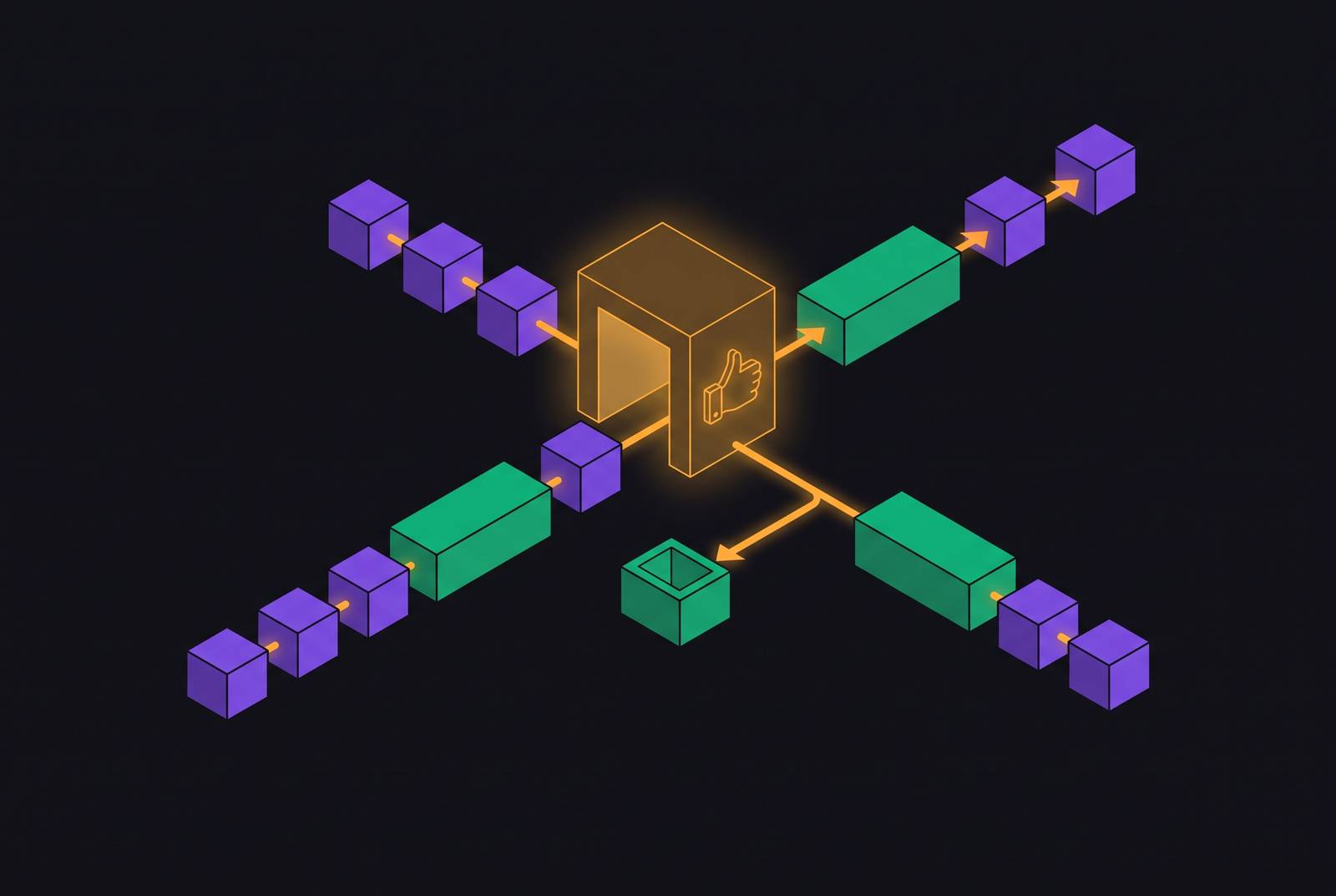
In July 2025, a Replit AI agent deleted SaaStr's production database. No checkpoint existed in that autonomous workflow to catch the write action before it executed. That single incident captures the subject of this piece: the gap between an agent that performs well in a demo and one that can be trusted with real consequences in production.
Demos work because nothing in them matters yet. A demo agent reads data, drafts a response, summarizes a document. Production agents operate across connected systems, CRMs, ERPs, DevOps pipelines, financial infrastructure, so when something breaks, the damage spreads through every system the agent touches, far past where a single human error would stop.
Scale alone doesn't explain the failures. Anthropic's April 2026 postmortem on its own agent described a caching regression that slipped past multiple human and automated code reviews, unit tests, end-to-end tests, automated verification, and dogfooding. The weak point in agent deployment is the outlier that nobody built a catch for, not the average case, which most review processes handle fine.
Those two incidents together make the argument against full autonomy. Agents don't need to fail often to be dangerous. They need to fail once, on a write action with no checkpoint behind it, for the damage to be done before anyone notices. That's the problem this piece works through: where to put a pause in an agent's workflow, and how to design that pause so it actually catches what matters.
Human-in-the-loop, and the terms it is often confused with
Three terms get used almost interchangeably in conversations about agent oversight, and they describe three different control structures with three different risk profiles. Mixing them up is where governance gaps start.
Human-in-the-loop, or HITL, means the system pauses at a defined checkpoint and waits for a human to approve or authorize before it executes. This fits high-risk decisions: financial disbursements, legal agreements, access to sensitive data. Nothing happens without a yes.
Human-on-the-loop, or HOTL, is looser. This suits medium-risk scenarios where speed matters more than a pre-action gate, letting mistakes be caught and reversed without lasting harm.
AI-in-the-loop, or AI2L, reverses which party holds decision-making authority. Humans remain the primary decision-makers, and the AI supplies supporting information or recommendations without ever taking control of the outcome. The evaluation structure here has little in common with HITL: the AI never holds the pen, it just hands over material for a person to use.
These models aren't interchangeable settings for the same dial. Oversight has to flex step by step.
That flexibility is hard to build if HITL logic lives inside each agent's application code, which is how most teams currently build it. HITL works best as a concern handled at the system level, with the application layer calling into it rather than reimplementing it each time.
The single most useful rule: split actions into reads and writes
Set the theory aside for a moment. If there is one rule a team can apply this week, without a framework document or a planning meeting, it's this: split every action an agent might take into reads and writes.
A read is anything that pulls information without changing anything: a search, a summary, a recommendation, a lookup. Let the agent do as much of this as it wants. A wrong summary costs little and gets caught fast, usually by the next person who glances at it.
A write is anything that changes a system of record: sending a message, making a payment, committing code, deleting a file, updating a database.
Most real deployments that work well settle near this line. A person approves the one step that actually changes something. That split keeps most of the speed automation promises while putting a human between the model and anything that can't be quietly reversed.
The reads/writes split pairs naturally with sandboxing. A sandbox restricts where an agent is even allowed to act, and a checkpoint governs what it's allowed to do once there. Together they form two separate safety layers rather than one, so a failure in either doesn't leave the system exposed on its own.
Is every read actually safe, though? The next section builds the framework that handles exactly that gap.
A risk classification framework for calibrating checkpoint placement
Three dimensions decide where a checkpoint belongs: consequence, reversibility, and sensitivity. Get this classification right, and a team avoids two opposite failures at once, checkpoints on everything that grind the workflow to a halt, and checkpoints on nothing that let a damaging write through unchecked.
Consequence asks what happens if the action is wrong. Does it cause financial loss, reputational damage, legal liability, or a downstream failure that compounds as it spreads? The higher the consequence, the earlier and more explicit the checkpoint needs to be.
Reversibility asks whether the action can be undone cleanly, and within a time window that actually matters. A draft pull request, a staged change, a flagged item awaiting confirmation: these tolerate a review after the fact, because undoing them costs little.
Sensitivity asks whether the action touches regulated data, personal information, or a decision that affects someone's rights. This dimension can force a checkpoint even on an action that looks low-consequence on its face. An agent querying a healthcare record is, technically, a read. It still needs logging and authorization, because the sensitivity of what it's touching outweighs the fact that nothing was changed.
A rough grid helps here. Most actions in a real workflow sort cleanly into one of these three buckets once a team sits down and maps them out.
Multi-step and multi-agent workflows complicate the picture, because an action that looks low-risk on its own can trigger something high-consequence downstream. Classification has to account for what an action enables as well as what it does in isolation. Kuaishou's KRCA multi-agent system illustrates the pattern well: it dispatches parallel specialized agents to verify causality and gather evidence across anomalous metrics at the same time. The notification step, a write that alerts people to an incident, is where the checkpoint candidate sits, even though everything feeding into it ran without supervision.
A separate design framework gives this classification a shared vocabulary, formalizing HITL integration along four dimensions: intervention conditions, role resolution, interaction semantics, and communication channel. Together, these four map directly onto the consequence, reversibility, and sensitivity classification above, and give a team the language to write checkpoints into code and policy rather than leaving them as a verbal understanding among engineers.
Designing a checkpoint that supports real decisions, not rubber-stamping
A checkpoint only works if the person looking at it can make a real decision. Design it badly, and oversight becomes theater: a reviewer clicks approve because there's nothing on the screen to disagree with.
A bad checkpoint asks a question like "Agent wants to send this. Approve?" with no context attached. A reviewer facing that prompt dozens of times a day learns fast that disagreeing takes more effort than clicking yes, and the checkpoint stops functioning as oversight.
Aviation cockpits solved a similar problem decades ago by giving pilots and co-pilots shared instruments and a shared view of the same data before either one acts on it. A reviewer should be able to make the call in seconds, because everything needed to make it is already on the screen.
If approving an action means opening three other systems to verify what the agent found, the checkpoint is in the wrong place, or it's missing the information that would make it useful. Blaming a tired reviewer for rubber-stamping an approval misses the actual defect, which is a review screen that gives them nothing to work with.
Some of this comes down to what the agent's output even represents by the time it reaches a human. Workflow instances should persist as live objects, so a reviewer sees the agent's intermediate outputs, its inference records, and a snapshot of the context it was working from, rather than something reconstructed after the fact from a log file. A reviewer should be able to tell at a glance which numbers on the screen are a calculation and which are a guess dressed up as a conclusion.
None of this works if the person at the checkpoint was never told what their job actually is. A checkpoint is only as good as the judgment behind it, and judgment has to be built, not assumed.
Confidence-gated routing so the review queue doesn't kill the workflow
None of the preceding sections mean much if the end result is a review queue so backed up that the agent might as well not exist. Routing approvals by the agent's own confidence, paired with the risk classification from earlier, keeps the human workload tied to genuine uncertainty rather than to raw workflow volume.
This changes what reviewers actually spend their time on. Attention goes toward the decisions that were genuinely uncertain, not toward the actions that were never in doubt to begin with. That's also the mechanism that lets HITL scale at all: human workload grows with uncertainty, and uncertainty grows far more slowly than the number of actions a workflow runs through in a day.
None of this works without the agent exposing a reliable signal about its own confidence, and that signal is a runtime capability. Prompt engineering alone doesn't produce it. The agent's operating environment has to surface it directly, as something the routing logic can read and act on.
Batch review handles the medium-risk middle ground well. Instead of a synchronous approval on every single action, the agent stages a batch of proposed actions and a human scans the batch before a commit window closes. Throughput holds steady, and the oversight on anything consequential stays in place.
The routing logic itself needs to be auditable.
As an agent builds a track record in a given action category, the confidence threshold for that category can shift. That's how a team moves from close supervision to semi-supervised operation to something closer to full autonomy, one category at a time, instead of flipping a single switch and hoping the agent earned that trust across the board.
The infrastructure required to make checkpoints real: routing, interfaces, and audit logs
Designing a good checkpoint is not enough; checkpoints also need infrastructure that makes them enforceable, auditable, and workable across more than one agent running at once.
Three components do the work. Routing logic decides what needs review. An interface surfaces the agent's reasoning to the person doing the reviewing. An audit log records every decision with enough surrounding context to reconstruct what happened later.
Treating HITL as its own decoupled system component, rather than code embedded inside each individual agent, is what makes governance consistent and reusable as a company adds more agents. Tightly coupled approval logic, written fresh into each agent, tends to drift: one agent's approval flow stops matching another's, logic gets duplicated, and the whole system fragments the moment a third or fourth agent joins the environment.
The approval infrastructure needs to pause agent execution cleanly, route requests to the humans actually authorized to clear them, enforce a time-boxed window for the decision, and log every intervention as it happens, because these are identity and policy concerns, and treating them as anything less leaves a gap a determined failure will eventually find.
Checkpoints also need to show up where people already work. Slack, a command line, a web dashboard, SMS: wherever the reviewer's attention naturally lives, the checkpoint should meet them there instead of demanding they open a separate governance console. Tight integration with the agent's operating environment cuts the latency between an action proposed and a decision made, and it cuts the friction that pushes reviewers toward rubber-stamping out of sheer fatigue.
The audit log is what turns a checkpoint from a good intention into something that holds up under real pressure, including in front of a regulator.
Multi-agent workflows raise the stakes on all of this. A kill switch sitting at the orchestrator level does nothing to stop sub-agents running independently beneath it. Checkpoint and termination logic has to cascade through the entire agentic graph, not just the top of it; otherwise a shutdown command becomes a false sense of control.
EU AI Act Article 14 requirements for agent systems
Everything built above, the reads/writes split, the risk classification, the routing logic, the audit trail, isn't only an engineering preference. Article 14 of the EU AI Act treats human oversight as a legal requirement for high-risk AI systems, and the obligations it describes map closely onto the architecture this piece has walked through.
The article requires that high-risk systems be designed so a human can oversee their operation effectively, including understanding the system's capabilities and limitations, recognizing signs of malfunction, and being able to intervene or halt the system when needed. That requirement reads almost like a specification for the checkpoint interface described earlier: a reviewer who can see the agent's reasoning, who understands what's a model judgment versus a deterministic calculation, and who has an actual stop button available, not a theoretical one.
Where most teams fall short isn't the legal reading of the article but the architecture that implements it. A company can write a policy stating that a human oversees high-risk decisions and still have no routing logic that reliably sends those decisions to a person, no interface that gives the reviewer enough to judge with, and no audit log that proves any of it happened the way the policy claims. Compliance with Article 14 is the same routing logic, interface design, and audit infrastructure that make a checkpoint functional in the first place, built once and relied on for both purposes at the same time.