Architectural Red Flags That Expose Persistence and Scheduling as Afterthoughts in Agent Frameworks
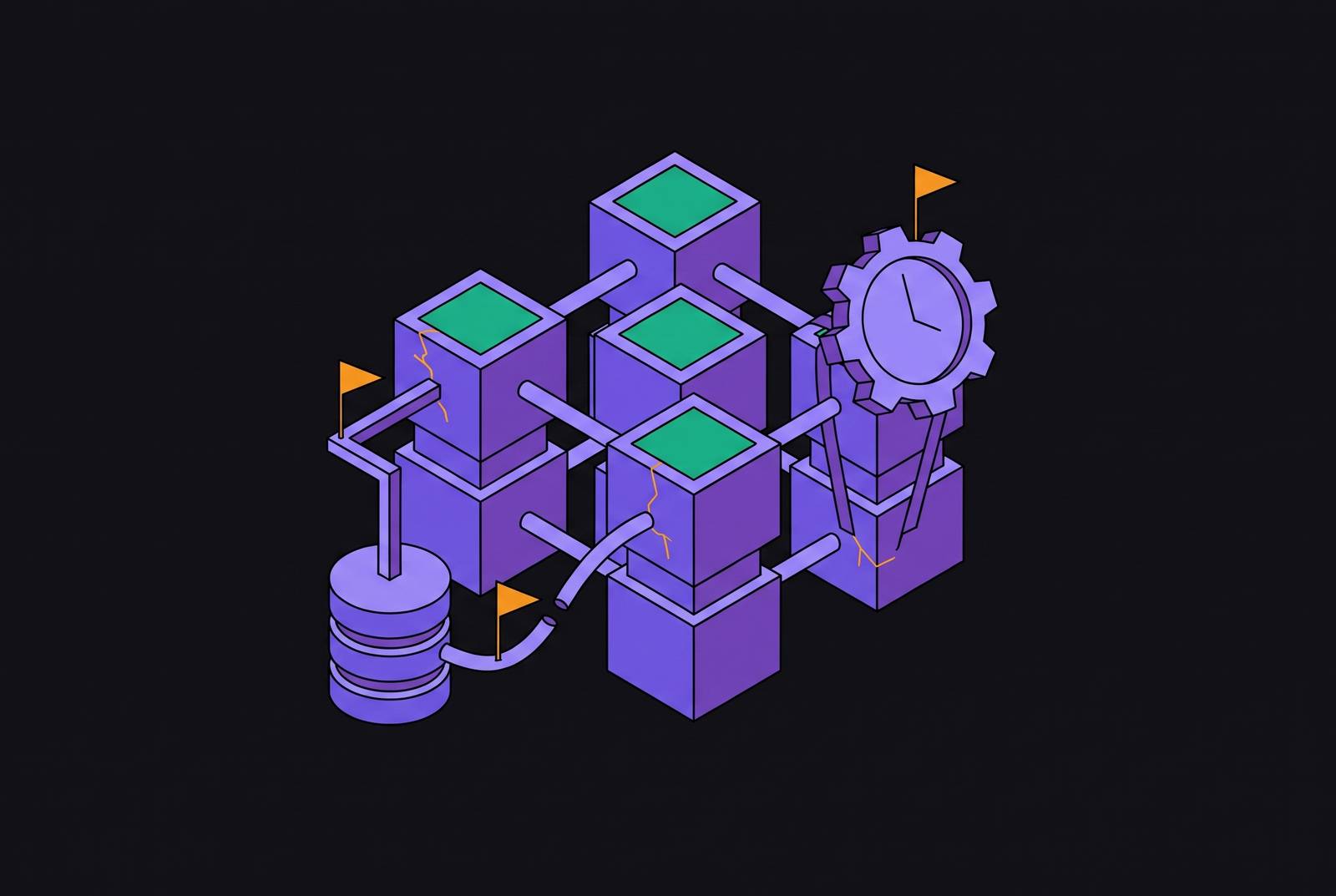
Persistent and scheduled autonomous agents at scale require memory and durable execution to share a lifecycle. The architectural red flags are broken memory access during scheduled runs, cross-session forgetting, ungoverned context growth, and scheduling that restarts work from the beginning. These patterns show that the framework was built around single-turn tasks, with persistence added later instead of built into its control model from the start.
Why most agent frameworks were never designed for persistence or scheduling
A cognitive agent is built to complete a bounded, user-specified task. Its tools, memory, and decision procedures serve that task until the interaction ends. A persistent agent has a different contract. It must perceive changes in its own context and its environment, then adapt without treating every change as a fresh request. The distinction is not how long the loop runs, but what controls the agent’s life beyond that loop.
Agents in the Large: Perception-Centered Architecture for Persistent Agents describes existing frameworks as largely organized around those bounded tasks. The Pera paper also reports that even systems running continuously for tens of hours plateau in their effective task horizons well before their runtime claims suggest. Elapsed time is therefore a poor proxy for continuity. Keeping execution alive does not show that the system can keep useful context, respond as needs change, or manage work across sessions.
Storage can keep information without changing the rules for when an agent wakes, what context it gets, or what it keeps when its work is interrupted. Scheduling, multi-tenant isolation, and persistent memory stay outside the framework layer unless that layer has durable execution. The red flag is a mismatch between the lifetime of the task abstraction and the lifetime of the service expected from it.
What it looks like when scheduling and memory are built by separate teams on separate timelines
The worst failure at the boundary comes when scheduling and memory each work on their own but fail when used together. A framework can claim to have both while giving scheduled execution a context that cannot reach the memory subsystem. Nothing has to be missing from storage. The break occurs because the two subsystems make incompatible assumptions about how an agent run begins.
The Pera paper calls this failure pattern “channel fracture.” In its Channel C case, a scheduler hardcoded a flag such as skip_memory=True, while memory tools registered dynamically only when a memory manager was initialized. The scheduler bypassed that initialization context, so scheduled runs could not access the tools even though the tools and stored memory existed. Channel C failed completely because those constraints were in place together. The isolation guards at the subsystem boundary became the mechanism of failure.
What would reveal this without a tour of the internals? A manually triggered scheduled run that behaves differently from an interactive run, despite unchanged agent logic and inputs, exposes the diagnostic gap. The scheduled and interactive runs take different execution paths. If the scheduled path loses memory access, scheduling and memory remain separate, adjacent features. A secondary warning appears when only internal framework logs can establish whether memory was accessed, with no observable continuity in agent behavior to support a shared contract.
How the single-turn assumption produces volatile working memory and cross-session forgetting
Even a scheduling interface that works cannot save memory that is lost when the session ends. Single-turn frameworks treat working context as an artifact of the current interaction, with no guarantee of promotion into durable episodic or semantic stores. The Pera paper describes cognitive agents as augmenting the interaction loop with internal context. That context can help the agent do well while the loop keeps running, yet give it little to carry forward when the session ends.
The loss becomes visible through repeated work. In one documented case, three consecutive sessions each independently re-proposed a subsystem that had already been built and was sitting dormant. The relevant design documents were present in context each time. What had disappeared was the connective tissue of earlier decisions, leaving the agent fluent enough to propose work but unable to recognize why that proposal was no longer appropriate. The plan survived, but the reasoning behind it did not.
Researchers use catastrophic forgetting for neural networks that lose prior knowledge while training on new tasks, while here an agent loses key context after compaction. It is not evidence of the same training failure. Here, the architectural choice is to compress context through a lossy summary, leaving ungoverned which knowledge becomes durable.
That distinction makes behavior a useful diagnostic. If session two repeats answered questions or proposes completed work as though it were session one, cross-session continuity has failed. The presence of documents in storage is not enough to rebut that evidence, because the failure concerns whether past decisions remain usable. A memory subsystem can retain text while losing the relationships that make the text informative.
Token budgeting as the missing control mechanism that distinguishes real memory management from storage dumps
Token budgeting is the concrete control to look for in a framework’s configuration surface. Its absence signals that memory is being treated as passive storage. A store answers whether information can be retained. A budget forces a different question, namely what deserves space in the agent’s working context, at what cost, and under which constraints.
That decision becomes harder as a task accumulates history. Keeping everything in storage leaves open what the agent should get at the next step, and compaction alone leaves open which knowledge must survive when detail is lost. Token budgeting makes those trade-offs explicit. It gives memory management a constraint against which retention and context use can be governed, rather than leaving growth to end in unpredictable loss.
The Pera paper says persistent agents need active perception of internal context so that their own state can help guide decisions about their lifecycle. A framework without token budgeting is missing a tool for that self-monitoring. The agent may have access to remembered material without a governed way to account for its context cost.
Establishing durable memory requires evidence beyond a budget that channel fracture is resolved and knowledge from the session is promoted as it should be. Its significance is narrower and more useful for evaluation. It reveals whether the architecture recognizes context as a constrained resource to manage, rather than treating a growing store as an answer to every memory problem.
Why cron-shaped scheduling is the wrong primitive for agent work, and what its presence signals about a framework’s design
When the primary scheduling interface means “trigger at time T, start a fresh execution,” each run is structurally an independent session. Recurrence changes the frequency while preserving the underlying task model. This is the single-turn assumption applied to work that is expected to continue over time. The concern is not the use of a clock, but the absence of an agent lifecycle behind the trigger.
Cron-shaped scheduling has no mechanism for state to survive between runs, so the agent must re-establish context each time. It also has no way to manage dependencies between agents that run on different schedules. Those are distinct coordination gaps. One breaks continuity within an agent’s work, while the other leaves related work without a scheduling-level account of its dependencies.
The other two failures concern what happens after execution. Cron-shaped scheduling has no structured failure capture beyond a log line and does not keep sessions for audit or replay. An invocation record cannot answer the question raised by a harmful downstream action. Tracing the action requires knowing whether the job ran and what state, inputs, and reasoning led to it.
If a failed scheduled run must restart from the beginning rather than resume from a checkpoint, the scheduling layer has no concept of the agent’s progress. It is invoking a function. A framework can thus start work reliably at the set time yet fail to keep work going reliably from the state it has already reached.
How benchmark-tuned frameworks ship without the infrastructure real deployments require
Many agent benchmarks evaluate work within a single session. With that limit, a framework can score well without cross-session persistence, durable scheduling, or memory promotion. The test never crosses the boundary where those capabilities are needed.
The Pera paper identifies realistic benchmarks for persistent service as underdeveloped. Its account of existing frameworks focuses on user-specified, bounded tasks, which helps explain why it is still easy to miss the gaps in infrastructure. Evaluation rewards the capabilities it exercises. When the test ends with the task, it does not reveal whether the next session inherits useful knowledge or whether a scheduled execution reaches the same memory as an interactive one.
This is a reason to read benchmark performance within its scope, because a capability profile and a deployment architecture answer different questions. A framework may perform impressively on standard evaluations yet remain structurally unsuited to workflows that span sessions, require stateful scheduling, or need audit-grade replay.
Channel fracture is seen when a scheduled job needs memory, volatile context is seen when work crosses sessions, and missing replay is seen when a team needs to trace what happened in a production incident. Teams may have put a great deal into a framework before they reach those conditions. The Pera paper describes the broader transition as moving from “programming in the small” to “programming in the large” for agents. The red flags persist because evaluations centered on the former do not expose the infrastructure required by the latter.
How do you run long-running agents reliably without losing state between steps?
A first-class architecture gives scheduling, memory, and execution a coherent state model. Scheduling knows about memory state, memory has rules for promotion and eviction, and their interface sets out how they work together. Scheduled and interactive runs use the same path for memory access. No separate scheduled context has isolation rules that silently cut off access to the agent’s past.
The Pera paper describes a perception-centered persistent architecture that responds to signals from episodic task executions, internal context, and the surrounding environment. Those signals help control the agent’s lifecycle as well as its current interaction. The agent can notice changes in its own context and adapt proactively. This requires the framework to connect what the agent remembers with when it acts and how its work continues.
The emerging structural response is an agent operating system layer, or runtime plane. This layer takes explicit responsibility for agent lifecycle, workflow coordination, context and memory coordination, scheduling, and runtime assurance. These responsibilities belong together because a decision in one changes the conditions under which the others operate. Memory access during a scheduled run then comes from the runtime contract, instead of depending on luck for features built on their own to work together.
Memory preserves facts and conversational context, while durable execution preserves control-flow progress, pending work, and recovery state. Neither substitutes for the other. The foundation for persistent service is an architecture that preserves both what the agent knows and where its work stands.