Agent Framework Maturity Signals Engineering Teams Should Track
Five behavioral stages reveal whether your agent rollout is maturing or stalling.

Agent maturity shows up as a set of observable operational behaviors: how config is managed, how work gets orchestrated, how governance decisions get made, and whether delivery metrics actually move. Most engineering organizations get this backwards. A board-level mandate to "do something with agents" produces an ambitious proof-of-concept, a few weeks of demos, and then a quiet period where nobody asks what happened to it. That pattern repeats because the measurement itself is broken.
A VP of Engineering can be rated "Operational" on a general enterprise AI adoption scale while the organization merges far more pull requests than before, with no gain in throughput. Only a handful focus on software engineering teams across the full development lifecycle, and that is where you need to measure agent maturity.
Part of the problem is linguistic. What separates a mature team from an immature one has nothing to do with naming conventions.
The five-level behavioral model that makes maturity readable
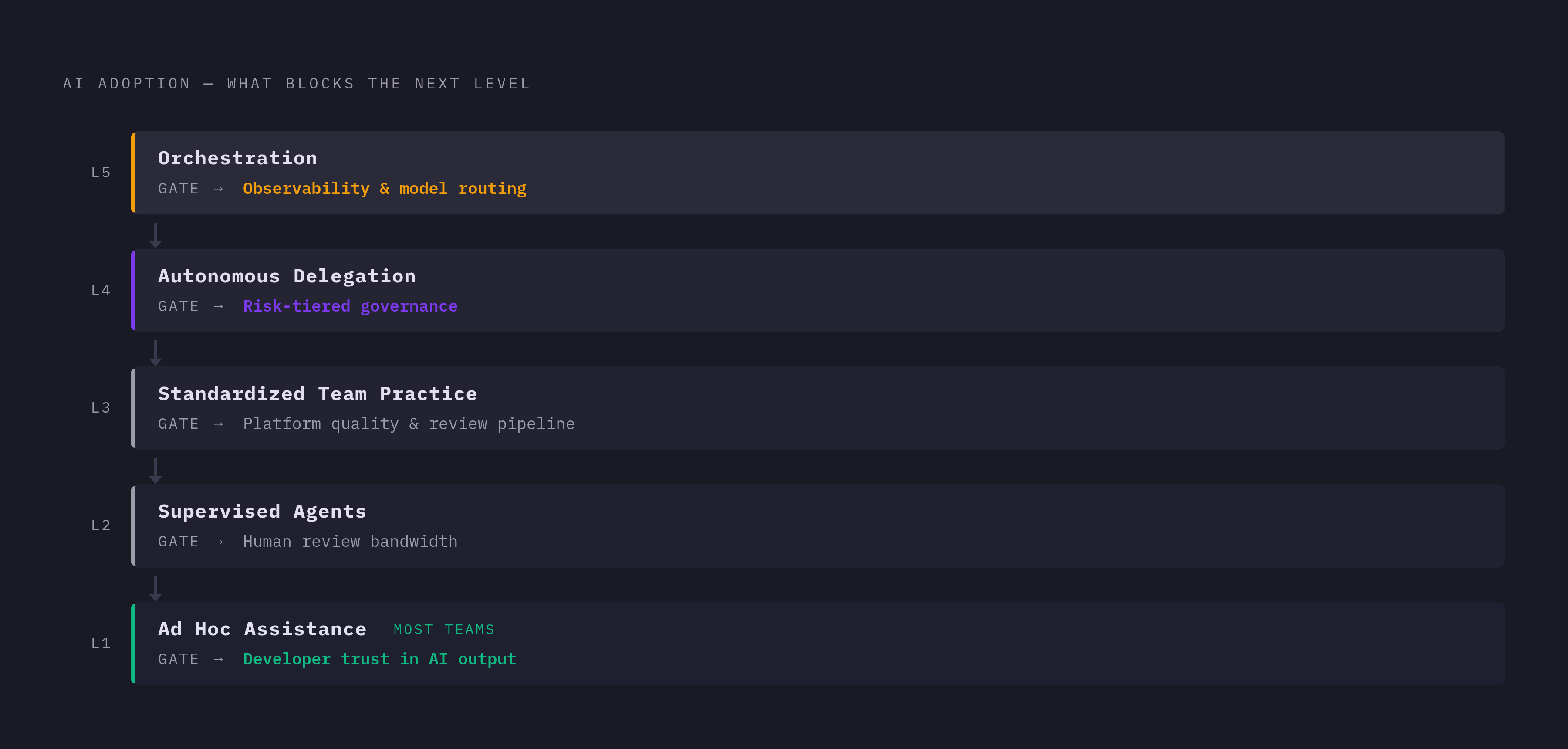
A useful way to read agent maturity is as a five-level model, where each level is defined by the team's dominant operating mode and the specific constraint blocking its next move, not by which products show up on an invoice.
Stage 1 is Ad Hoc Assistance. The gating constraint here is simple: developer trust in AI output. Stage 2 is Supervised Agents, where IDE agents get steered interactively and their output lands in human review queues. The constraint shifts to review bandwidth: how much agent output can humans actually process without becoming the bottleneck themselves?
Stage 3 is Standardized Team Practice. The constraint moves to platform quality and the review pipeline itself. Stage 4 is Autonomous Delegation: background and CI-integrated agents start opening pull requests on their own, headless agents return finished work without a human steering every step. Stalling at this stage comes from the absence of a risk-tiered governance architecture. Stage 5 is Orchestration: multi-agent systems run on their own, and humans only steer at defined checkpoints. The constraint here is observability and model routing across what can be dozens of concurrent agent workflows.
The enterprise AI agents maturity map describes the same shape as a pyramid: solid foundations below, and no reliable way to build at the top without them. If a team skips a level, you get an expensive demo that never reaches production. One rule holds across all five stages: autonomy is earned through demonstrated reliability at the current level. It isn't switched on by ambition for the next one. The sections that follow take this model and walk it dimension by dimension, starting with the one that's easiest to observe directly.
Config discipline: the first behavioral signal that separates levels
Config discipline is the fastest single signal you can read for where a team sits on the maturity curve. It's observable in minutes, and it tells you almost everything about reproducibility, governance, and whether institutional knowledge survives when one engineer leaves the team.
At Level 1, agent config lives per-engineer. Agent activity rarely leaves a path that another engineer could audit or reuse, so every engineer is effectively running their own private experiment.
Level 2 introduces something concrete: AGENTS.md, a repo-level file that gives AI coding agents persistent, project-specific operational guidance before any work starts. OpenAI's Codex documentation describes the core behavior directly: Codex reads AGENTS.md files before doing any work. Before this convention existed, every tool kept its own instruction file. AGENTS.md fixes that fragmentation: every agent, regardless of vendor, now has one place to read from.
Level 5 is further still: self-improving, org-wide configurations backed by a compounding knowledge base, where config itself becomes an organizational asset that grows more valuable over time.
A practical test any team can run today is whether a new engineer joining the team would start with the same agent behavior as a ten-year veteran. If the answer is no, the team is at Level 1, regardless of how many tool licenses sit on the procurement spreadsheet. Infrastructure choices start to matter here. A purpose-built agent operating system should treat config as a first-class, versionable object, so it isn't scattered across individual dotfiles and IDE settings that nobody can audit from the outside.
Orchestration patterns: what coordinated agent execution looks like
Moving from standardized individual agents to coordinated multi-agent orchestration is the highest-value transition in this entire model, and it's also the one teams stall on most often. New software alone will not get a team there.
MIT CISR's research on this transition is specific: progressing from Stage 2 to Stage 3 produces the greatest financial impact of any step in the maturity curve, with performance moving from below industry average to well above it. The process change does.
What does Level 3 orchestration actually look like from the outside? Level 4 goes further: a centralized orchestrator decomposes a task and routes pieces of it to specialized sub-agents, structured as a HostAgent coordinating role-specific AppAgents, each one equipped with its own domain knowledge and scoped tool access.
Framework choice is a readable signal of a team's orchestration philosophy, not just a technical preference. LangGraph fits stateful, multi-step agents that need explicit control over branching, retries, and human-approval gates. Mastra is TypeScript-native, splits model-driven agent loops from deterministic workflow step graphs, reached stable 1.0 in January 2026, and has crossed 22,000 GitHub stars with more than 300,000 weekly npm downloads, built on top of the Vercel AI SDK. LlamaIndex is strongest for retrieval-heavy agents reasoning over enterprise documents, built around indexes, retrievers, and query engines, with 49,000 GitHub stars. Teams with complex branching needs often pair LlamaIndex with LangGraph.
What about teams still building their own orchestration framework from scratch? The common failure mode looks different: teams reaching for Level 4 multi-agent systems while their data foundations are still stuck at Level 1. Ambition outruns infrastructure, and the system breaks the first time it meets a real-world edge case. A genuine Level 5 signal looks like this instead: humans steering at defined checkpoints, multi-agent parallel execution running autonomously between those checkpoints, and the agent system itself proposing improvements to its own workflow.
MCP adoption and the tool-integration standard that now separates production teams from experimenters
Whether a team has standardized on MCP for tool integration, and whether it has absorbed what changed on July 28, 2026, is now one of the clearest signals separating production-grade agent stacks from experimental ones. The question that actually matters operationally: can this team's agents keep working if a request lands on a different server instance than the one it started on?
MCP, introduced by Anthropic in late 2024, has since been adopted across OpenAI, Google DeepMind, Microsoft, and AWS, with more than 10,000 active public server implementations by early 2026. It has become the default mechanism by which an agent discovers and calls external tools and data sources. The 2026-07-28 spec update removed transport-level session state entirely, so the protocol core is now stateless, and that unlocks horizontal scaling and lets requests route through standard HTTP load balancing. It's described as the largest change to the spec since launch.
What does that mean for a team running agents in production? Any team that had been relying on MCP itself to carry cross-session continuity now has to manage that state at the application layer, on its own. That's a real architecture decision, not a configuration tweak.
This creates a usable maturity marker. Production-ready frameworks are now expected to carry MCP support for tool integration, stable releases, active maintenance, clear upgrade paths, OpenTelemetry support, checkpointing for long runs, and observability hooks that expose tool calls and state transitions cleanly.
One gap the spec change doesn't close: MCP can expose memory through shared tools or resources, but it defines no actual memory standard. A team is left to decide on its own how it stores, segments, or reuses memory across sessions. That's the largest open question in the current stack, and it's where the next section picks up.
Memory architecture and persistent state: what mature teams build that others leave to chance
If an agent forgets everything between sessions, it is an expensive chatbot, not a mature agent. Memory architecture is one of the clearest tells for where a team actually sits on the maturity curve, and it's become more urgent now that MCP's stateless core has pushed persistence entirely onto the application layer.
At Level 1, there's no cross-session state. The agent can't build on a prior run or accumulate a pattern it learned last week, so you re-solve every task from scratch no matter how many times it's been handled before.
A production memory architecture needs four distinct layers. Working memory is a fast, short-lived cache for the active context of whatever session is running right now.
Infrastructure has started catching up to this need. AWS made Bedrock AgentCore runtime instances generally available, giving agents cloud-compute-backed sessions that persist up to 14 days, with GPU support and multiple agents able to collaborate on a shared instance. No governing standard exists for how memory gets stored, segmented, or reused, so teams at Level 3 and above have to design this themselves.
Spec quality interacts directly with this. Long-context models combined with multi-agent orchestration can implement complex, cross-module features autonomously from a single specification document, but if the spec going in isn't rigorous, output quality degrades sharply. Memory architecture amplifies both directions: a well-specified task with strong memory compounds in quality over repeated runs, and a poorly specified one compounds its errors just as fast. A purpose-built agent operating system treats memory, scheduling, and tool access as first-class runtime services, the same role a traditional operating system plays for a regular application, rather than something each team bolts on after the agent is already running in production.
Governance controls: the behavioral signals that separate Level 3 from Level 4
Stalling at Level 3 almost always traces back to one missing piece: a risk-tiered governance architecture. Teams at this stage usually have agents that work. What they lack is an architecture for deciding which agents can act without approval, under what conditions, and with what blast radius if something goes wrong.
You need this architecture for the jump from Level 3 to Level 4, because when headless agents return pull requests on their own, the risk profile is not the same as when a human reviews every output interactively. The permission model is the actual control surface here: agents should carry the fewest tools possible, each with least-privilege credentials, time-boxed tokens, and explicit allow-lists. That permission model is directly tied to how much damage a single runaway agent can do before anyone notices.
Consider the "5% failure at scale" problem. AI provenance tracking addresses this directly: recording on every change whether it was AI-assisted, and at what level, through something as simple as a commit trailer or a PR field. A team cannot connect a production incident back to the agent activity that may have caused it without it, and that correlation is the diagnostic point of tracking provenance.
The QA inversion is a quieter shift: classical QA assumes humans write tests against an application that holds still. Dependency verification catches hallucinated package imports before they can sit quietly in a dependency tree as a security vector.
Gartner's research on agentic AI projects points to a sobering number: over 40% face cancellation by 2027 if escalating costs, unclear business value, or inadequate risk controls go unaddressed. The underlying philosophy carries through every one of these controls: autonomy gets earned by demonstrating that an agent handles exceptions gracefully at its current scope, before that scope ever gets expanded. It doesn't get declared by ambition alone.
Delivery metrics: the quantitative signals that confirm or contradict behavioral observations
The most dangerous reading of a team's maturity is high PR volume paired with no improvement in stability. Delivery metrics aren't the primary evidence of maturity. Their real job is to check whether the behaviors described in every section above are actually producing organizational throughput, or just activity that looks like it.
DORA's 2025 research delivers the counterintuitive finding that matters most here: AI adoption shows a positive relationship with both software delivery throughput and product performance, while showing a negative relationship with software delivery stability. A team tracking only throughput will misread exactly where it stands, because the number that looks best is the one hiding the problem.
The metrics picture shifts clearly by stage. Level 4 and above govern agent delegation decisions by outcome metrics, not just output metrics: stability, SLA adherence, and incident correlation get tracked right alongside throughput, not treated as a separate concern.
Agentic output quality degrades sharply without rigorous up-front specification, even where the underlying evidence shows real velocity gains for AI-assisted teams overall. MIT CISR's data backs the stakes of getting this right: enterprises in the first two stages of AI maturity showed financial performance below industry average, while stages 3 and 4 performed well above it. That financial data confirms the behavioral signals after the fact. It doesn't lead them.
The metric most teams still aren't collecting is AI provenance on code changes. Correlating an incident back to AI activity is impossible without it, and that correlation lets an organization make evidence-based decisions about expanding or constraining agent autonomy.
Locating your team on the curve and deciding what to fix first
The question worth asking isn't "which level are we at?" It's "which gating constraint is blocking our next move?" The constraint determines the fix, and teams that try to skip the constraint end up skipping the level entirely, no matter how it looks from the outside.
| Stuck at | Fix | What it actually means | |---|---|---| | Level 1 | Developer trust, config versioning | Introduce AGENTS.md or an equivalent shared default | | Level 2 | Review bandwidth | The bottleneck is human capacity to process agent output, not agent quality | | Level 3 | Platform quality, review pipeline | Introduce CI-integrated agents and measure delivery impact directly | | Level 4 | Governance architecture | Risk-tiered delegation, least-privilege permissions, provenance tracking | | Level 5 | Observability, model routing | The system is too complex for humans to steer without instrumentation |
The most common misdiagnosis in this whole model: a team identifies as Level 3 or 4 because of tool presence, while its config discipline, memory architecture, and governance controls are still sitting at Level 1. Tool licenses are not behavioral signals, no matter how the procurement dashboard reads.
This is also where the need for dedicated infrastructure becomes unavoidable. The gating constraints at Levels 4 and 5, governance architecture, observability, model routing, memory management, scheduling, are exactly the services a purpose-built agent operating system should provide as runtime primitives. UFO, an agent operating system built for team-scale autonomous work, is one example of infrastructure designed around that distinction directly, treating agent behavior, context, and outcomes as organizational assets rather than something that lives and dies inside one engineer's tool instance.
Earning autonomy in practice looks narrow at first. Start with a single, well-specified workflow agent. Instrument it with provenance tracking and outcome metrics from day one. Use the incident and postmortem data that accumulates to justify extending its scope, rather than letting a mandate from leadership set the scope in advance. A Level 5 team's operating posture reflects that discipline: humans orchestrate, agents execute in parallel, the knowledge base compounds with every run, and the infrastructure layer handles scheduling, memory, and tool access as first-class concerns from the start. That architecture is what lets a small engineering team do the work of a much larger one, and it's earned one demonstrated level at a time, not declared by ambition on a slide.