Multi-Agent Platform Comparison for Production Deployments
LangGraph's explicit graph model and per-step checkpointing outperform alternatives at scale.
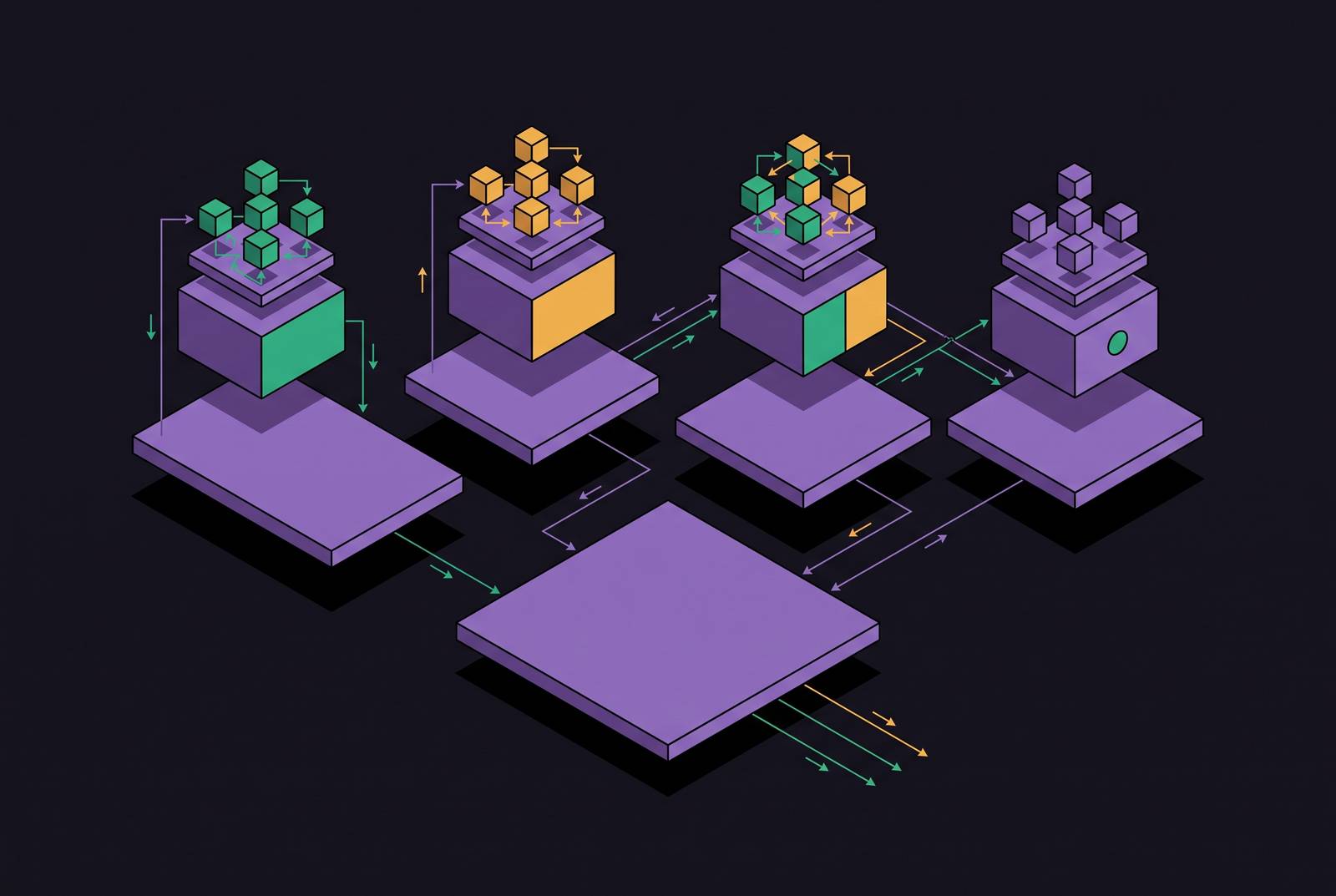
Multi-agent platforms are moving out of demo videos and into production systems that handle real transactions, real customers, and real money. The choice between them now turns on four operational properties, not on which framework has the flashiest GitHub readme. Adoption is already ahead of governance: a majority of organizations are experimenting with or actively scaling AI agents, yet many organizations have moved only a fraction of their AI pilots into production, and even fewer report mature governance for autonomous agents, a gap widely noted across industry surveys. That gap is where a system that looked flawless in a demo starts losing state, misrouting errors, or running past a spending limit no one thought to enforce, and it is the reason the rest of this article is organized around what breaks at scale rather than what impresses in a pitch meeting.
LangGraph holds up most consistently in production when control flow, state persistence, error routing, and cost controls are the deciding criteria. Its directed-graph model declares handoffs, error paths, and human-in-the-loop checkpoints explicitly in the graph definition rather than leaving them to LLM inference, and per-step checkpointing means a failure at step four of a nine-step process resumes at step four rather than starting over. Reported benchmarks put its orchestration overhead at roughly 120 milliseconds per node against 450 milliseconds per task transition for role-based alternatives, with token costs running 47% lower because explicit edge transitions replace LLM-driven routing. The OpenAI Agents SDK is the lowest-friction option for GPT-centric workflows, offering durable sessions and native subagent support, while Microsoft Agent Framework reached production-ready 1.0 status in April 2026 for teams on Azure, though its production history is shorter than LangGraph's and its community resources are still maturing.
The four properties that separate production-grade platforms from prototypes
Four things decide whether a multi-agent system survives contact with real traffic.
The first is the orchestration model, meaning how control actually passes between agents. A graph-based system, a role-based crew, a hierarchical tree, and a conversational loop all produce different execution patterns, and that choice determines how much work goes into debugging, how errors get routed, and how reliably the system recovers once something goes sideways.
The second is state and memory. A workflow needs state that survives a crash, a restart, or a dropped connection. Without it, a failure at step four of a nine-step process doesn't resume at step four, it starts over from step one and rebills the customer for work already completed. That is not a minor inconvenience: a finance team will approve a system that resumes at step four, and reject one that starts over from step one and rebills the customer for work already completed.
Third is error handling. Production systems need an actual answer to the question of what happens when a sub-agent times out, fails outright, or hands back malformed output. Retries, fallback paths, and human-in-the-loop checkpoints have to be designed into the architecture from the start, not bolted on after the first outage.
Fourth is observability. Someone operating the system needs to see every model call, every tool invocation, every state change, every branch the execution took, and every error, and needs to tie all of that back to latency and cost. A single run should be diagnosable on its own, without someone reconstructing what happened by cross-referencing three different log files.
The protocol layer every platform now has to speak
Over roughly eighteen months spanning 2024 to 2026, an open-protocol layer emerged that now functions as the connective tissue holding the entire agent ecosystem together. Two protocols sit at the center of it, and mixing them up is one of the most common mistakes engineers make when they're new to this space.
Model Context Protocol, or MCP, governs how an agent talks to tools. Agent-to-Agent, or A2A, governs how agents talk to each other. They solve different problems and neither one substitutes for the other.
MCP in particular has become the default connector layer across a long list of platforms: Claude Desktop, Cursor, Windsurf, VS Code, JetBrains, GitHub, Linear, Notion, Slack, Stripe, and most of the major agent platforms built since. The MCP registry has grown nearly eightfold since early 2025, a growth curve that occurs when a protocol solves a real, shared problem rather than a vendor-specific one. MCP's governance now sits with the Agentic AI Foundation, a directed fund under the Linux Foundation whose membership includes Anthropic, OpenAI, Google, Microsoft, AWS, Block, Cloudflare, and Bloomberg, a roster that reads less like a partnership announcement and more like an admission that no single company wanted to own this layer alone.
How the modern agent stack is structured, and where orchestration frameworks fit within it
The stack that supports any multi-agent deployment is starting to settle into a fairly consistent shape, even as the specific products filling each layer keep changing. At the bottom sits the model layer: the frontier families like Claude, GPT, and Gemini. Above that is the inference layer, either a hosted runtime or a self-hosted option such as vLLM. The agent and orchestration layer sits above inference, and it's where the frameworks compared in this piece, LangGraph, the OpenAI Agents SDK, and others, actually operate. Above that is the protocol layer covered in the previous section, MCP and A2A. Then comes retrieval, handled by vector stores such as pgvector, Pinecone, or Qdrant, with evals and observability layered on top of the whole stack.
That the shape of this stack is stabilizing, even while the vendor list that supports it keeps shifting, is a useful signal for any team about to make a multi-year platform bet: build to the layer boundaries, not to a specific vendor's API.
The "agent OS" is a single runtime hosting agents across every surface a business operates on, terminal, messaging, voice, scheduled jobs, while keeping one persistent memory store and one set of reusable skills across all of them. The AIOS framework, for instance, proposes isolating resources and LLM-specific services, things like scheduling, context management, memory management, storage management, and access control, into a kernel that manages multiple agents running at once. The moment more than one agent runs concurrently, resource contention, runaway costs, context overload, and unpredictable behavior appear, and the orchestration layer is exactly where those problems get managed, or inherited.
Which multi-agent framework holds up in production when orchestration model, state persistence, error routing, and cost controls are what matter?
LangGraph models an agent system as a directed graph: agents are nodes, and the edges between them are explicit. Control flow, error routing, and points where a human needs to step in are all declared up front in the graph definition, rather than left for the LLM to infer at runtime. That's the core design bet the framework makes, and it's the reason teams reach for it when the cost of an ambiguous handoff is too high to tolerate.
State management follows the same philosophy. Checkpointing saves a snapshot of the entire graph's state at every step, organized by thread. Fault-tolerant resume, conversation memory, time-travel debugging, and human-in-the-loop pauses all come built in rather than requiring custom plumbing.
The production track record backs this up. Klarna runs LangGraph at a scale of 85 million users, and the framework sits behind agents shipped by Anthropic, Replit, LinkedIn, Uber, and Elastic. Reported load testing puts LangGraph's orchestration overhead at roughly 120 milliseconds per node, compared with 450 milliseconds per task transition for a role-based alternative, and benchmarks have shown token costs running 47% lower, a gap attributable to explicit edge transitions replacing LLM-driven task routing, which tends to burn tokens deciding what to do next rather than just doing it.
The fastest path from prototype to a running multi-agent crew
Some frameworks solve for a different problem: getting from an idea to a working multi-agent system as fast as possible. These frame orchestration around a crew of role-playing agents, where each one gets a role, a goal, a backstory, and a set of tools. That mapping onto business-process language, roles and goals rather than nodes and edges, is why non-specialist engineers can pick it up and reason about it quickly.
Two execution modes cover most use cases: sequential, where each task's output feeds directly into the next, and hierarchical, where a manager agent delegates work out to specialists. That covers a lot of ground fast. It runs out of runway once a workflow needs complex branching logic, at which point teams find themselves reaching for workarounds that a graph-based system would have handled natively.
Speed to a working prototype trades off against precision of control once that prototype needs to become a production system handling edge cases nobody thought about in week one.
OpenAI Agents SDK: lowest-friction choice for GPT-centric workflows
Released in March 2025, the OpenAI Agents SDK replaced the earlier, experimental Swarm framework with something built for production use rather than for demos. It gives teams durable sessions, tool use, optional subagents, and a choice between hosted execution or running the orchestration inside a customer's own environment, and it supports more than 100 models via LiteLLM.
The design intent is visible in how the API is put together: agents are meant to hold long-lived context, call tools, coordinate subagents, and either run inside OpenAI's own infrastructure or orchestrate work wherever the customer's systems live. For teams already committed to GPT-centric workflows, this is the lowest-friction entry point available, especially when sandboxed tools and native subagent support are prioritized over framework flexibility across model providers.
Microsoft Agent Framework and the Azure-native path
Microsoft Agent Framework reached version 1.0 and general availability on April 2, 2026, described by Microsoft as the production-ready release for both.NET and Python, with stable APIs, long-term support commitments, and an MIT license. Integrations for Foundry, OpenAI, Ollama, Azure OpenAI, Anthropic, and others ship as separate packages rather than being baked into the core.
The framework's existence is itself the result of consolidation: Microsoft folded AutoGen and Semantic Kernel into this single project. AutoGen, still the name most engineers search for out of habit, went into maintenance mode in October 2025, and Microsoft's guidance for any new project is to start with Agent Framework instead.
A 1.0 release in April 2026 means this framework has a shorter production history than LangGraph or the role-based alternatives, and the broader ecosystem of examples and community resources is still maturing. For teams that want Azure-hosted execution without running their own infrastructure, Azure AI Foundry sits above the framework layer as the managed orchestration option.
Google ADK and cloud-native options from AWS
An agent framework differentiates itself on several fronts, including first-party MCP support for standardized tool discovery across agents. Many editors and third-party platforms, VS Code and JetBrains among them, now include MCP integration as part of their standard offering.
ADK is the strongest fit for teams already living on GCP or needing multimodal agent capability out of the box. Google Vertex AI Agent Builder provides a managed layer for teams wanting GCP-hosted deployment.
AWS offers a comparable set of choices depending on how much infrastructure a team wants to own. The AWS Multi-Agent Orchestrator targets AWS-native production deployments. The Strands Agents SDK is AWS's agent SDK with native Bedrock integration. And AWS Bedrock AgentCore is the managed platform layer for teams that want hosted execution without operating the infrastructure underneath it themselves.
Vertically integrated data platforms: when the agent layer lives inside the data warehouse
A different category of platform skips the "agent reaches out to distributed data sources" model entirely and instead builds the agent layer directly inside the data warehouse. Snowflake, Databricks, and Microsoft Fabric all follow this logic: consolidate the data centrally first, then let agents query and share results against it under one uniform governance model, rather than stitching governance together across a dozen scattered systems.
Snowflake's Cortex AI Functions became generally available in November 2025, and they let agents run multimodal AI pipelines, meaning text, images, audio, and video, entirely inside the Snowflake SQL engine, with no external service calls and no data movement required. A shared semantic layer ensures every agent querying the system references the same business-term definitions, so "revenue" or "active customer" means the same thing no matter which agent is asking.
Databricks launched Agent Bricks in 2025 as a unified platform for building and governing enterprise AI agents, with observability and management handled through AI Gateway and MLflow, and fine-grained access control enforced via Unity Catalog. It supports hybrid builds: a team can stand up some agents through no-code builders and build specialized ones directly in a graph-based framework, then deploy the whole set to serverless compute through Databricks Apps for consistent governance across both.
The logic connecting all three platforms in this category is the same: rather than asking agents to negotiate access across a scattered set of external systems, each with its own permissions model, they bring the data and the governance into one place first, and let the agent layer operate on top of that consolidation. For an organization already living inside Snowflake or Databricks, that architecture removes an entire category of coordination problems that teams building on distributed frameworks have to solve themselves.