Prompt Injection Detection in Production Agentic Pipelines
Attackers now bypass single-layer defenses by targeting trusted channels agents already use.
Prompt Injection Detection in Production Agentic Pipelines.
Why prompt injection is now a production infrastructure problem
Prompt injection in a production agentic pipeline is not a wording problem you fix by tweaking a system prompt. It's an infrastructure problem, and it needs the same layered, runtime defense that any other infrastructure risk gets: input sanitization, tool-output validation, memory integrity checks, and behavioral anomaly detection, all working together across the pipeline. OWASP has ranked prompt injection as LLM01:2025, the top vulnerability in its Top 10 for LLM Applications, for a second straight edition Beyond Pattern Matching / arXiv:2604.18248. That's not a fluke of one bad report. The OWASP GenAI Security Project's own governance guidance shifted tone entirely between its 2025 and 2026 editions: the earlier one described threats that seemed plausible, while the newer one is stacked with actual CVEs, vendor advisories, and breach reports touching almost every category of agentic risk.
Governments noticed too. Because the bug isn't really about text processing.
The structural reason there's no clean fix at the model layer is this. That's an infrastructure job.
How the attack surface changed between 2023 and 2026
Direct prompt injection, the classic "ignore your previous instructions" trick typed straight into a chat box, is the version everyone already understands digitalapplied.com Beyond Pattern Matching / arXiv:2604.18248. It's also shrinking as a share of real incidents, now accounting for something like one in ten production agent cases digitalapplied.com Beyond Pattern Matching / arXiv:2604.18248. So what makes up the other nine? They travel through channels the agent already trusts: tool outputs, retrieved documents, memory stores, MCP server metadata, and third-party API responses.
That's attackers finding a bigger door.
The stakes go past nuisance-level mischief. A campaign tracked under the designation GTG-1002 used hijacked coding agents to carry out an estimated 80 to 90% of an entire espionage operation against roughly 30 targets How Prompt Injection Attacks Compromise AI Agents in 2026 arxiv.org Beyond Pattern Matching / arXiv:2604.18248. That figure bears repeating: the agents weren't a side channel in that attack, they were doing most of the work.
Researcher Simon Willison's "lethal trifecta" framing explains why this keeps happening. Any agent that combines three properties, access to private data, exposure to content it didn't write, and the ability to talk to the outside world, can be turned into a data-exfiltration tool by a single injected instruction. Meta's internal "Agents Rule of Two" turns that observation into an actual operating budget: without a human in the loop approving the action, an agent should satisfy at most two of those three properties at once. It's a simple rule, and it's exactly the kind of constraint that has to be enforced by infrastructure, because no amount of careful prompting stops an agent from having all three capabilities simultaneously.
The four primary injection vectors in a production agentic pipeline
Four vectors appear repeatedly in production systems, and each one deserves its own attention because each fails differently.
Any writable surface feeding a retrieval pipeline for RAG and retrieval content, an internal wiki, a Notion workspace, a Confluence space, even a public web index, is a place an attacker can plant something. Research published in January 2026 found that five carefully crafted documents were enough to manipulate AI responses 90% of the time through RAG poisoning alone How Prompt Injection Attacks Compromise AI Agents in 2026. Attackers don't need privileged access. They just need edit rights somewhere the retrieval index already trusts, an open wiki, a public doc site, a GitHub repo, and they wait for the crawler to do the rest.
Vector 2 is tool outputs and MCP server metadata. This is arguably the fastest-growing category right now, because agents increasingly chain together third-party APIs and MCP servers, and a function-calling result can carry adversarial instructions the same way a poisoned document can. Even the metadata around a tool, its name or description field read during discovery, can hide an instruction. The clearest illustration: a package called postmark-mcp shipped fifteen clean, apparently trustworthy versions before a sixteenth quietly added a single line of exfiltration code, becoming the first malicious MCP server caught operating in the wild. Fifteen versions of good behavior bought the trust that the sixteenth version spent.
Agent memory is the third vector. Agents built with long-term memory, whether vector stores or plain file-based memory, carry injected content forward across sessions. Write a poisoned instruction into memory once, and every future session that reads that memory treats it as trusted context. What started as a one-time exploit becomes a standing backdoor the agent keeps consulting.
Vector 4 is inter-agent communication inside multi-agent pipelines. Here the danger isn't a single bad output, it's goal hijacking: an attacker redirects what the agent is actually trying to accomplish. In a multi-agent system, one compromised agent can pass that corruption downstream, poisoning shared memory or steering an orchestrator's decisions. Supply chains widen this vector further. The LiteLLM "hackerbot-claw" incident in March 2026 shows this directly: a backdoored package sat on PyPI for three hours and still pulled in over 119,000 downloads, and because LiteLLM sits underneath frameworks like CrewAI, DSPy, and Microsoft GraphRAG, that three-hour window touched a huge number of downstream systems at once Prompt injection still drives most agentic AI security failures in production - Help Net Security.
Why defenses fail when applied to only one layer
Researchers Maloyan and Namiot, synthesizing 78 separate studies and cataloging 42 distinct attack techniques, found that attackers using adaptive strategies beat state-of-the-art defenses more than 85% of the time Prompt injection still drives most agentic AI security failures in production - Help Net Security arxiv.org. It's most of the armor failing.
A 2025 study added detail to that picture: eight published defenses against indirect injection were each bypassed with attack-success rates above 50% once the attacker adapted to them, and later work extended the same result to jailbreak defenses generally. One might ask why a defense that works in a lab paper collapses in production. Lab benchmarks test against known attacks, and adaptive adversaries don't stay known for long.
Credential sprawl sets in when moderation API keys need rotating across dozens of independent services rather than one place. And audit trails end up scattered, so investigating an incident means stitching together logs from every affected service by hand.
Real CVEs make this less abstract. In GitHub Copilot, a flaw tracked as CVE-2025-53773 (CVSS 7.8) let malicious instructions embedded in externally fetched content push the agent into executing attacker-controlled commands, and an allowlist-only defense missed the whole thing. In Cursor, CVE-2026-22708 showed something worse: an attacker used shell built-ins like export and alias, which weren't blocked, to poison the shell environment itself, so that even allowlisted commands like git branch ended up delivering arbitrary payloads Prompt injection still drives most agentic AI security failures in production - Help Net Security. The allowlist didn't just fail to help. It became the attack surface Prompt injection still drives most agentic AI security failures in production - Help Net Security. A third case, CVE-2025-59532 in OpenAI's Codex CLI, involved a model-generated working directory being trusted as the sandbox's writable root, which quietly redefined the sandbox boundary to include paths outside the user's actual session folder.
Testing against a six-agent, production-representative system across 14 attack vectors produced similarly uncomfortable numbers: 67% of agents had at least one exploitable scope violation even with guardrails written into the system prompt, and indirect injection through tool outputs alone succeeded 43% of the time Prompt injection still drives most agentic AI security failures in production - Help Net Security arxiv.org. Coding agents concentrate this risk more than any other category. Of 53 agentic projects tracked by OWASP's surveyor, 28 are coding agents, and the five repositories carrying the most security advisories, n8n at 57, Claude Code at 22, AutoGPT at 15, Dify at 13, and Roo-Code at 11, are dominated by that same category Prompt injection still drives most agentic AI security failures in production - Help Net Security. Every piece of this evidence points the same direction: defense has to be architectural, has to run at detection time, and has to answer to governance, because no one layer catches what the others let through.
The layered detection architecture: what each layer catches and why it cannot be skipped
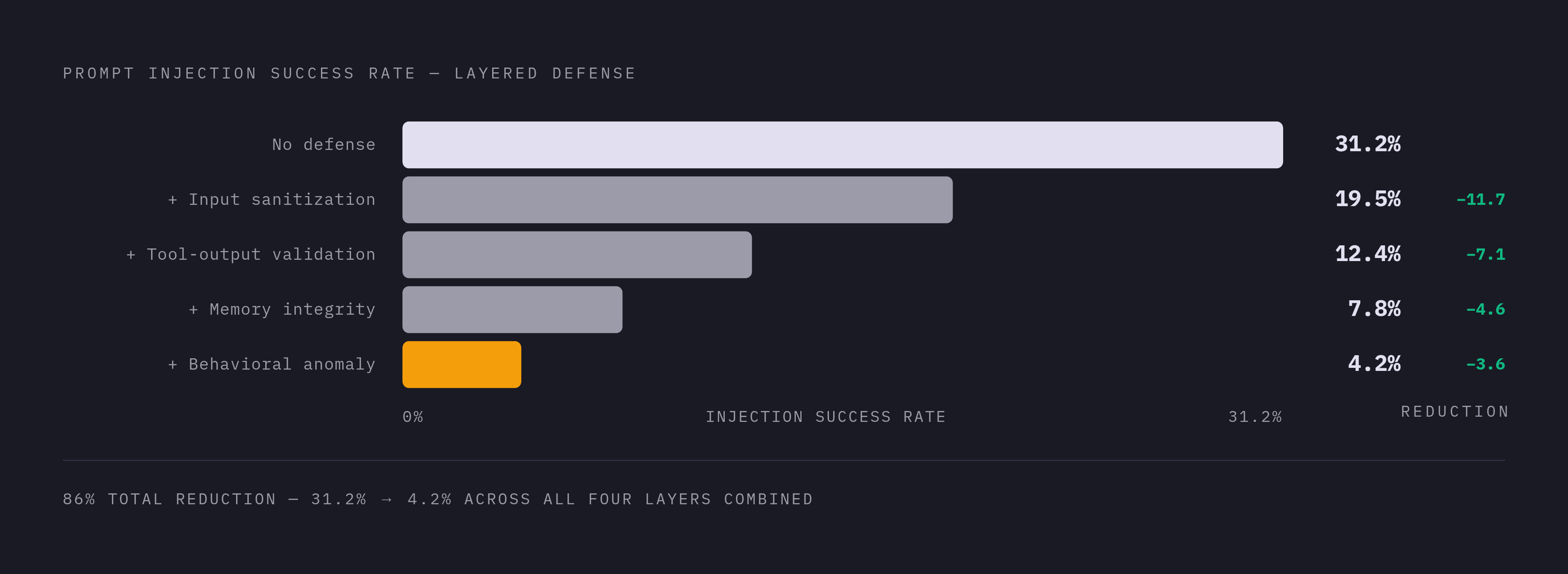
The payoff for building this properly is measurable. Four architectural defenses, combined rather than deployed individually, took overall injection success from 31.2% down to 4.2% in the same testing referenced above Prompt injection still drives most agentic AI security failures in production - Help Net Security arxiv.org. That's the difference layering actually buys.
Layer 1 sits at the gateway boundary: input sanitization and semantic classification.⟦c33⟢ Direct prompt injection ("ignore previous instructions") is well-understood and shrinking as a share of production incidents; it now accounts for roughly 1 in 10 production agent incidents digitalapplied.com Beyond Pattern Matching / arXiv:2604.18248. Simple regex pattern matching misses attacks that are paraphrased even slightly, so transformer-based classifiers have become the working standard, though they're still vulnerable to an adversary that adapts around them. These are purpose-built classification models scoring the full message payload for injection signatures before anything gets forwarded to the model provider. Because the gateway sits in one place that every request passes through, credentials and audit logs live in a single location instead of scattered across services. But this layer has a hard limit: it never sees content arriving through tool outputs, retrieval results, or memory, which is nine out of ten attack classes, and that's precisely why the next layers aren't optional.
Layer 2 handles tool-output validation, scrutinizing every single tool call as a high-risk event. MCP tool allow-lists stop injection-driven abuse at the point of invocation, and guardrails need to run against tool arguments and tool results, not just against what the model reads and writes at the chat level. One working pattern attaches registered guardrails as hooks: a rule applying PII detection on LLM Input, a separate rule applying prompt-injection detection on LLM Input, and if both rules apply to the same event, both run, with a baseline rule with no target condition applying to all traffic. What this layer can't see is anything already sitting in memory from an earlier session, poisoned content that's past the point of interception.
Layer 3 covers memory integrity and taint tracking. Taint tracking flags data that originated from an untrusted source and follows it through the agent's reasoning chain, so if tainted data ends up driving a high-privilege action, the system can demand confirmation or block it. Writes to long-term memory that came from retrieved content deserve the same skepticism: treat them as untrusted until something validates them. Pre-set behavioral invariants, plain rules like "never send email to an address outside the user's existing contact list," give the system something concrete to check plans against before execution, and this check catches a memory-poisoning payload that survived long enough to reach the action stage.
Layer 4 is behavioral anomaly detection running across the whole pipeline. Monitoring inter-agent communication patterns for anomalies caught 84% of cascading injection attempts in the same benchmark referenced earlier, once that layer was active Prompt injection still drives most agentic AI security failures in production - Help Net Security arxiv.org. Content mutation detection catches something subtler: outputs that still look plausible on their face but have quietly been steered away from the intended behavior, which matters a lot in RAG pipelines where nothing obviously breaks. Output scanning for exfiltration matters just as much, because injected instructions often push sensitive data out through the model's own output, toward a user, a downstream agent, or an external API, and a defense that only checks input never sees that leak happen. Message signing with provenance tracking, essentially letting agents cryptographically verify where a message actually came from, cut inter-agent injection by 91% in testing Prompt injection still drives most agentic AI security failures in production - Help Net Security arxiv.org. This layer only works, though, because the earlier three already cut down what makes it this far.
Privilege separation runs beneath all four layers as the constraint that ties them together. A dual-model design, where one model reads untrusted external content and a separate, walled-off model is the only one allowed to take action, keeps a compromised reader from ever touching the actions directly. Least privilege matters just as much in practice: agents should hold only the permissions their current task actually needs, scoped down the moment the task ends, and privilege-scoped tool access by agent role removes privilege escalation as a category of risk entirely rather than just making it harder Prompt injection still drives most agentic AI security failures in production - Help Net Security. It's worth admitting, honestly, that least privilege is well understood in theory and rarely done rigorously in practice, because every new task seems to need a slightly wider grant, and widening scope is always the path of least resistance. A newer set of approaches, systems like CaMeL, FIDES, Progent, RTBAS, and FORGE, tries to sidestep the whole problem by enforcing security outside the model entirely: a deterministic policy, built from capability grants or information-flow labels or a reference monitor, mediates what the agent is allowed to do regardless of what the model itself decides. Several of these report something close to eliminating attacks outright on the AgentDojo benchmark. Layer 1 (Input sanitization and semantic classification at the gateway boundary).
Detection techniques beyond classifiers: seven cross-domain signals that compose with existing defenses
What happens when classifiers themselves start hitting diminishing returns against attackers who already know how classifiers work? One recent paper's answer is to stop looking for detection methods inside LLM security at all, and borrow them from fields that have been fighting analogous problems for decades. The paper (Munirathinam, arXiv:2604.18248, version 4.0) proposes seven such techniques, each producing a signal that's architecturally separate from pattern matching or transformer classification, and they stack on top of existing defenses rather than compete with them.
The logic here holds up for a second. Regex misses paraphrase. Classifiers get out-adapted. So instead of building a better classifier, pull signal from a completely different discipline, one where an adversary optimizing against text-classification defenses has no reason to have thought about it.
Two of the seven give a feel for the range. Forensic linguistics, the discipline built around spotting who actually wrote a disputed document, gets repurposed to catch stylistic breaks between an agent's legitimate content and an injected payload sitting inside it. Materials-science fatigue analysis, normally used to model how a material accumulates damage under repeated stress before it fails, gets repurposed to model cumulative behavioral drift across a long agent session, catching an agent that's slowly being pulled off its original task even when no single step looks alarming on its own.
Neither of those techniques replaces the layered architecture already laid out. They're additional sensors, tuned to catch what a gateway classifier or a taint tracker structurally can't see, because they're not built the same way and don't share the same blind spots. That's the actual shape of defense against an adaptive adversary: not one clever filter, but several differently-built ones, stacked so that what slips past one gets caught by the next.