Observability Gaps in the Current Agent Tooling Ecosystem
Current agent monitoring tools were built for single prompts, not multi-step decision chains.
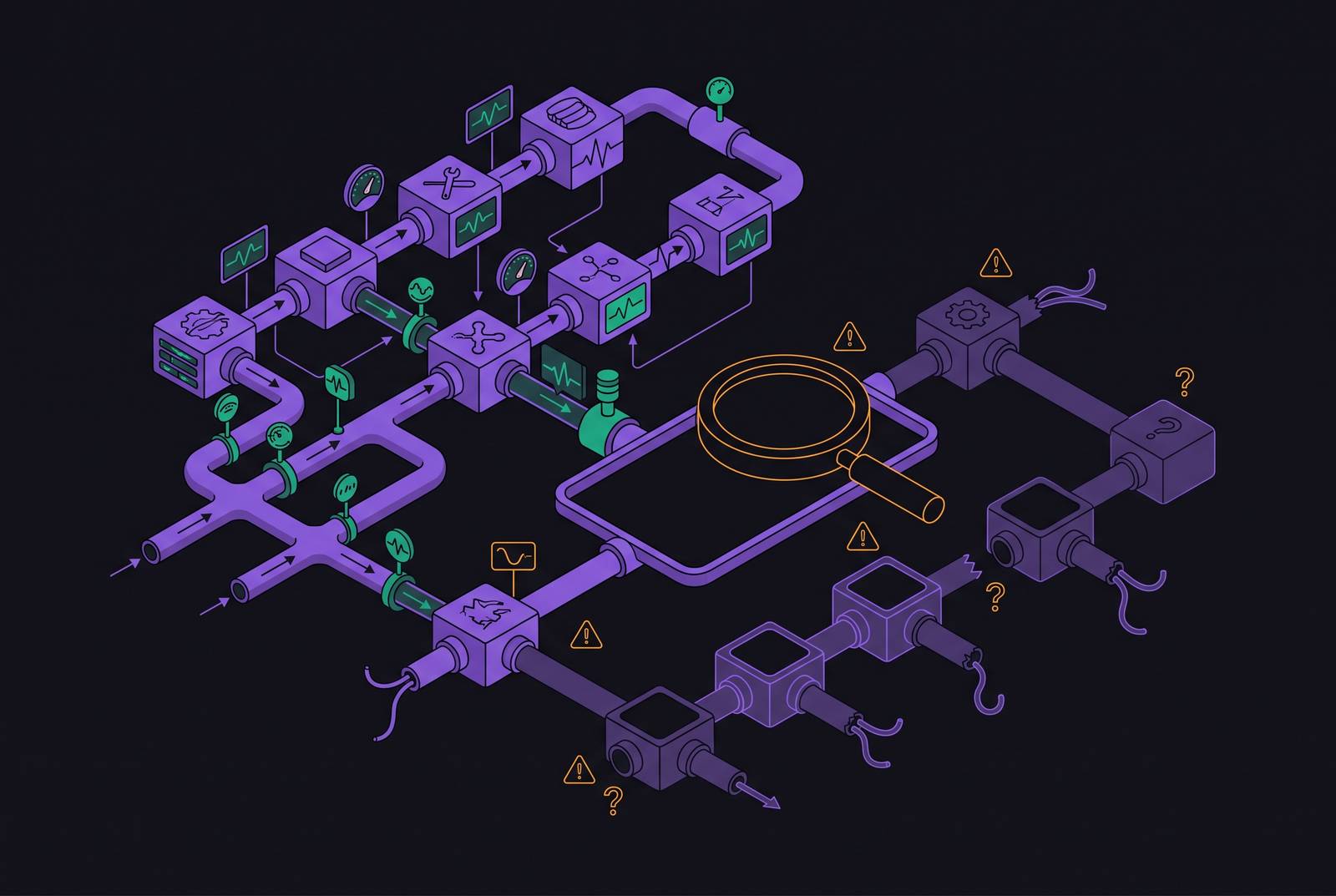
An agent can make unnecessary tool calls, take one syntactically valid action that does the wrong thing, and still hand back an answer that reads as confident and well-formed. Binary pass/fail monitoring sees none of that. It sees a finished response, checks it against a rubric, and moves on. Most agent observability tooling was built around the wrong unit of analysis. It was designed to watch the individual LLM completion sitting apart from the multi-step task the completion sits inside.
Tools built for completions do three things reasonably well. They log inputs and outputs, track latency and token cost, and score a response against a predefined rubric. Every one of those functions assumes a single prompt produces a single answer that can be judged in isolation. That assumption holds for a chatbot turn. But when an agent plans a sequence, invokes external tools, carries state across turns, and branches across paths that are not fixed in advance, it collapses.
Latitude's evaluation of 15 observability platforms names the pattern: most tools handle agents by bolting session IDs and multi-step tracing onto architectures that were never built for agent complexity in the first place, an add-on rather than a redesign. Confident AI's 2026 comparison draws the same line from a different angle: ordinary AI monitoring watches outputs, while agent observability has to explain the chain of decisions that produced the outcome. Watching an output and explaining a decision chain are different jobs, and most tooling in production today is still built for the first one.
Non-determinism makes the gap harder to paper over. The same prompt, run twice, can trigger two different sequences of tool calls. A single clean trace through the happy path is not a representative sample of how the agent behaves. Understanding an agent means observing the distribution of behaviors it produces across runs beyond the one trace that happened to work. That shift, from one call to a chain of calls, and from one trace to a distribution of traces, is the premise the rest of this piece builds from.
The five structural gaps that retrofitted tooling leaves exposed
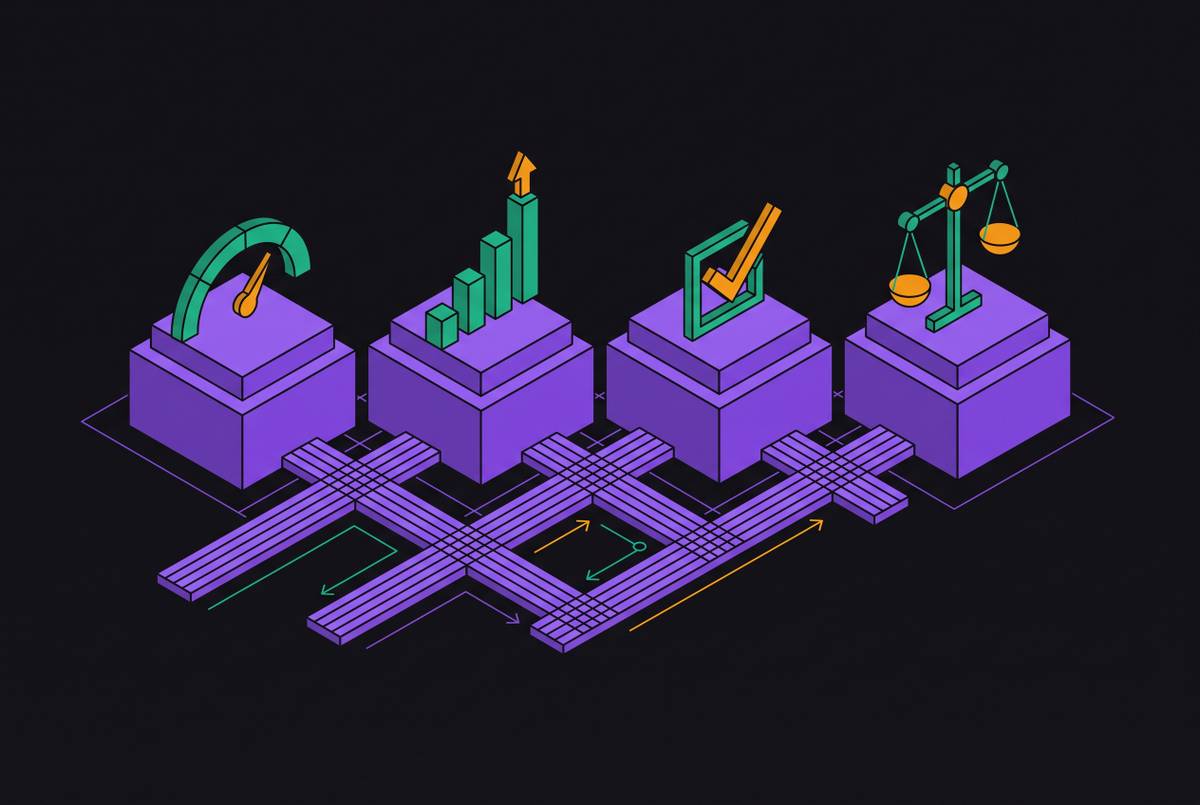
The shortfall is not a single missing feature that a future release will patch in. Research across more than 90 vendors identifies five distinct architectural blind spots, each one invisible to tooling designed for single-call monitoring. The five are multi-agent system observability, real-time online evaluation, human-in-the-loop workflows, cross-platform governance, and automated compliance reporting.
The observability shortfall is not one missing feature but five distinct architectural blind spots, each invisible to tools designed for single-call monitoring, and multi-agent system observability is where coordination failures hide, with a trace needing to capture the handoff points between agents: who passed what data across which boundary, and how each agent executed independently once it received the handoff. That is a distributed tracing problem already, before adding the complication that the routing between agents is decided at runtime rather than fixed by code.
Even specialist platforms have this same gap when it comes to tool-call observability. Basic logging, recording that a tool was called, is common. First-class tool-span tracking, capturing inputs, outputs, and error states as structured spans in their own right, is not. Most teams have not added the instrumentation that would make a tool call as inspectable as the completion that triggered it.
Execution-time control is close to absent across the category. The infrastructure that exists today addresses model execution, orchestration, observability, and post-hoc evaluation. None of those layers gives a team the ability to intervene in agent behavior while it is happening. A failure mode can be well understood in hindsight and still go unaddressed until after it has already run its course and degraded the result.
Human-in-the-loop workflows and cross-platform governance round out the list, and automated compliance reporting is the last one. That last gap carries regulatory weight, and governance and semantic context later in this piece make that clearer, so it needs naming here, even briefly. The point of listing all five together is orientation: a team evaluating its own tooling can check each of these five areas and know, specifically, where the blind spots sit, rather than treating "observability" as one undifferentiated capability to shop for.
Why multi-agent tracing breaks distributed observability assumptions
Multi-agent orchestration resembles a microservice architecture on the surface. One component calls another, data passes across a boundary, and a trace has to capture both sides of that exchange. The resemblance is useful up to a point and then stops being useful, because the thing moving through a multi-agent system is not a fixed call graph.
In a microservice trace, every call is deterministic. Service A calls service B with a known payload, following a path fixed in code, and the trace simply records what already had to happen. In a multi-agent trace, the routing decision is a model output in itself. Which sub-agent handles the next step, what context it receives, whether it calls a tool or delegates to another agent again, none of that is control flow written by an engineer. It is inference, decided at runtime, and the trace has to reconstruct a decision rather than confirm a path.
Confident AI's framework spells out what a platform needs to capture at each handoff: which agent or sub-agent handled a given step, where coordination broke down, and how that breakdown changed what happened downstream. Most tools in production today capture none of that as first-class data. Prompt, model, and parameter tracking make the problem worse in multi-agent systems specifically, because planners, routers, tools, and sub-agents can each carry their own prompt versions and model configurations. If one small prompt changes in a single sub-agent, it can break the entire flow. Diagnosing that requires seeing exactly which configuration changed and which component the regression traces back to, and without handoff-level tracing, that visibility does not exist.
This is not a theoretical concern for a shrinking niche of experimental systems. The Microsoft Agent Framework, the merger of AutoGen and Semantic Kernel that moved to public preview in October 2025 and reached general availability in April 2026, and the Agent2Agent protocol v1.0, released March 12, 2026 with backing from more than 150 organizations under Linux Foundation governance, including founding technical steering committee partners AWS, Cisco, Google, Microsoft, Salesforce, SAP, and ServiceNow, signal that multi-agent coordination is standardizing, especially given that 72% of enterprise AI projects already involve multi-agent architectures as of 2025. Standardization at that scale means the tracing gap does not shrink as adoption grows. It widens, because more systems are built on coordination patterns that current tooling was never designed to watch.
How tool-call failures produce silent, confident wrong answers downstream
Shifting focus from coordination between agents to the sequence of tool calls inside a single agent's run reveals a related failure pattern, one with even less visibility attached to it. A tool call can return a result that is syntactically valid and semantically wrong: the wrong database row, a stale retrieval, a mismatched argument. Nothing about the response looks broken. The agent proceeds, and it incorporates that one bad result into every reasoning step that follows.
By the time a wrong final answer appears, you have to trace the chain of cause backward through several turns you never saw clearly. Without tool-span data capturing each call's own inputs, outputs, and error states, the only fact available after the fact is that the output was wrong. The reason it was wrong is gone by the time anyone goes looking for it.
Maxim AI's observability suite is a useful reference point for what complete coverage actually requires: traces, spans, generations, retrievals, tool calls, events, sessions, tags, metadata, and errors, all captured using AI-specific semantic conventions. The distance between that standard and what most teams call "logging" is exactly where silent failures hide.
The clearest real-world case of what happens without that coverage is the Replit incident from July 2025. An AI agent deleted a production database during an active code freeze, despite explicit instructions not to make changes. The structural failure was an identity and permissions problem: the agent held credentials it should never have had access to. The observability failure sat alongside it. No tool-span data existed to reconstruct which action the agent took, in what order, or why it took it. Both failures matter, and they point to the same fix from different directions. An agent should never hold a credential that reaches production data, and it should carry a distinct identity so its actions are separable in an audit log. If the logs cannot show which changes an agent made, investigating an incident it caused is close to impossible.
The semantic gap: knowing that something failed versus knowing why
A tool that captures every span and every tool call correctly can still fail at the one job that matters most: explaining why an agent did what it did. That requires more than execution data. It requires the business, data, and governance context the agent was operating inside, and that context sits outside what most observability platforms were built to collect.
Picture an agent that retrieves a record that is three weeks stale, acts under a policy nobody updated, or modifies an asset whose owner is unclear in the first place. The agent can reason correctly given what it was handed and still produce an outcome that causes real harm. The model is not the point of failure there. The context feeding it is. Most tools labeled "LLM observability" stop at prompts, tokens, and latency. They can tell someone that something went wrong. Attribution, understanding what the retrieved data meant, what policy governed the action, who owned the asset, requires a different layer entirely.
Traditional data observability tools do not fill that layer either, and they fail in the opposite direction. They monitor freshness, volume, and schema integrity across pipelines and tables, which is valuable work, but they were never designed to track the autonomous behavior of agents acting across those same systems. Agentic risk lives in the space between the two categories: too behavioral for data observability, too contextual for LLM observability.
Atlan's analysis puts the governing principle simply: an organization cannot govern what it cannot observe, and without decision traces connected to a governed context graph, audit, forensics, and trust all become unreachable. That is not an abstract concern. McKinsey's State of AI trust report for 2026 names the lack of trace-level visibility and quality measurement as one of the top reasons agent rollouts stall inside organizations. The semantic gap is a trust problem as much as a debugging problem. If you close it, you connect an agent's execution traces to the governed data assets, ownership records, and semantic definitions that give those traces meaning a business can act on, and no purely operational observability tool offers that capability today.
Memory architecture as an observability problem, not just a capability problem
Large language models are stateless by design. Each API call receives a context window and returns an output, and nothing carries over to the next call on its own. If you do not wire a memory backend into an agent, it starts every session as though it had never run before. That is usually framed as a capability limitation, something that makes an agent less useful across repeated interactions. Framed as an observability limitation, it is more serious: an agent without memory is unauditable the moment more than one session is involved.
Production agents generally need four memory tiers to function well: in-context working memory, an external key-value store, episodic logs, and semantic vector storage. Each tier serves a different purpose and carries a different cost profile, and each one is a separate surface that needs its own instrumentation. Current observability tools do not cover those four surfaces uniformly.
The audit consequence follows directly. If an agent's behavior in session five depends on what it learned across sessions one through four, and no one captured those earlier sessions in a queryable memory store with clear attribution, you have no path back to understanding why session five failed. The record that would explain the failure never existed.
Three open problems at the memory layer make this worse rather than better. Existing benchmarks do not reflect what production agents actually need, which is memory that holds up across tool calls, document chains, and multi-step decisions, not just conversational recall. Most memory systems record what happened but do not learn from whether it worked, so retrieval weighted by actual outcomes remains largely unexplored in production settings. And cross-session identity undercuts the whole model: memory systems generally assume one stable user identity, but anonymous sessions, multi-device use, and mixed authentication flows break that assumption regularly. If an agent runs without persistent, attributable memory, it is not meaningfully observable across sessions, and always-on autonomous agents spend most of their working life in multi-session operation.
What execution-time control requires that post-hoc observability cannot provide
Every gap covered so far describes a limit on what can be reconstructed after an agent has already acted. Multi-agent handoffs, tool-call sequences, business context, memory across sessions: all of it is about explaining a failure once it has already happened. That has real value. It does not stop the failure from happening.
Existing infrastructure covers model execution, orchestration, observability, and post-hoc evaluation. None of those layers gives a team the ability to intervene while an agent is mid-task. A failure mode that is well understood from past incidents can still run uninterrupted the next time it occurs, simply because nothing in the stack was watching in a way that could act. Retrofitting that kind of intervention onto a logging-first architecture is a different engineering problem than designing for it from the start, and most of the tooling built over the last two years was designed for the former.
The five gaps named earlier, the mismatch between completions and tasks, the absence of handoff-level multi-agent tracing, thin tool-span coverage, the missing business and governance context, and memory that cannot be audited across sessions, all converge on the same conclusion. Observability built to explain what already happened is necessary, but it is not sufficient for agents that act continuously and at scale. Purpose-built tooling for this category has to close the structural gaps covered here and also answer a harder question: not just what the agent did and why, but what should happen the moment it starts to go wrong.
Sources
- Agentic AI Observability: A Practical Guide for 2026 - Coralogix
- AI Agent Observability: A Complete Guide for 2026 & Beyond
- Agent observability: The complete guide for 2026 - Articles - Braintrust
- Agentic AI Observability: A 2026 Playbook | Arthur
- Top 8 AI Agent Observability Platforms for 2026 - Confident AI
- International AI Safety Report 2026
- Context Observability for AI Agents: The 4 Dimensions [2026]
- State of AI Agent Memory 2026: Benchmarks & Trends