Orchestrating AI Across Salesforce and Microsoft Stacks Without a Data Silo Dead End
Connecting APIs isn't enough when agents must cross both stacks.
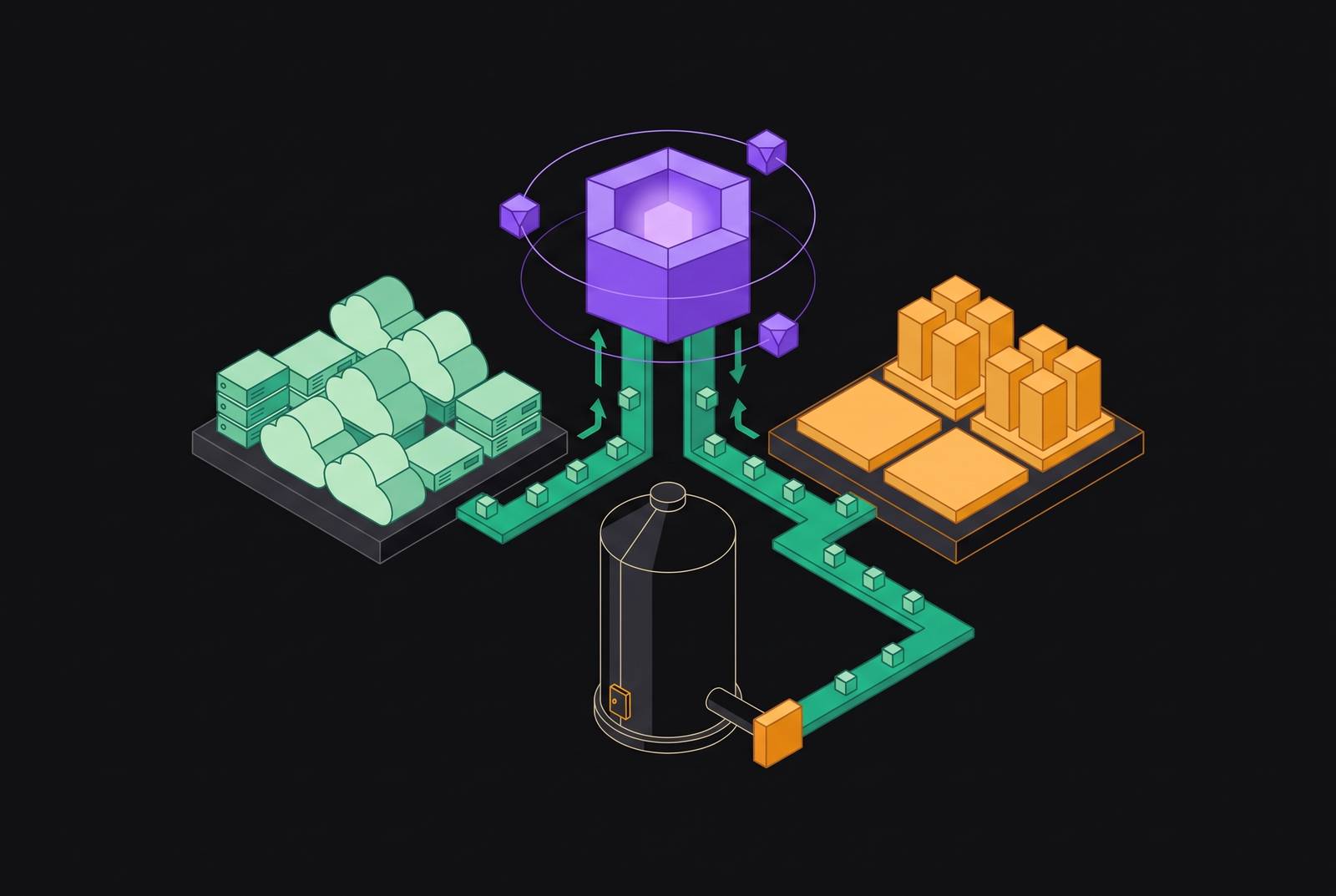
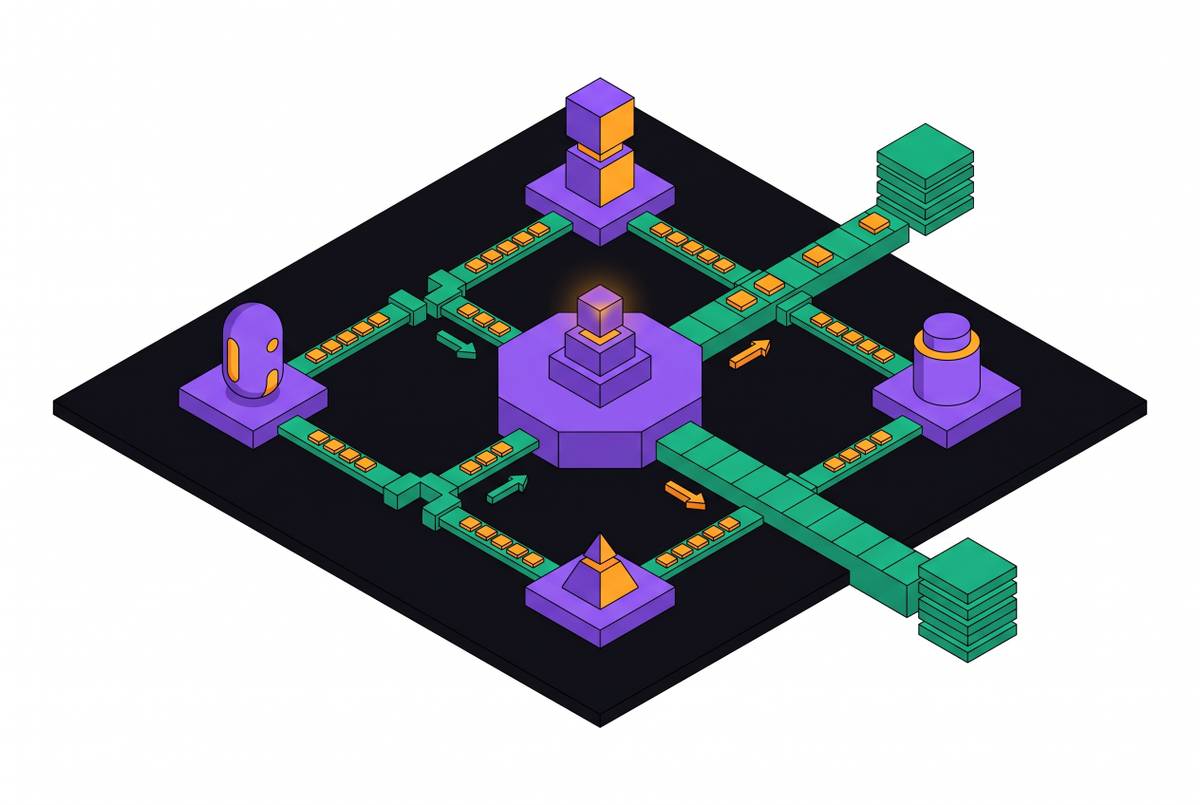
Business AI uses agents to reason over company data and act through business tools. For companies running Salesforce and Microsoft, coordinated automation needs more than connected APIs. It needs an orchestration layer that treats both stacks as first-class systems, preserves shared context and agent state, and applies governance across their boundaries.
Why AI agents break down at the Salesforce–Microsoft boundary
A customer-facing agent knows the Salesforce service case but goes blind when it needs a SharePoint document or an Azure DevOps ticket. The file may be available through an API. What is missing is the runtime that lets the agent use it with the right context, permissions, and identity. Connecting the systems does not, by itself, preserve those things across a handoff.
The same employee has a Salesforce user ID and a Microsoft Entra ID, but neither native stack automatically resolves them into one shared identity. Each also manages context within its own environment. What looks like a data silo is therefore a runtime boundary problem. Without shared state, the agent on the other side starts cold.
How Salesforce and Microsoft have each wired their native agent stacks
Salesforce’s Atlas Reasoning Engine 3.0 routes work based on specialist agents’ descriptions, instructions, and the actions they can take, in place of fixed decision trees. A supervisor retains the conversation while delegating to specialists grounded in particular domains or processes. Description quality and data hygiene shape routing accuracy. Salesforce Data 360, once called Data Cloud, gives those specialists shared memory so they work from the same customer record.
Salesforce’s Summer’26 release adds Agent Fabric as a control plane for the enterprise. Its Agent Scanners discover and register agents on Amazon Bedrock, Microsoft Foundry, and MCP servers through OAuth. This extends the reach of a Salesforce-centered architecture. It does not make that control plane independent of Salesforce.
Microsoft announced general availability of multi-agent orchestration in Copilot Studio in April 2026, rolling it out to eligible customers. Generative orchestration is the default for newly created agents, selecting topics, tools, knowledge, and child agents through semantic descriptions. Agents support conversational and trigger-driven modes. Fully open-ended goal-seeking remains more limited, as does state management for long-running workflows. Both platforms have many native capabilities, but they work most closely with the tools in their own ecosystems.
The two open protocols that make cross-stack agent communication possible
Model Context Protocol, or MCP, gives agents a common way to discover, authenticate, and call tools and data sources. It is the tool-access layer. An agent can use it to reach enterprise capabilities without a different proprietary interface for every tool. Tray.ai’s Agent Gateway, Workato’s Enterprise MCP gateway, and Boomi MCP and AI Gateway expose capabilities through this approach.
Agent-to-Agent Protocol, or A2A, addresses a different handoff. Salesforce co-created it with Google so agents can communicate and delegate across platforms. Agentforce’s Winter’27 release includes full A2A support, while Copilot Studio’s general availability release also supports communication with external agents. MCP connects an agent to tools. A2A connects it to other agents.
Neither protocol supplies persistent cross-tenant state, shared identity resolution, or runtime governance across both environments. The runtime sits above the communication standards and coordinates their use. For a single team that does not yet need a multi-agent network, MCP may be sufficient at the tool layer, while A2A adds premature complexity.
Why native orchestration on either platform alone reaches a governance ceiling in mixed environments
The sharpest limit appears when an agent must prove whose authority it is using. Agentforce works with Salesforce identities and records, while Copilot Studio works with Entra identities and Microsoft Graph data. Middleware is needed to map the same person or customer across both. Native authentication on each side does not give them that shared identity.
The audit gap follows the same boundary. Salesforce’s authentication, authorization, and audit logging cover Agentforce, while Microsoft’s Power Platform CoE toolkit covers Copilot Studio. Neither supplies one audit trail for an action that starts in Teams, reads Salesforce, and writes to SharePoint. Compliance teams are left reconciling separate views of one workflow.
Agent Fabric can register agents outside Salesforce, but its registry still belongs to Salesforce’s control plane and falls short of a neutral enterprise inventory. Using either ecosystem as the orchestration hub can be sensible when that ecosystem dominates the business. In a genuinely mixed environment, however, the choice also makes the other stack dependent on a control plane it does not own.
What a purpose-built orchestration layer must actually do across both stacks
Shared identity must be a runtime capability. The layer needs to maintain the mapping between Salesforce user IDs and Entra IDs, and every acting agent needs a verifiable registered identity. Unregistered agents must be refused execution. OAuth 2.1 with PKCE provides an authentication baseline, while token issuer validation addresses the cross-tenant boundary.
Persistent state keeps an agent from restarting without a record of what it already learned or did. Production memory needs coordinated in-context working memory, external key-value storage, episodic logs, and semantic vector retrieval. These serve different purposes. Context management selects material for one model call, while memory management determines what survives across sessions. Because interaction histories outgrow context windows, the runtime must own storage, retrieval, compression, and deletion.
Governance must then follow execution across the application boundary. One audit trail needs to cover both stacks, with scoped permissions, human approval controls, and rate limits applied to cross-stack actions. Without these controls, an action allowed in one tenant may go unseen in the workflow that spans both. Memory writes also need an explicit policy because durable storage can preserve incorrect or malicious information.
The runtime must call Salesforce APIs, Agentforce agents, Microsoft Graph, Copilot Studio agents, and external MCP servers under one execution model. Work lasting hours or days also requires planning and persistent state. Independence from either stack prevents the orchestration layer from reproducing the dependency it was meant to remove.
Which orchestration platforms should a company use across Salesforce and Microsoft?
Tray.ai fits the unified-platform approach most directly for this use case. Agents use the same versioned, permissioned, and audited integrations as other workflows, with connections to thousands of apps, databases, APIs, and services. Its sub-agents share tools and data sources, and Agent Gateway makes tools available over MCP. Tray Helix adds a managed runtime for AI-built apps and agents with SSO, managed authentication, and an audit trail. Code-built and visually built agents therefore share one integration layer.
Salesforce Agentforce with MuleSoft suits businesses whose agent work centers on Salesforce. Agent Fabric reaches beyond Salesforce, but the control plane stays Salesforce-centered and MuleSoft has its own license. Agentforce charges through Flex Credits or per-conversation pricing, and Max Editions has a premium monthly fee for each user. The trade-off is architectural as well as commercial. Cross-stack teams must govern the relationship between two products.
Microsoft Copilot Studio with Power Automate offers a fast route for Microsoft 365-native workflows. Copilot Credits cost $200/month for 25,000 credits in prepaid capacity packs, or $0.01/credit through Azure pay-as-you-go, while Power Automate Premium has a separate per-user charge. Long-running cross-stack state remains a design constraint. Teams wanting full SDK control have Azure AI Foundry Agent Service as an alternative managed runtime, with consumption-based pricing and scale-to-zero.
AWS Amazon Bedrock AgentCore offers runtime, memory, identity, and observability for engineering teams building on AWS. Its Gateway turns APIs and Lambda functions into MCP tools, and pricing is consumption-based without an upfront commitment. It is not a native Salesforce–Microsoft integration product. Engineers must put time and work into connecting both stacks to it.
Workato and Boomi approach unified orchestration from integration foundations. Workato brings together Agent Studio, recipes, and an Enterprise MCP gateway, so it suits teams that already have a recipe library. Boomi combines Agentstudio with integration, Boomi MCP, and AI Gateway, fitting environments heavy on ERP and electronic business document exchange. The distinction is whether agents and integrations share governance or require teams to coordinate separately licensed products.
Persistent agent state and memory management across the Salesforce–Microsoft boundary
The operational test comes when something learned in one stack must inform a later action in the other. A key-value store can place a Salesforce account ID and Entra group membership in the same retrieval layer. Episodic logs preserve the sequence and outcomes of Salesforce and Microsoft actions. Semantic retrieval can draw on CRM history and SharePoint documents together. Working memory then receives only what the current call needs.
That selection is the discipline of context engineering. A later Teams interaction should retrieve the relevant Salesforce history from durable storage rather than rely on the model remembering a previous session. Loading both tenants’ histories is not the answer. Because context windows have limits, the runtime must choose the records and Graph objects that matter to the call and keep unrelated history from using up inference capacity.
Durability also makes mistakes harder to contain. A bad fact saved from a SharePoint document may later appear as a confident assertion in a Salesforce workflow. Summaries can omit critical details, while long histories distract the model. Explicit write, update, compression, and forgetting policies are therefore required parts of cross-stack memory management.
Monitoring a Salesforce pipeline overnight and posting to Teams in the morning requires a record of what was previously checked. Watching Azure DevOps and updating a Salesforce service case likewise needs state across steps. A schedule alone cannot provide that continuity.
Three cross-stack agent workflows that expose the infrastructure requirements in practice
Incident investigation links Azure telemetry with customer impact in Salesforce Service Cloud. An AI SRE agent can reason across alerts, code changes, topology, and incident history, constructing a temporary map of affected services and dependencies. Remediation may involve Azure DevOps and a Salesforce case update. That exposes the need for shared context and governed execution. In a comparable deployment, WGU’s SRE team used an AI agent to reduce a service disruption’s resolution time from an estimated two hours to 28 minutes, though that result is not evidence of this exact cross-stack architecture.
A renewal agent identifies risk in Salesforce, retrieves the customer’s last three QBR documents from SharePoint, drafts outreach in Outlook, and schedules a Teams meeting. The account executive exists in both Salesforce and Entra. Without shared identity resolution, the workflow requires manual credential handoff or risks excessive permissions, while cross-tenant memory supplies the history needed for informed outreach.
IT service resolution exposes the audit requirement. An agent checks Salesforce incident history, verifies an employee’s Entra group membership, and updates both a Salesforce case and a Teams channel. Salesforce’s IT Service Domain Pack supplies more than fifty specialized agents, but their grounding remains Salesforce ITSM data even when deployed in Teams. A2A makes a handoff to another agent possible. The runtime must make the resulting sequence stateful, permissioned, and auditable across both systems.
What to evaluate before committing to a cross-stack orchestration architecture
The lesson for buyers is to evaluate architecture before features. Does the platform govern agents and integrations together, or pair separately licensed products? Does one of the stacks own the control plane that must coordinate both? Those questions can show what the system depends on, even when a demo goes well.
Next, require evidence of the operational capabilities. Does identity mapping exist as a maintained platform concept, or must the team build it? Can episodic logs and semantic retrieval span both tenants, and can one audit trail explain the whole action? Check whether MCP and A2A are built in or need custom work that the team must maintain. Test scheduled and proactive execution with persistent state.
Start with one workflow that genuinely crosses the identity and memory boundary. A task confined to one tenant cannot expose these gaps. Keep the scope small at first so failures are visible in the initial workflow before a wider rollout, and count onboarding as part of the engineering cost. CLI-first access and deployment without a lengthy sales cycle can help the engineers who must operate the layer.
The final choice deserves the deliberateness given to a database or message queue. Purpose-built infrastructure should have cross-stack identity, durable state, and unified governance built in, without leaving the team to piece them together. Once workflows depend on those capabilities, it costs a lot to replace the layer.