The Orchestration Patterns Behind Cost Reduction in Live Enterprise AI Deployments
Routing, caching, and state tiering can cut agent costs 60–80%.
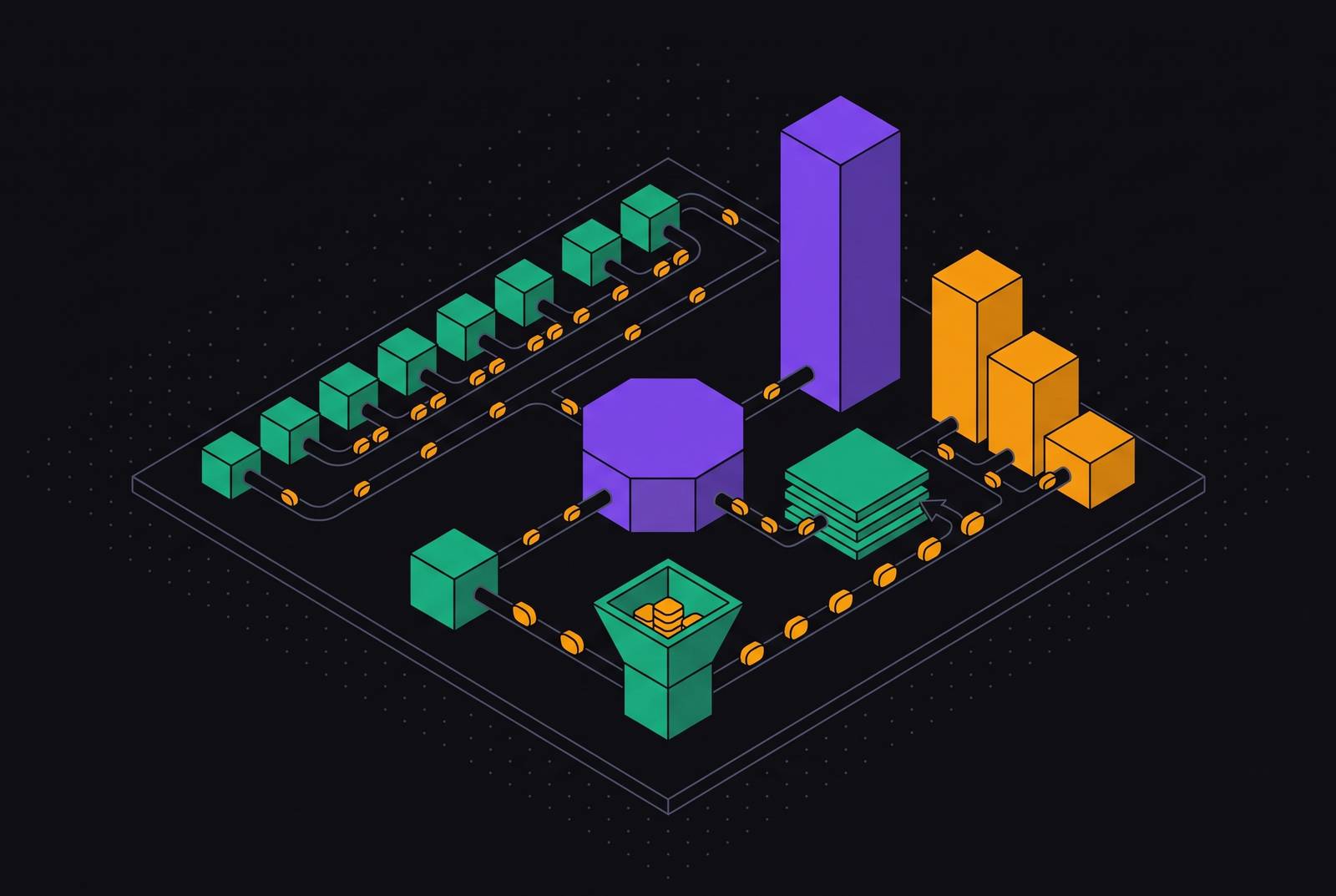
Business AI systems become cheaper to run when their orchestration layer controls which model handles each task, how much context it receives, and how agents coordinate. This article maps the patterns behind cost reduction in live enterprise AI deployments. Sustainable savings come from architecture.
Why enterprise AI costs grow faster than the agent fleets that generate them
A chatbot exchange and an agent task have different economics. An agent may plan, call tools, check results, and go through those steps again before it gives a useful answer. Across hundreds of tasks per day, that work adds up. A lower token rate makes that work cheaper but does not make it go away.
Fleet growth introduces another source of expense. The approximate O(n^1.7) cost curve described for production deployments is superlinear, so running more agents can raise costs disproportionately. Shared-state pairs multiply, bringing locking, versioning, and conflict resolution, while coordination adds communication overhead. Potential connections grow quadratically, although actual message traffic depends on topology and task. The fix for these structural costs must reach the architecture that creates them.
What the orchestration layer actually is and why it is the right place to intervene
The orchestration layer is the coordination harness between foundation models and business logic. It handles routing, memory hand-offs, tool calls, and how delegation works between agents. This is a distinct place to intervene. Changing a model changes the price of an inference step, while changing the harness changes how many steps happen and how much context each consumes.
That distinction also separates orchestration from ordinary workflow automation. A predefined workflow executes deterministic steps, while an agent harness makes context-aware decisions, routes around exceptions, and holds state across runs. Autonomy introduces both flexibility and expense. For business operations, the relevant comparison is therefore not just which tool offers the strongest model, but whether the work needs predefined execution or adaptive coordination.
Writer’s research illustrates the leverage available at this layer. Rebuilding its agentic harness reduced costs, accelerated completion, and improved output quality without changing the underlying foundation models. Control belongs at the same layer too. Because the harness directs execution, it can enforce budgets and interrupt recursive loops, as well as apply the routing, caching, and state patterns that follow.
Dynamic model routing: directing each task to the cheapest model that can handle it
Dynamic routing saves more than any other single change because expensive models often do work that smaller models can do well enough. The decision starts with the task’s demands. Lightweight models handle extraction, classification, filtering, and parsing, while mid-tier models handle summarization, drafting, and refactoring. Frontier models are still there for complex debugging, architectural decisions, and multi-step reasoning.
A confidence gate connects these tiers into a decision tree. The smaller model returns a probability score, and a result below the preset threshold sends the request to the next tier. Capability remains available when the task needs it. Palmyra X6 shows how routine classification and routing can run while larger models take on the edge cases.
But does a weaker model weaken the final output? It can when the work exceeds its ability, so the gate is central. The policy seeks the cheapest model that meets the quality threshold. Putting that logic in a named, version-controlled policy also keeps the routing strategy out of the agent code. Teams can then rebalance tiers as prices change without redeploying the agents themselves.
Shared prefix caching: preventing the same tokens from being paid for repeatedly
Routing determines which model runs, while caching determines how much repeated input is billed at full price. Agent calls often repeat system prompts, tool definitions, and retrieval context. Those payloads can dominate an otherwise short request. Shared-prefix caching makes stable input reusable.
Fleet specialization can undermine that reuse. When agents maintain separate prompt variants, their prefixes diverge and cache hits fall, even if much of their underlying instruction is similar. More agents then produce more fragmented caches. The architectural response is a two-tier context structure, with a stable global prefix shared across the fleet and task-specific material kept separate from it.
Someone needs to own the boundary between those tiers. Stable instructions and shared tool definitions belong in the common prefix, while task context that changes may not be reusable. Standardization is therefore a fleet-level decision.
Role-based state tiering: matching memory footprint to what each agent actually needs
If every agent gets persistent history by default, the system keeps relationships and context that many roles never use. Not every agent needs a memory. Removing state that is not needed leaves less of the quadratic overhead that comes from managing possible shared-state pairs.
The production pattern separates agents into three roles. Stateless classifiers, filters, and parsers get only the current input, while short-memory agents keep a sliding window for multi-turn work within a session. Full-state agents keep context for long-horizon coding, research, or incident investigation. The distinction follows the work. Savings come from eliminating unused state infrastructure rather than stripping memory from tasks that require it.
Even full-state agents need boundaries around prompt growth. Fixed retrieval budgets and periodic compaction prevent an entire conversation from being appended indefinitely when only recent exchanges are relevant. Hierarchical memory makes those boundaries practical. Hot memory holds the current task in context, warm memory keeps recently finished work in files that agents can reach through tool calls, and cold memory stores past patterns for retrieval when needed. Shared team memory is now emerging, so agents can reuse conventions they have learned or what they know about incidents without sending the same context over and over.
What the three patterns achieve in combination and where the curve flattens
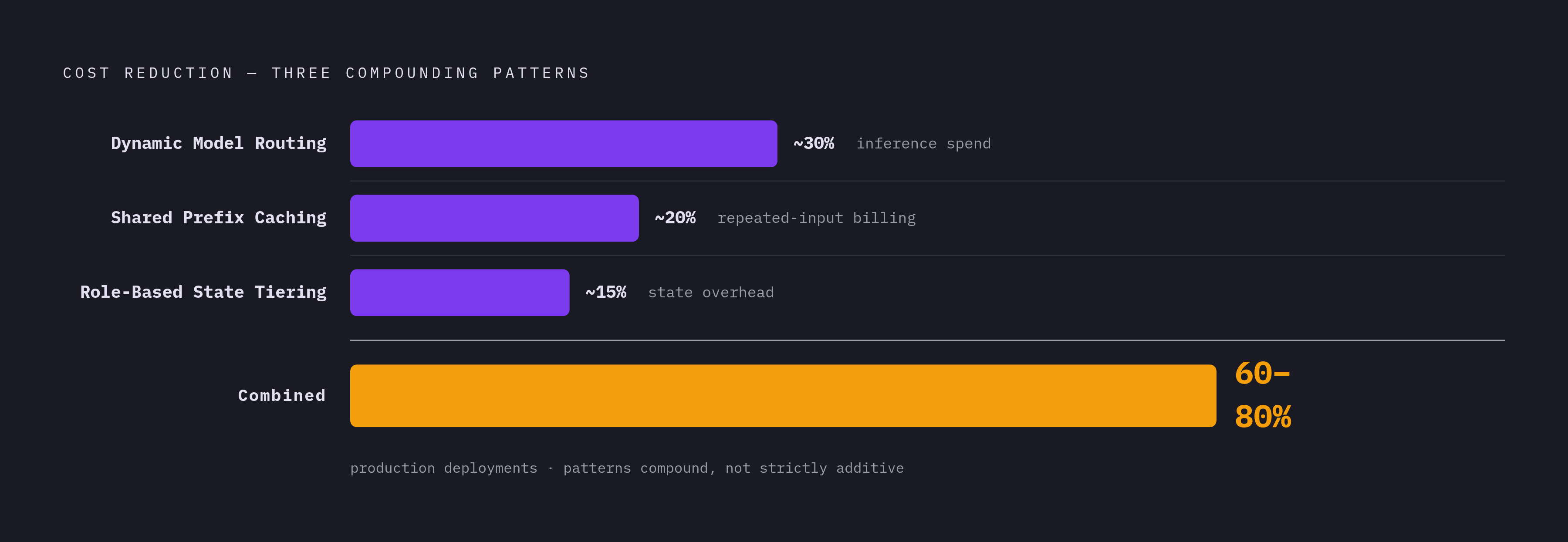
The combined effect is more useful than three isolated discounts. Routing changes where inference spending lands, caching changes the price of repeated input, and tiering reduces the state work surrounding execution. Their effects compound across different cost drivers. With these changes, adding agents to a fleet need not drive up context volume and coordination overhead in the same costly way.
Improving routing, caching, and context management together targets a total cost reduction of 60–80% in production deployments. How much it saves depends on how much routine work, repeated context, and unneeded state the system had to start with. Even with a flatter cost curve, some workloads will still not be linear because tasks can need a great deal of reasoning and coordination.
A design can be economical under normal conditions and still permit an agent to retry or delegate beyond its intended budget. One runaway process can erase accumulated savings in minutes. To keep those savings, the harness needs governance, including policies that retire agents when their cost per useful output stays above a set multiple of baseline for measurement periods in a row.
Governance as enforcement: gateway orchestration, circuit breakers, and cost attribution
Tagging each request with team, project, and agent identity makes spending attributable while the work is happening. Limits can then act on identified consumption. Token budgets for each team, priority levels, and alert thresholds give the gateway rules for blocking requests when teams have used up their allocations.
Circuit breakers address a different failure mode. A process stops when it goes past either its maximum turn depth or its cost-per-task thresholds. Retrying is not free, even when it seems reasonable. An agent that repeatedly attempts a failed tool call can consume a large multiple of the intended token budget without producing a better result.
Attribution becomes more useful when paired with outcome measurement. Evaluating a support agent requires measuring how many tokens it consumed, what it resolved and the cost per resolution. Cheap activity can still be wasted activity. Cost-per-outcome measures give engineering and finance a shared basis for allocating budgets and deciding whether an agent should remain active.
Observability makes those decisions possible during operation. A dashboard tracking tokens per agent, per workflow, and per hour provides the minimum instrumentation described for this approach. Aggregate totals hide where the waste begins. Granular telemetry can expose costly retries, workflows, or agents before optimization starts, while automatically checked sunset policies prevent unproductive agents from remaining active simply because nobody reviewed them.
What the supervisor pattern and hierarchical coordination add at the architecture level
So far, the patterns have controlled calls, context, and state. Coordination topology adds another lever by determining which agents may delegate to which others. The supervisor pattern centralizes that decision. A supervisor classifies incoming work, assigns it to the appropriate sub-agent, and receives the result, keeping the coordination graph shallow rather than opening unrestricted peer-to-peer communication.
Anthropic recommends the orchestrator-subagent pattern as the starting point for most use cases because it handles a broad range of problems with relatively little coordination overhead. It closely matches hierarchical supervision. Sub-agents execute and return, while one agent holds the delegation logic. That setup can keep message growth linear because each agent no longer has to handle the coordination needs of every other agent.
Other topologies make different trade-offs. Pipelines offer predictable execution but add latency and token overhead at each stage, with failures requiring the chain to retry. Fan-out parallelizes work but introduces state aggregation costs. Swarms offer greater flexibility, yet fully peer-to-peer arrangements are harder to govern and cost-contain, so selective use with hard budgets is the recommended approach. A supervisor also makes the earlier patterns easier to apply in the same way each time because delegation gives shared-prefix rules and role-based state assignments one place to come together.
What purpose-built agent infrastructure provides that adapted general-purpose tooling cannot
General-purpose infrastructure can support these patterns, but it does not provide them automatically. Teams assembling the pieces must maintain the memory hierarchy, attribution, budget enforcement, and circuit breakers themselves. That work competes with building useful agents. Purpose-built infrastructure changes the division of responsibility by making those controls runtime primitives.
The important comparison is governance designed in versus governance added later. A runtime built for agents can treat lifecycle management, capability grants, sandboxing, managed persistent memory, and budget policies as core functions. Those are concrete evaluation criteria for enterprise platforms. They also expose a limitation for a business without a technical team, since developer-oriented infrastructure should not be mistaken for a ready-made business workflow.
Managed memory shows how this boundary is shifting. Google’s Memory Bank and Sessions became generally available for global and multi-regional endpoints in June 2026, and SAP’s Agent Memory Service became generally available in Q3 2026. Persistent memory is becoming a platform responsibility. As platforms take on that work, there is less reason to build each agent’s memory tier as its own custom engineering project.
A single-command installation and version-controlled policy files offer a developer-first route to adoption without making a guided wizard or lengthy integration project the necessary starting point. Coordination, memory, and cost controls need to be supported together so that economical behavior remains the default as the fleet grows. An architectural cost problem deserves infrastructure designed from first principles for agents.