Small Business AI Adoption Without Engineers Starts With Process Mapping Not Tools
Document your actual workflow before picking an AI tool to avoid wasting money on unused software.
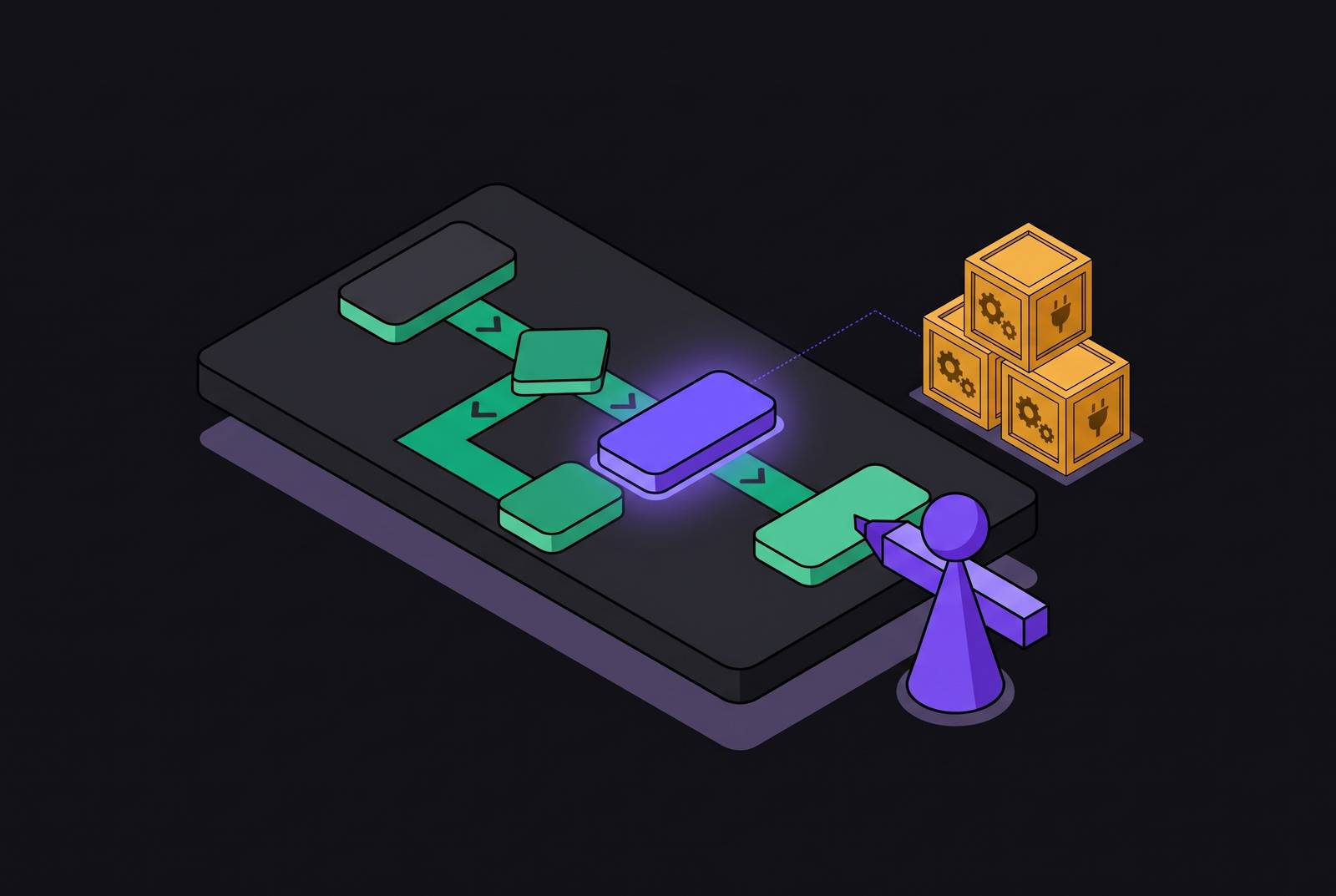
For a small business without engineers, AI adoption starts with process mapping before the business chooses a tool. The first job is to document how work actually moves, choose one recurring workflow, and define a measurable improvement. That gives a business a basis for choosing AI tools that remove work.
Why most small businesses stall after buying AI tools
Buying a tool feels like a clear first step. A business gets licenses, employees try prompts, and adoption appears to be underway. Raise Networks reports that most small business owners are now using or actively testing AI, but there is still a gap between having access and changing how work gets done. The purchase leaves unanswered which task should change, who owns the result, and how the team will know whether the change helped.
Tied Inc. describes a familiar pattern in which employees experiment for a few weeks, usage fades, and the business concludes that AI did not work. Its explanation points to a structural trap involving three omissions, namely no target process, no updated standard procedure, and no success metric set beforehand. Teamazing offers a practical test for spotting it. Does AI cut steps from the day, or do people still have to switch apps, copy text, and apply the output by hand?
What the integration gap actually reveals about how AI creates value
Teamazing defines integration as AI running inside existing tools, processes, and decisions. An employee may get a useful answer from a chatbot while still doing all the work needed to move that answer into the business. The answer’s value depends on what happens before and after it in the workflow.
Cybarworks illustrates the problem with a vendor demo in which an email arrives, AI reads it, a CRM updates, and a customer receives a response. In the real business, the email may lack information, the customer may have two accounts, and pricing may depend on a contract exception. An employee has been quietly resolving those issues. Those judgments are part of the process, even if nobody has documented them. Automating the steps people can see without understanding that hidden work can make confusion spread faster.
AI therefore amplifies the quality of the process it enters. Teamazing argues for fewer tools used more deeply, because embedded workflows offer greater returns than ad-hoc prompting. It also sees more of a threat from AI-native teams that work without the usual back-office, legal, or sales structures than from competitors that put chatbots on laptops. That comparison shifts the question from software ownership to work design. For a small business, the useful starting point is understanding the work well enough to decide which parts should change.
What process mapping actually means in a small business context
Process mapping means documenting how work actually moves. Cybarworks describes its purpose as creating an operating picture that helps a business distinguish work to simplify, standardize, automate with rules, assist with AI, or leave in human hands. An elaborate flowchart is not the goal. A useful map shows the choices people make and what the work depends on. It can reveal that a simpler procedure is the right answer before any AI is involved.
A complete map begins with the trigger that starts the work and the inputs it needs, including information, files, forms, and approvals. It follows the steps through the systems people use, recording decision points, handoffs, pauses, and exceptions that change the normal path. It also identifies the output and the owner accountable for the business result. Dependencies belong on the map as well. These include the applications, accounts, connectors, and devices required, together with the customer, employee, financial, legal, security, or operational data used.
To build that picture, Cybarworks says to choose one process and follow several real examples from start to finish. The people to consult include employees doing the work, the manager responsible for the outcome, the software support person, and anyone receiving the output. Their accounts need not match the written policy. NIST’s AI Risk Management Framework supports the same logic through its Map function, which calls for documenting purpose, value, tasks, scope, benefits, costs, human oversight, and risk before a deployment decision.
How to identify which process deserves the first AI pilot
Which workflow offers a useful first test? Tied’s selection framework uses two axes, namely frequency and standardization. Frequency concerns how many hours the task consumes each week, with three or more hours per week as the threshold at which improvement becomes visible to the team. Standardization concerns how fixed the procedure and output format are. The more templated the work, the more of it AI can take on.
A task that comes up often and follows the same procedure gives the business enough work to improve and a clear way to judge the result. By contrast, Tied advises avoiding tasks that combine low frequency with low standardization. Novelty is a poor selection criterion here. An impressive demonstration does not establish that the business repeats the task often enough, or understands it well enough, to benefit.
For a check in the first week, Tied says to list recurring tasks across 2–4 weeks and note how many hours they take each week and their degree of standardization. Cybarworks adds that leadership should be able to say what needs improving in a candidate workflow. Qualified sales inquiries waiting too long for a response, invoice approvals disappearing into email threads, and project handoffs creating rework are concrete starting points. Wanting an AI agent is not the same thing. If three departments use different intake forms and nobody owns data quality, standardizing intake may deliver more value first while creating cleaner inputs for later automation.
Why data readiness is part of process mapping, not a separate project
Mapping exposes data problems before automation makes them operational problems. Cybarworks points to hidden exceptions, missing fields, and decisions stored only in one employee’s head as issues the exercise can uncover. These discoveries are useful outputs that show what the chosen process needs. Readiness for AI hinges on usable inputs for the chosen process.
Tied recommends digitizing and gathering only the information the pilot requires. For AI-drafted quotes, past quotes and a price list in one shared folder are a legitimate starting point. Scoped preparation can be achievable in days, while waiting for a company-wide systems overhaul can become a way never to start. Scope does not remove responsibility for access. Raise Networks identifies identity, access, and data ownership as part of AI adoption itself, so those questions belong in the selected workflow rather than in a separate, indefinite IT project.
Running a three-month pilot that produces a decision, not just an experience
A useful pilot starts with a written agreement on what to measure. Tied says to set a numeric target before work begins, such as cutting five hours of weekly meeting-minutes work to two. That target establishes what the business is trying to change. At the three-month mark, it provides a basis for deciding whether to continue, adjust, or stop. Without it, a team can accumulate opinions about the tool without producing evidence about the process.
The process map gives that target its context. It identifies the recurring work AI will assist, the inputs involved, the people responsible, and the points where human judgment remains necessary. The pilot tests a change to that defined workflow. This keeps the trial tied to work. It also helps the team learn more when the result disappoints, because people can discuss where the mapped process broke down.
Tied recommends a 15-minute weekly review focused on whether the tool was used and where it broke down. Outcome signals can be reviewed monthly and can stay simple, including time saved, faster replies, fewer errors, and fewer escalations. If the workflow is not delivering, the next move is to adjust or drop it. If the numbers hold, they provide a basis for building the next part of the roadmap.
Raise Networks describes an early progression from hidden AI use to licenses without a plan and then to workflow-driven adoption. The pilot’s job is to move a business from the second stage to the third. Buying more licenses is not that transition. Mapping AI to real recurring work and proving its value before expanding is. This gives a business without a technical team a concrete measure of progress that does not depend on how sophisticated the technology looks.
Embedding what works so gains survive past the pilot
Tied recommends writing the AI step into the standard procedure so that continued use does not depend entirely on individual habit. Once the numbers hold, expansion should move to an adjacent process. That keeps growth tied to demonstrated results. Sequential improvements can then build on work the team already understands instead of asking everyone to adopt an undefined new way of operating.
Guardrails help make that routine use practical. Raise Networks says to use approved business accounts, keep sensitive HR and payroll data out of prompts, and have people review outputs. For high-impact actions, Cybarworks advises against giving an AI workflow more authority than the business would give one employee. Its practical defaults include narrow permissions, approval gates, useful logs, spending or action limits, reversible steps, and a reliable stop procedure.
A further infrastructure question arises when an embedded workflow needs to persist across sessions, remember context from prior runs, and act proactively. At that point, manual use reaches its limits. An agent operating system built for this purpose gives agents the runtime environment they need to hold state, schedule actions, and work with employees without going back to stateless behavior. The mapped process still determines what the agent should do, where it may act, and which decisions remain with people.
The sequence that separates businesses that extract value from those that don't
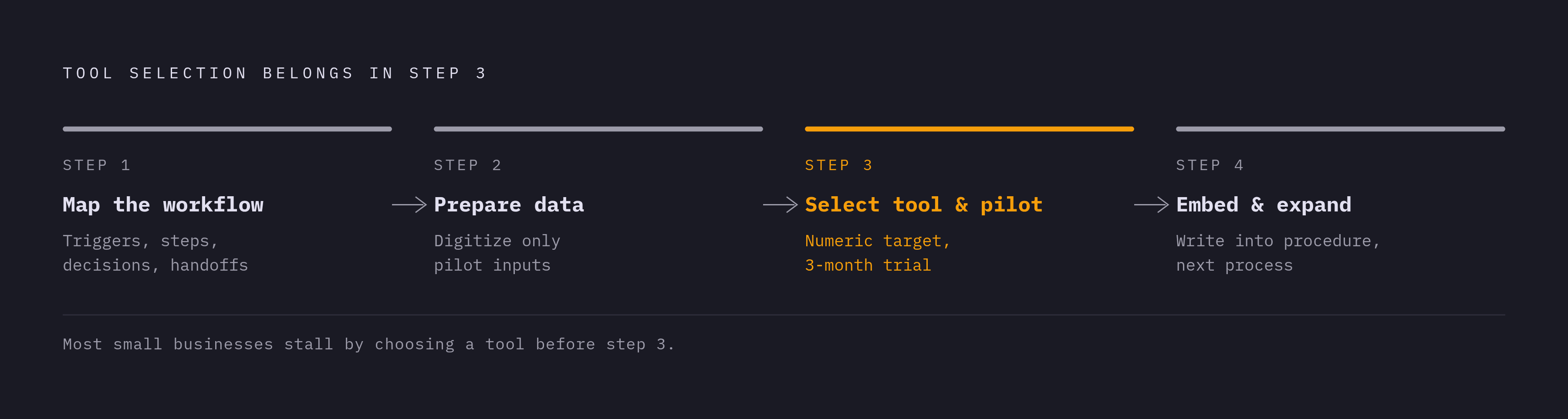
The order of work determines what a tool purchase can accomplish. Mapping first establishes the workflow, scoped data preparation makes its inputs usable, and selecting and piloting one process tests whether the proposed change delivers. Embedding the result in a written procedure then turns an experiment into a repeatable practice from which internal capability can grow. Tool selection belongs in the third step. By then, the business has requirements grounded in its own work rather than a feature list borrowed from a demonstration.
That internal capability is what lets the sequence continue. Tied recommends that outside help, when used, develop the business’s own people rather than replace them, with an internal champion helping sustain progress after the engagement ends. A small business needs to become precise about the work it wants to improve and the evidence that would justify a change. Cybarworks asks businesses to begin with “which workflow is worth improving, and what kind of change will produce a measurable result?”.