Open-Source Agent Frameworks and the Hidden Operational Tax
Building agents is easy; running them in production requires hidden infrastructure work.
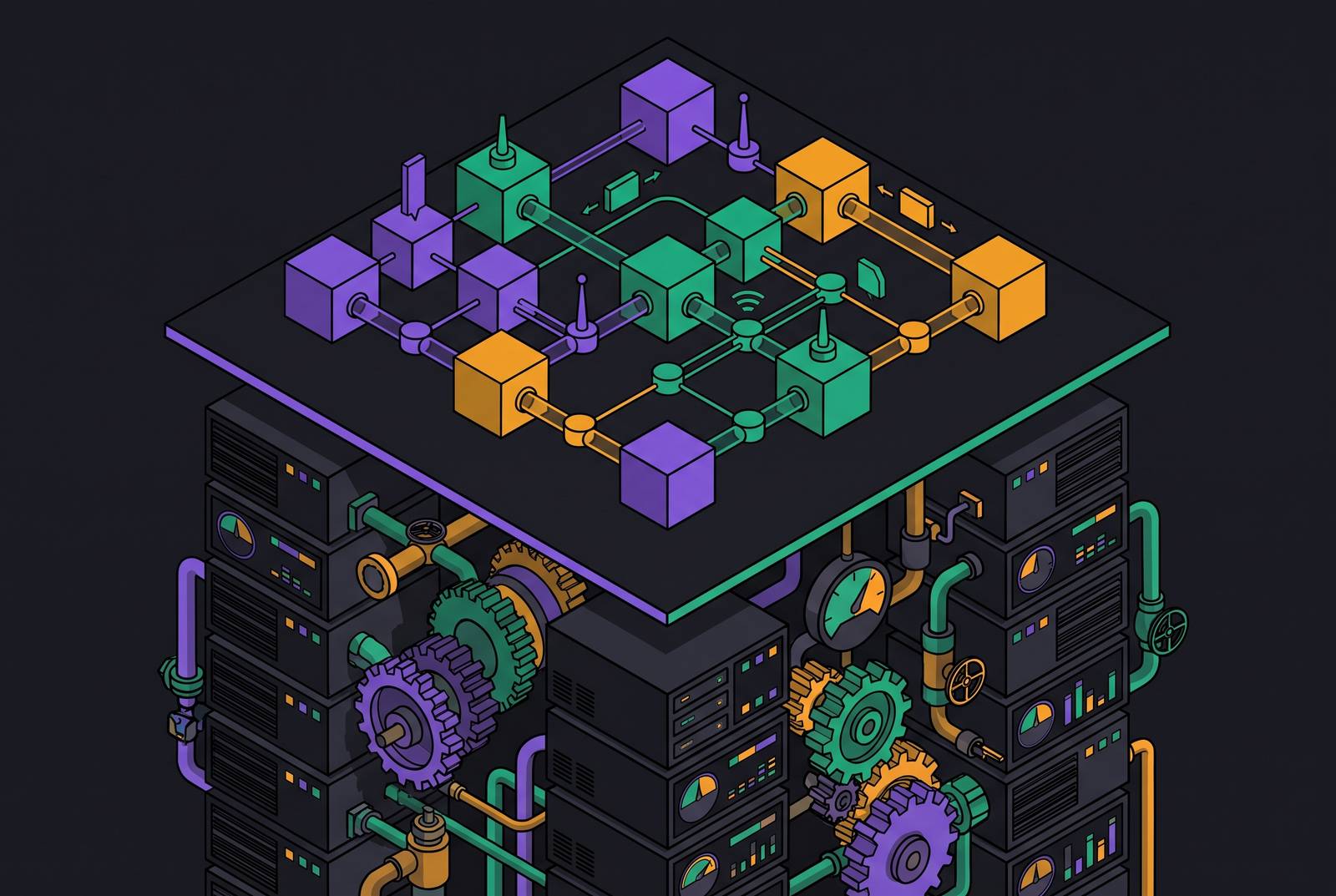
Open-source agent frameworks make it much easier to build an agent, but they do not remove the work of running one. That is the hidden operational tax. The agent loop is the easiest part of the system, while hosting, memory, reliability, and governance become a continuing engineering obligation. The real investment decision is not whether to use open source, but who will build and maintain the operating layer around it.
What open-source agent frameworks actually give you
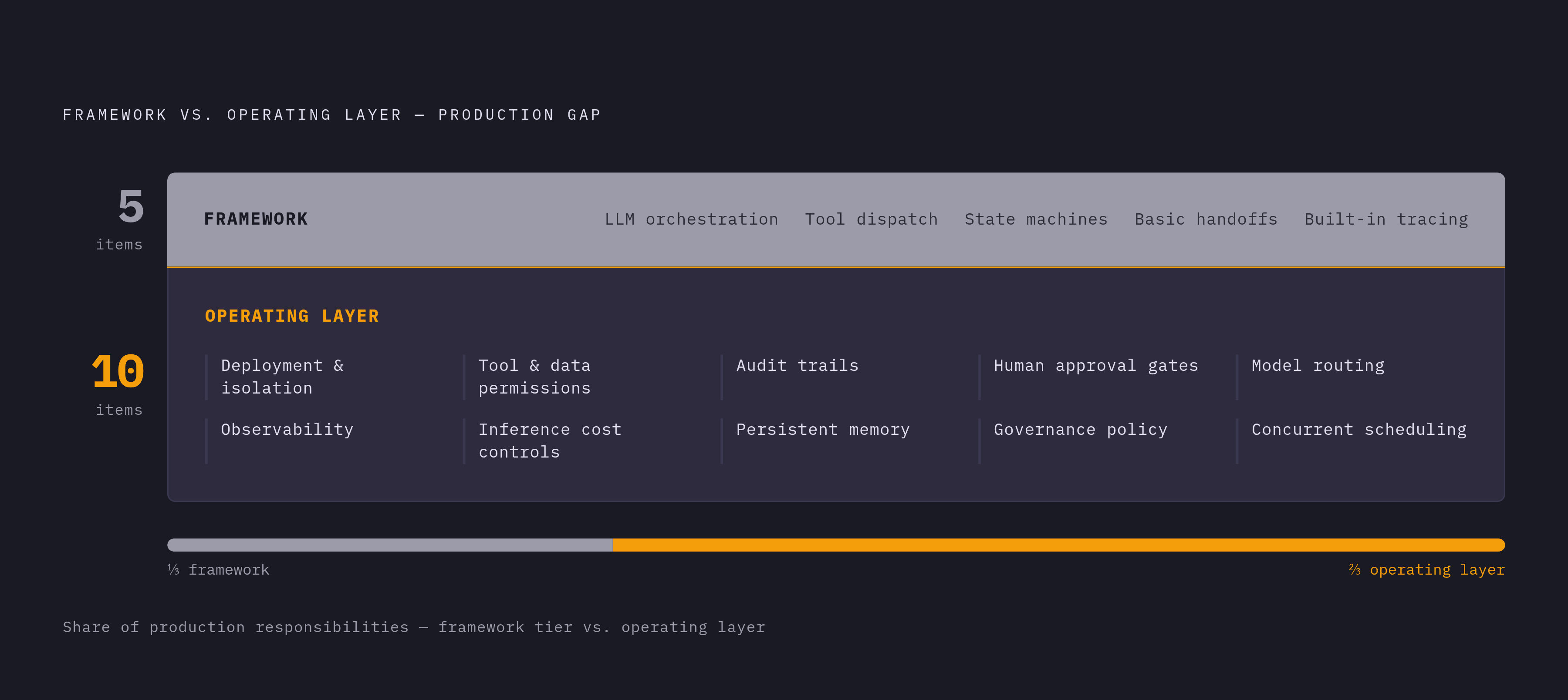
An agent framework organizes the cycle of LLM call, tool invocation, and observation. In the leading frameworks as of 2026, orchestration, graph-based state machines, tool dispatch, and basic handoffs are mature capabilities. They let teams say what an agent should do without rebuilding the loop for each application. That is useful work, and different frameworks approach it with different strengths. Saying how an agent should behave and running a complete production system are separate jobs.
OpenAI Agents SDK, shipped in March 2025 as the successor to Swarm, centers on agents, tools, and handoffs, with built-in tracing. Its provider-agnostic design comes with a qualification, since its tracing dashboard and hosted tools are tightly coupled to OpenAI's stack. LlamaIndex is document-first, and production teams frequently use it for retrieval beneath another orchestrator. Haystack provides pipeline-style, serializable workflows with an explicit audit trail, while Google ADK supports multi-agent orchestration with native Agent-to-Agent (A2A) protocol support.
Latency, auditability, model portability, and the team's language stack can each determine which framework makes sense. Some frameworks already supply pieces of the operating layer, so the distinction is not that every operational feature is absent. It is that those pieces do not amount to ownership of the whole system.
Why the demo looks cheap and the production system does not
A successful demo proves that the agent logic can work. It does not prove that deployment is isolated, access is controlled, or a decision can be reconstructed for an auditor. Nor does it show that a human approval process will work when an agent pauses and waits. Those are different claims, requiring different infrastructure. The economic mistake is treating proof of the first claim as evidence that the others are nearly finished.
The engineering team must assemble the operating layer and maintain it for as long as the agent remains in service. None of that work needs to be exotic to be expensive. Its cost comes from the number of responsibilities involved and their persistence after launch.
After the initial build ends, platform maintenance keeps drawing on senior engineers who could otherwise be building the organization's differentiated product. That is why the price of a prototype is a poor guide to the cost of a production system. The invisible part of the iceberg becomes visible only after the demo.
The specific operational costs a framework never mentions
Deployment and isolation determine where models run and how one team's agent is kept away from another team's data. In regulated or on-premises settings, this requires infrastructure engineering. Tool and data access add a permissions system that must account for the agent, the user invoking it, the tool, and the records involved.
Audit trails add a separate burden. A reconstructable record needs to connect the documents read, tools called, recommendations made, and human approvals or overrides. Human approval gates then need a workflow with its own routing, state, timeouts, and escalation.
Model routing needs logic that chooses among models based on the task, how sensitive it is, and what it costs. Observability needs logs, traces, and monitoring that help explain why a non-deterministic system did what it did. Inference adds to the bill because teams pay for failed runs and oversized context windows too. Runaway loops and retry storms can reach the inference bill before anyone notices. These costs arrive on different timelines, which helps explain why the first budget often misses them.
How the tax compounds: patching, deprecation, and project abandonment
The team has no control over when security advisories, interface breaks, and deprecations arrive. Changing orchestration can mean rewriting state schemas, nodes, and edges. Maintenance therefore means keeping the current system working well and changing it when others outside the organization make decisions that affect it.
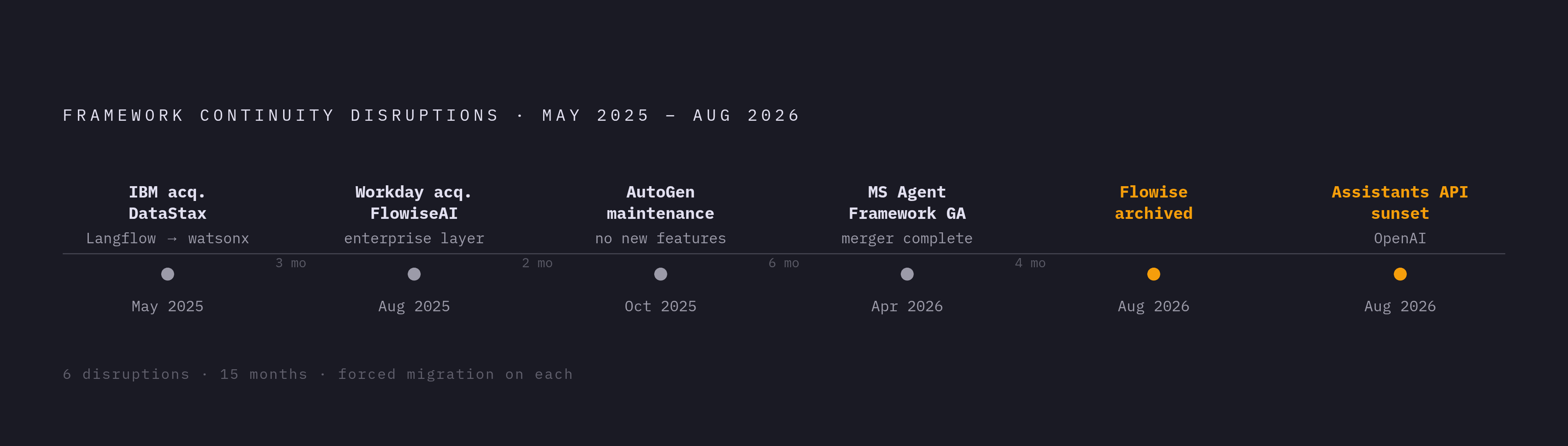
Project continuity makes that exposure concrete. AutoGen entered maintenance mode on October 2, 2025, and receives no new features, with the Microsoft Agent Framework merger reaching GA on April 3, 2026. OpenAI sunset the Assistants API on August 26, 2026. Flowise was archived in August 2026. Teams built around those projects or interfaces face migration work that was not part of the original agent logic.
Ownership changes create another source of uncertainty. IBM's acquisition of DataStax in May 2025 moved Langflow into IBM's watsonx orbit. Workday acquired FlowiseAI in August 2025, positioning it as the agent-builder layer for the Workday platform before sunsetting the standalone product in August 2026. These events show why continuity belongs in the cost calculation. Inside the team, a related risk accumulates when the reasons behind bespoke glue code live mainly in the engineers who wrote it.
Memory and persistent state: the layer frameworks hand off but agents can't live without
Memory is especially easy to misunderstand because a single-session demo can hide its absence. Context management determines what enters the LLM's finite context window for one inference. Memory management stores and retrieves knowledge across sessions. The first is an immediate operating concern, while the second is a persistent architectural one. Mixing them up leads to agents that either forget work in progress or fill their context with information that was poorly chosen.
Production teams in 2026 pair layers to cover those separate needs. LangGraph's PostgresSaver provides thread-scoped checkpointing and replay for fault tolerance, human-in-the-loop interrupts, and crash recovery. A separate memory layer such as Mem0 or Letta keeps facts that need to last across sessions. Checkpointing a thread and preserving useful knowledge are related, but one does not replace the other.
Letta makes the distinction visible through its architecture. The agent executes memory-management functions as tool calls, deciding what to summarize, move to archival, or drop when context fills. That differs from a static retrieval pipeline and makes memory management part of the agent's behavior. With either approach, the operating system still needs persistent state that lasts beyond the current exchange. Without it, an agent may reason well within a turn but cannot accumulate the context needed for ongoing work.
The governance and compliance multiplier in regulated environments
For regulated organizations, the operating layer is a condition of deployment. An agent can perform its task correctly in a demo and still lack what makes the use case approvable. Credit decisioning makes the gap clear. The EU AI Act classifies AI systems used to evaluate creditworthiness as high-risk and mandates human oversight mechanisms, record-keeping, and transparency. Teams need more than an agent loop to keep the logs, run the oversight process, and provide the documentation those requirements call for.
Security adds another set of obligations. The OWASP Top 10 for Agentic Applications, published in December 2025, names ten risk classes specific to agentic systems. They include goal hijacking, tool misuse, identity & privilege abuse, memory & context poisoning, insecure inter-agent communication, and cascading failures. A governed production system needs answers to the full taxonomy.
Microsoft's Agent Governance Toolkit is an open-source project released under MIT license that brings runtime security governance to autonomous AI agents. It shows that governance is a layer of work beyond orchestration that others have recognized too. Open source can help supply that layer, but the team still has to integrate and operate it. As the workload becomes more consequential, governance takes a larger share of total cost, and the framework handles a smaller share of the work required to deploy the system.
The concurrent-agent problem: operational complexity that only appears at scale
A single-agent demo leaves the problems of concurrency untested. Agents working in shared repositories or infrastructure can operate on overlapping scopes. At that point, the question is no longer just whether each agent can finish its task. It is also whether their work can coexist without creating conflicts that the surrounding process cannot handle.
They used exact temporal overlap to identify co-active agent-authored PR pairs and found that those pairs made up 79.4% of all AI-agent-authored PRs in the dataset. Most co-active pairs were authored by the same agent. The finding establishes substantial temporal overlap within that dataset.
The operational concern is that concurrent tool calls, shared-state writes, and overlapping work require isolation and scheduling above the loop. Verbose inter-agent message-passing can also increase token use compared with A2A-native approaches at equivalent task complexity. Proactive execution adds another responsibility because agents acting on a timetable need scheduling infrastructure absent from most framework defaults. As more agents are used, teams need to coordinate how they run together as well as design each agent.
What an agent operating system actually provides that a framework does not
An agent operating system is a software infrastructure layer that manages scheduling, memory management, tool orchestration, governance policy enforcement, and observability. Its purpose is to support concurrent agents across environments. In this framing, a framework resembles a user-space library more than the operating system beneath it. The library helps express behavior, while the runtime controls execution.
Operators need to retain identity, isolation, audit, and rollback controls in a policy-controlled execution environment. An Ubuntu VM with a properly confined agent runtime can fit that definition better than a labeled agent operating system that gives one process broad shell access. Persistent memory, proactive scheduling, and concurrent-agent coordination need to be built into that environment from the start.
The 2026 runtime market offers several approaches. Managed hyperscaler runtimes include AWS Bedrock AgentCore, Google Vertex AI Agent Engine, and Azure AI Foundry Agent Service. Framework-native platforms include LangGraph Platform and OpenAI Agents SDK, while sandbox and serverless options include Modal, Daytona, Fly.io Machines, and Cloudflare Agents. These categories are not interchangeable guarantees of completeness. A2A, governed by the Linux Foundation, serves another part of the architecture by letting separate agentic applications find out what others can do through Agent Cards and delegate tasks, while execution controls are still needed.
Running the build-vs-buy comparison honestly
A fair comparison looks at the total cost of ownership over several years for both choices. A two-week demo and a platform license are not equivalent purchases. The useful questions concern who owns failures at 2 a.m., how much senior engineering capacity the system will occupy, and what happens when its builders leave. If the internal team owns production support, that is a continuing on-call and maintenance commitment. It belongs in the comparison from the start.
Teams must assess whether the work differentiates the product or rebuilds plumbing. Access control, audit trails, and model routing rarely help a product beat its rivals on their own. A platform's economic case is therefore not that an internal team lacks the ability to build them. It is that buying the operating layer can return those engineers to work that does distinguish the product.
Framework-first can make sense when development is under six months, dedicated ML infrastructure engineers are available, inference volume keeps retry overhead immaterial, and governance requirements are light. When those conditions change, the calculation needs to change with them. The constructive choice is an explicit decision about who will own the operating layer, what that ownership costs over time, and which commitment best serves the work the agents are meant to do.