LLM Provider Failover and Routing in Agent Infrastructure
Autonomous agents need stateful failover, not the stateless design built for single requests.
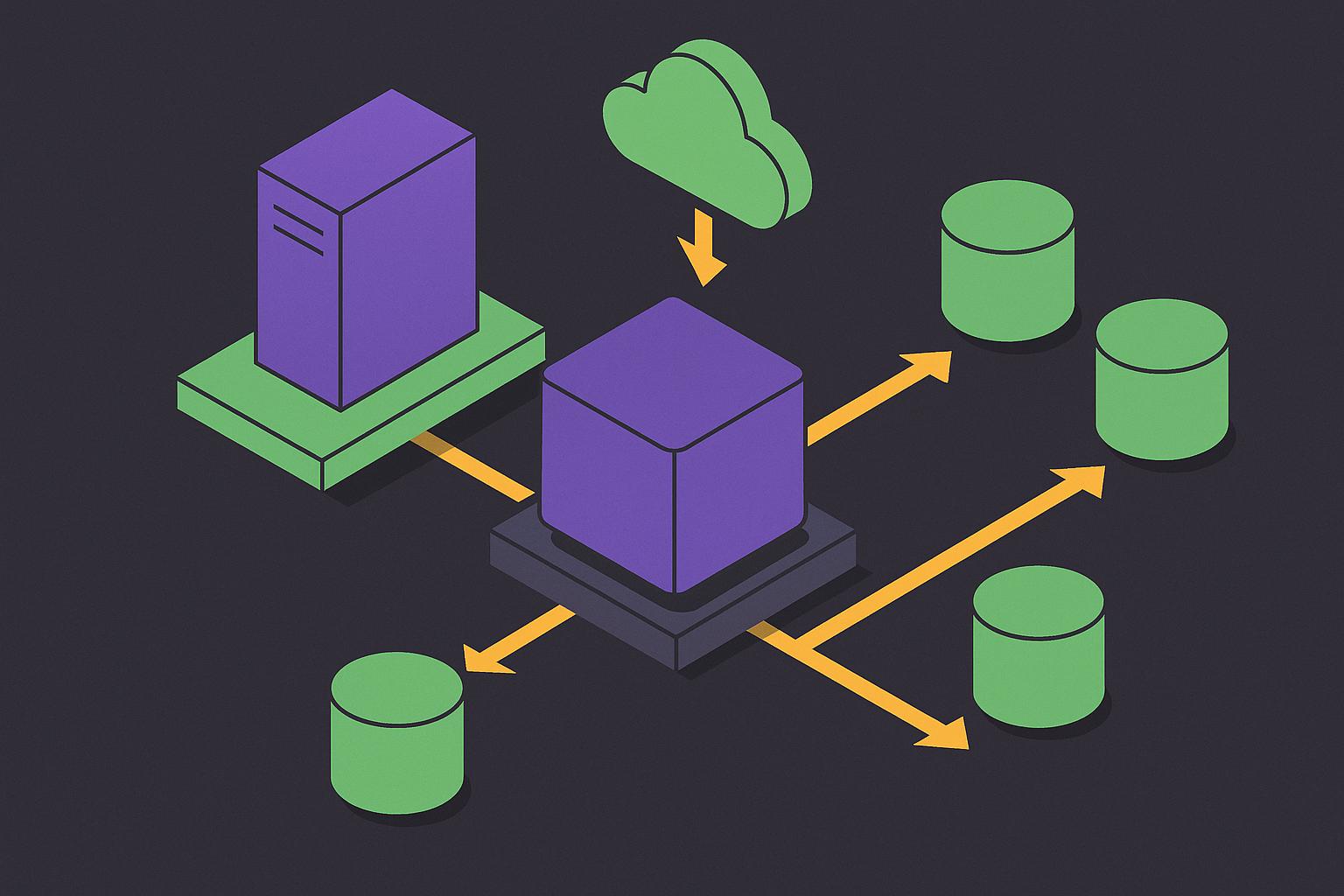
The standard model for LLM failover was built for a world where each request stands alone. A call fails, a backup provider picks it up, the answer comes back, and nothing about that exchange needs to be remembered afterward. That design made sense when a typical interaction was just one prompt and one completion, so self-contained that swapping providers mid-flight carried no risk, because there was nothing to lose.
Autonomous agents don't work that way. A single agent task can span dozens of calls to a model, hold onto a growing conversation history, call out to tools, hand work off to other agents, and carry half-finished reasoning that never gets written down between one call and the next. The agent is routing a goal it is still figuring out how to reach, built step by step as it runs: forming a plan, picking a model, calling a tool, revising an assumption, taking an action in the world, all before the task counts as done.
Firing a failover in the middle of that process doesn't behave like a clean retry. Control passes to a new provider that has no idea what the agent already decided, already tried, or already assumed. The backup model answers the request in front of it correctly. It just has no memory of the nineteen steps that came before, and for an agent mid-task, that gap can decide whether the job finishes or quietly goes off the rails.
How multi-provider gateways fail in practice
Multi-provider gateways route, load-balance, and rate-limit traffic across multiple model providers, and by now you can count them as critical production infrastructure. The trouble is that nobody had mapped out how these systems actually fail. Each team ran into the same problems on its own, through its own outages, with no shared vocabulary to describe what had gone wrong. A research effort called FailureAtlas set out to close that gap, building a two-axis taxonomy that sorts gateway failures by where they originate and by how visible they are.
The first axis covers the whole stack: Network/Transport, Streaming/Protocol, State/Session, Model Behavior, and Governance/Cost. Each layer fails in its own way, from a dropped connection to a silently corrupted tool call. The second axis is the one that actually determines how dangerous a failure turns out to be in production: Loud failures trip alarms and return error codes, something any on-call engineer would catch within minutes. Silent failures return HTTP 200 and sail through every standard health check, but they corrupt application state, so only semantic-level observability can catch them.
FailureAtlas documents two cases, and both came out of first-hand evaluation work. The first is a concurrency race condition in how conversation state gets managed. Two coroutines serving the same session each read the conversation history, appended a new turn, called the model, and wrote the history back. The second writer overwrote the first writer's contribution without any warning. Turns disappeared from the context window and the model's output quality dropped, but every request still came back as HTTP 200. No metric, not latency, not error rate, not pod health, registered anything wrong.
The second case is a retry storm. An upstream provider returned a transient 502, and every parallel evaluation agent retried on the same fixed interval. Those retries synchronized into a thundering herd, saturating the provider's rate limit on every retry window, and a meaningful share of requests failed permanently even though the original problem had already passed. FailureAtlas classifies this one as loud: infrastructure monitoring could, in principle, have caught it. The race condition is different. The race condition showed up only in semantic continuity metrics, specifically a drop in persona adherence, something standard dashboards never would have flagged. That asymmetry is the whole point: a gateway reporting green across every metric it tracks can still be quietly destroying the state an agent depends on.
Why agent sessions compound existing gateway failure modes
Agent workloads don't just inherit these failure modes. They make each one worse, because the unit of value shifts from the response to the session. Losing state partway through a stateless request degrades one answer. If an agent session loses state partway through, that can invalidate everything the agent has done up to that point, including actions it already took in the outside world.
State/Session failures are the most dangerous silent category in the FailureAtlas taxonomy, and they become more likely as agent workloads grow, not less. Agent tasks are running longer. Serving systems increasingly treat context compaction as routine, load-bearing infrastructure, a sign that sessions now regularly outlive a single context window. Multi-hop pipelines add more failure surface on top of that: every time control passes from one agent to another, the receiving agent rebuilds its understanding from a prompt string and drops whatever intermediate state the sender was carrying. A production study on memory failures, cited in the research surrounding FailureAtlas, found that at the scale of months-long deployments, the failures that actually matter are memory failures: knowledge loss, documentation going stale, degradation that happens without ever throwing an error.
Governance and cost failures take on a different shape here too. A failover that quietly routes to a pricier model, or one with a different tool-call schema, might look like a perfectly normal network event from the gateway's point of view, but it can produce agent behavior downstream that's wrong or unsafe. Streaming failures carry more weight as well, since agents often parse tool-call payloads mid-stream. FailureAtlas documents a streaming index collision that corrupted tool-call payloads: in a stateless setting that produces one bad response, but in an agent session it can corrupt the agent's tool-calling logic for the rest of the task.
Thundering herd dynamics hit harder in multi-agent pipelines. If a shared upstream incident hits, every agent in a pool can synchronize its retries at once. That coordinated load adds pressure back onto the provider that's already struggling, turning the failure into a cascade. What would have been a contained, momentary blip turns into a pipeline-wide event.
Routing strategies production teams use, and where each one breaks for agents
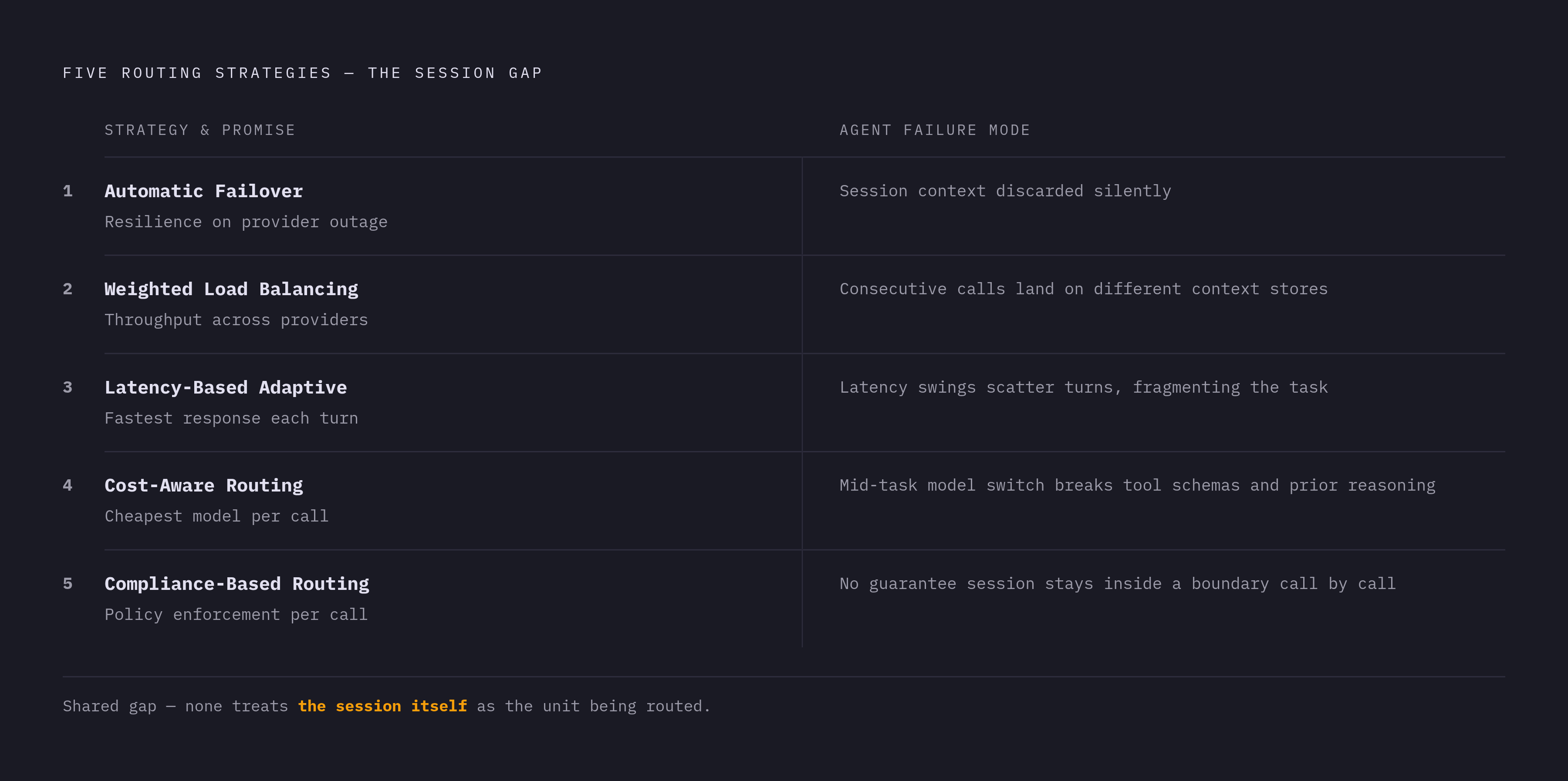
Five routing strategies cover most of what production teams reach for today, and none of them were built with agent sessions in mind. Each one solves a real problem. Each one also carries an assumption tied to the thing being routed being a single request, and a multi-step agent task breaks that assumption.
Automatic failover is the baseline, and it's the most widely adopted of the five. It discards session context without telling anyone, because it was never built to carry that context in the first place, which makes it useful for stateless traffic and risky for agents.
Weighted load balancing spreads traffic across providers according to configured weights, which keeps any single endpoint from saturating under rate limits. But it gives no guarantee that two consecutive calls inside the same agent session land on a provider that shares the session's accumulated context. Latency-based adaptive routing sends traffic to whichever provider is performing best right now, which is a sound way to optimize response time for isolated requests. Applied to an agent session, it can scatter successive turns across different providers based on momentary latency swings, fragmenting a task across providers that share nothing.
Cost-aware routing shifts traffic toward cheaper providers as a budget gets consumed, and the risk it introduces is specific: a cheaper model that fails the task can end up costing more in retries than it ever saved in tokens. For agents that risk compounds, because a mid-task model switch can change tool-call schemas or context formatting, and that can invalidate reasoning the agent already completed. Conditional and compliance-based routing, which sends traffic by team, tier, region, or data-residency rule, comes closest to being semantically aware. It still operates one request at a time, though, with no mechanism to guarantee that an entire agent session stays inside a policy boundary once routing decisions start varying call by call.
In practice, most teams stack these strategies rather than pick one: failover sits under weighted balancing, which sits under cost rules. Stacking doesn't close the gap underneath them. None of these five strategies treats the session itself as what gets routed.
Provider outages are now frequent enough that "design for failover" is not optional
Provider incidents aren't rare events anymore, they're a recurring operating condition. The Cloudflare outage in November 2025 cascaded into ChatGPT, Sora, and a wide set of other AI services that depended on it. A rate-limit incident on Gemini 2.0 Flash in February 2025 knocked one team's evaluation pipeline offline for an extended stretch.
The pattern across incidents like these holds steady: teams with no routing layer between their application and the upstream model had no automated path back to normal operation. Recovery meant manual intervention, a new deployment, or someone running a runbook by hand, so it added tens of minutes of extra downtime on top of whatever the provider itself caused.
For agent workloads, the math gets harder to ignore. Any agent task that runs long enough will, at some statistical point, run into a provider incident somewhere in the middle of its execution. Any agent task running unattended for more than a few minutes at a time needs session-aware failover as a basic requirement, not just a nice architectural touch.
Agent-aware failover infrastructure needs
Agent-aware failover starts from a different unit of analysis: the session, not the request. Every other design decision follows from that one shift.
Session state has to be durable before failover ever fires. Conversation history, tool-call state, and whatever intermediate reasoning the agent is holding need to be written to storage that survives a provider swap. Skipping that step turns a failover into a reset dressed up as a recovery.
Recovery needs semantic verification, not just a status code. An HTTP 200 from a backup provider says the request succeeded. It says nothing about whether that provider actually got the session's context and read it correctly. Confirming that requires semantic-level observability, the kind that watches for things like persona drift, not just the latency and error-rate dashboards most teams already have running.
Provider capability has to match at the moment failover happens. A backup provider that doesn't support the tool schema, context window, or model capability the session depends on will corrupt that session the moment it accepts the request, whether or not it returns an error.
Retries need idempotency carried through them. Agent actions that touch the outside world, a database write, a message sent, a pull request opened, can't get replayed just because a retry fired. Idempotency keys need to travel with the session through every failover, so a corrupted retry doesn't turn into a duplicated action.
Budget and governance rules need to scope to the session, not the request. Those budget and rate limits must apply across the whole task, so a failover that lands on a pricier provider still respects whatever was set for that agent's workload even after it resets with each call.
Streaming has to survive a mid-stream failover. If agents extract tool calls from a live stream, the gateway needs to buffer and sequence those stream segments, letting it resume where it left off when a provider fails partway through. The streaming index collision FailureAtlas documents is what happens when a gateway lacks this mechanism.
How current gateway tools map to these requirements
The gateway market has largely settled on a shared set of capabilities for request-level failover. Coverage of session-level, agent-specific requirements is a lot less consistent, and the real differences between tools show up there.
Bifrost, the open-source, Go-based gateway from Maxim AI, goes furthest on raw failover depth. It supports fallbacks at the provider level, the model level, and the key level, backed by a four-state health machine (Healthy, Degraded, Failed, Recovering) that drives adaptive, health-aware routing, along with cluster-mode failover for larger deployments. It adds a native MCP gateway for tool orchestration, hierarchical budget governance through virtual keys, and semantic caching on top of that. It's self-hostable under Apache 2.0, and air-gapped deployment is available for teams that need it, but in-VPC support sits behind the separately licensed Enterprise tier. Benchmarks put its overhead at 11 microseconds under high sustained load, so you can see how little friction the gateway adds at the transport layer.
What Bifrost doesn't document as first-class capabilities are the two requirements that matter most for agent sessions specifically: session-state durability before a failover fires, and semantic continuity verification after one lands. Those aren't failures of design so much as evidence of where the whole category still has room to grow. The tools available today were built to solve request-level failover well, and several of them solve it very well. The session as the unit of routing, with durability, semantic verification, and capability matching built in as standard rather than bolted on, is still the layer the infrastructure hasn't fully caught up to yet.
Sources
- FailureAtlas: A Taxonomy of Failure Modes in Multi-Provider LLM Serving Infrastructure
- ContinuityBench: A Benchmark and Systems Study of Stateful Failover in Multi-Provider LLM Routing
- ContinuityBench: A Benchmark and Systems Study of Stateful Failover in Multi-Provider LLM Routing
- From Conventional Multi-Vendor Failover to Adaptive API Routing: An Industrial Experience Report on Resilient Third-Party Service Integration
- [2501.12469] An Empirical Characterization of Outages and Incidents in Public Services for Large Language Models