Managed LLM Gateways vs. Direct Provider Integration for Agent Systems
Gateway control over routing and policy becomes essential as agent fleets scale beyond prototypes.
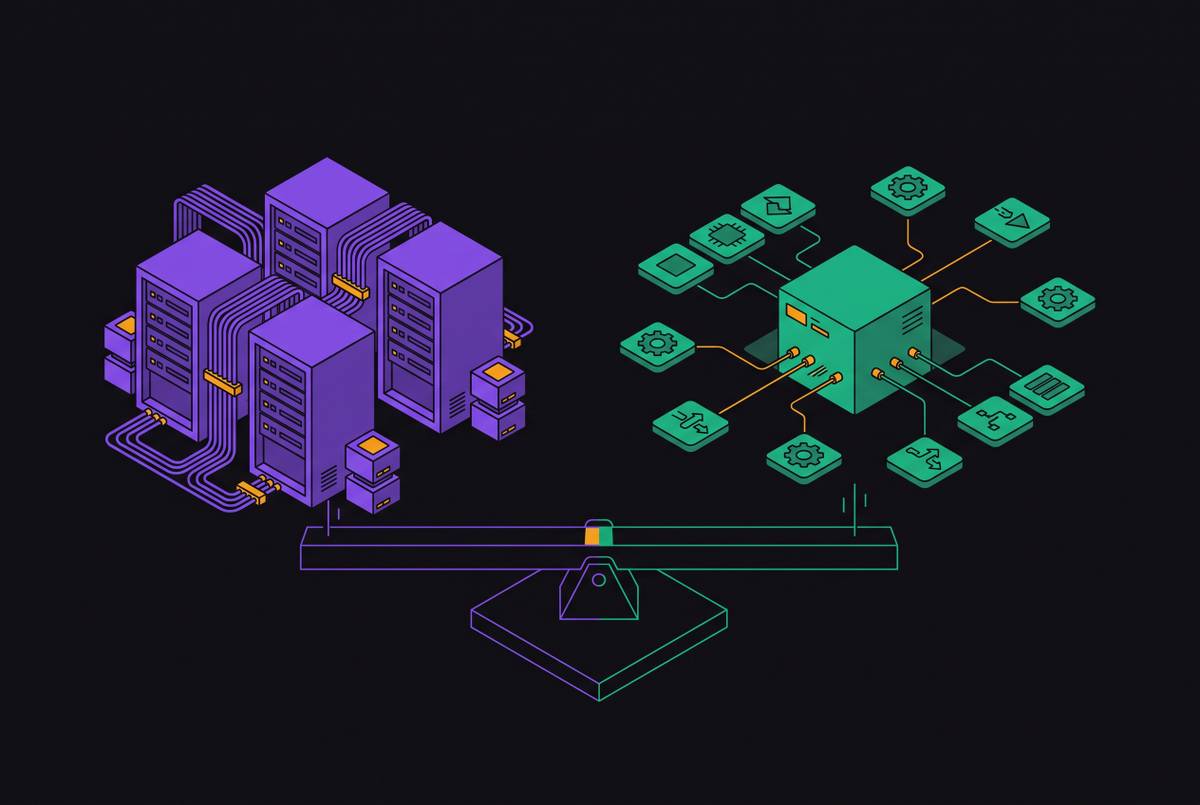
Direct provider integration and managed LLM gateways serve different units of work. A direct API connection suits a single-app prototype, but an agent fleet needs shared control over model calls, tool use, cost, and policy. The architectural choice turns on where that control lives. A gateway provides the common request path, while intentional memory management and an agent runtime complete the execution loop.
Why direct provider integration is workable for a single app but not for an agent fleet
For a prototype calling one model from one provider, direct API integration is the correct choice. It adds no gateway infrastructure or operational overhead, and the request path is clear. The application sends a request and receives a response. At that stage, shared routing and governance would solve problems the application does not yet have. Simplicity is a sound starting point here.
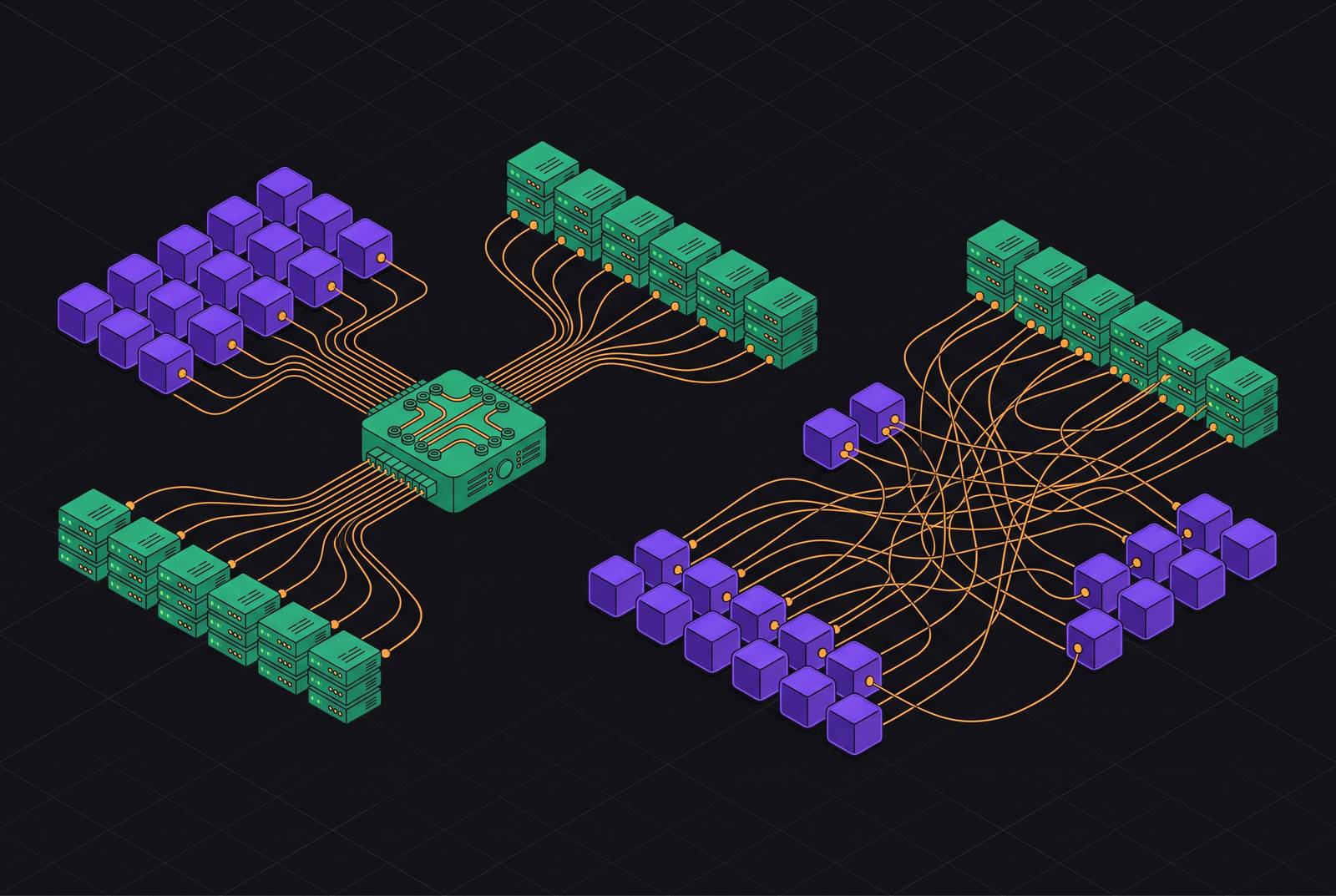
The pressure changes when the application succeeds. Its original model becomes too expensive for high-volume requests, another model proves better for reasoning tasks, or the primary provider enforces rate limits during peak traffic. Each consuming service then needs its own changes. Once those services have multi-provider routing, fallback logic, and cost controls, the team is building gateway infrastructure inside application code. That infrastructure may still lack a common home.
Agents make this distinction sharper because their work extends beyond a request and a response. An autonomous agent constructs a plan, chooses a model, retrieves context, invokes tools, delegates subtasks, revises assumptions, and takes external actions. Part of its execution path emerges at runtime. Adding another agent therefore adds more than another API consumer when credentials, failover, and cost tracking remain local to each agent. The decisive unit of work is the whole goal-directed execution loop.
The four structural failures direct integration produces at agent scale
API fragmentation, cascading provider outages, uncontrolled token spend, and absent governance share one root cause. Logic that belongs in a common layer is scattered across agents. These failures are structural. A team can implement each control correctly in one agent without gaining consistent control over the fleet.
API fragmentation begins with differences in request structures, response shapes, authentication schemes, error formats, and parameter names. Each connection between a provider and an agent needs its own upkeep. A provider switch can turn a routing change into changes across every consuming service. As the fleet grows, the burden follows those connections.
Outages expose the same fragmentation under pressure. Without shared routing, a provider outage or rate-limit spike reaches every agent using that provider at once. Load balancing and fallback must then be implemented in application code. Yet failover has a boundary even with a gateway. Failure before streaming begins can be handled transparently, while a failure after tokens have been sent still requires application-level handling.
Token spend and governance fail less visibly. Without central attribution by agent, team, or model, the invoice can become the first clear sign of runaway consumption. Meanwhile, PII redaction, content guardrails, model allowlists, and access control must be implemented independently in every agent. How can operators audit a policy that has many separate implementations?
How a managed gateway layer resolves each failure mode at the infrastructure level
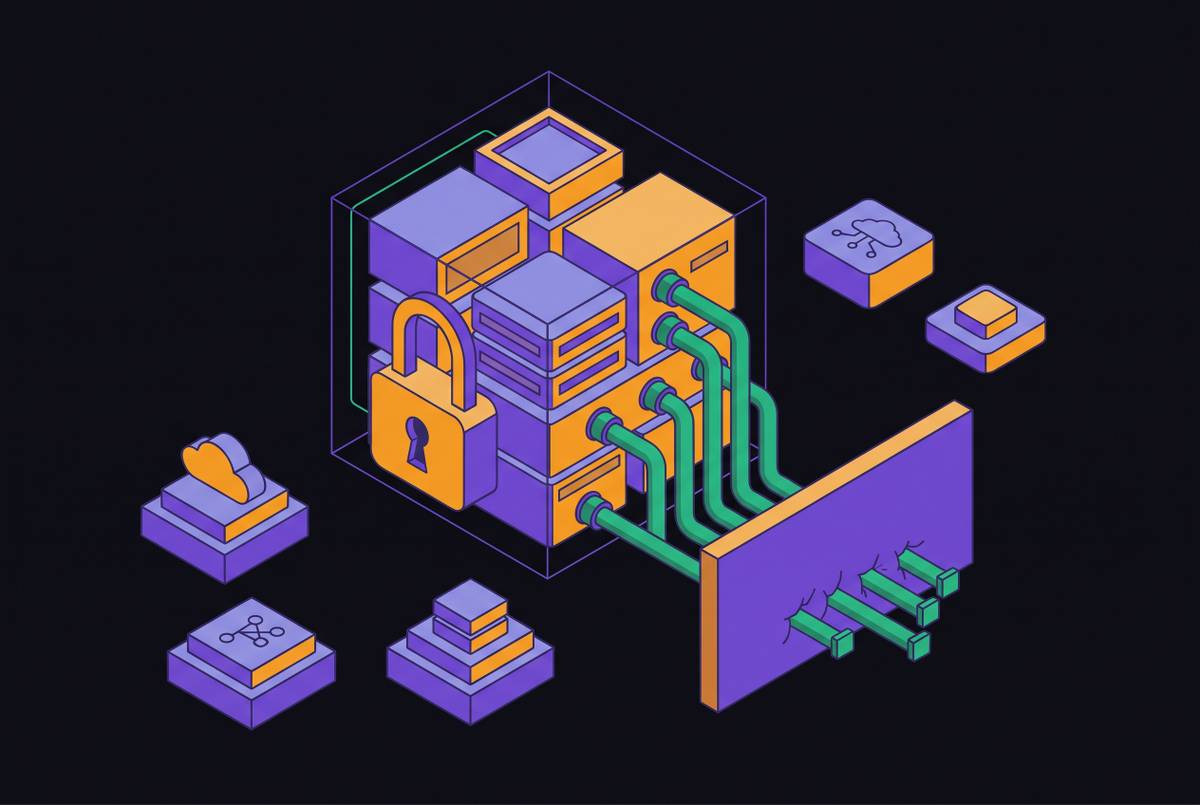
A managed LLM gateway is a reverse proxy built for LLM API traffic. It moves routing, failover, cost governance, and policy enforcement into a centralized request path. Here, “managed” describes shared controls independently of where the service runs. These capabilities belong to the gateway pattern, whether a team operates the gateway itself or uses a vendor-managed service.
A unified API addresses fragmentation by normalizing provider requests through one OpenAI-compatible endpoint. Switching models changes a parameter while leaving the integration intact. Automatic fallback chains then address provider downtime, rate limits, and degraded performance by routing requests to an available alternative. Some gateways also support strategies based on latency, cost, or model capability. The streaming boundary still applies to these controls.
Teams can control cost as they handle requests, before they review the invoice. Per-key or per-team spending caps, configurable alerts, and per-request cost breakdowns provide both attribution and limits. Cost-based routing can send large amounts of work where cost matters to cheaper providers and keep more capable models for requests where quality matters most. PII redaction, content guardrails, model allowlists, and access controls likewise run in the shared path before data reaches an external provider.
Centralization also gives operators a common debugging surface. Latency, token counts, and provider error rates accumulate where requests pass, without separate instrumentation in each agent for those request-level measures. Traces can show which prompt went to which provider, what returned, and how long the call took. But that visibility ends at the traffic the gateway handles. For agents, model calls are only part of the work that needs governing.
Why agent workloads demand an MCP gateway layer on top of an LLM gateway
An LLM gateway governs model requests, while agents also generate tool traffic through the Model Context Protocol, or MCP. Without a common tool entry point, each connection between an agent and a tool needs to be secured, watched, and kept working. This is the N×M integration problem. Each new agent adds connections to tools, and each new tool adds connections to agents.
An MCP gateway collapses those connections into a governed entry point, but its performance becomes part of workflow performance. Agents can make dozens or hundreds of tool calls in a session. Even at twenty calls per complex workflow, modest per-call overhead accumulates before the agent processes results. An agent gateway therefore has a broader role than routing individual model requests. It supports workflows in which models make successive decisions, invoke tools, and call models again.
Kong AI Gateway controls GenAI and MCP flow with existing services, including vector databases and event streaming. Its guardrail plugins include prompt guards, a PII sanitizer, and integrations with AWS Bedrock Guardrails, Azure AI Content Safety, GCP Model Armor, and Lakera Guard. Amazon Bedrock AgentCore Gateway provides a fully managed entry point that converts APIs, Lambda functions, and existing services into MCP-compatible tools. It also fronts other agents, routes inference across providers, and handles inbound and outbound authentication with semantic tool search.
TrueFoundry's LLM Gateway provides routing, caching, cost tracking, failover, and built-in observability. LiteLLM combines a Python SDK with a Rust core and a proxy exposing 100+ LLM APIs in the OpenAI format. It supports retries, fallbacks, load balancing, virtual keys, spend tracking, guardrails, caching, and an MCP gateway. These capabilities are not an interchangeable feature checklist. The architecture must bring both model and tool traffic under the controls the fleet requires.
How agent memory failures compound the cost of missing gateway infrastructure
A wrong answer can begin before the model receives a request. An agent may pull in the wrong facts, lose a constraint during summarization, or leave parts out of the context window. Without a central record of the context passed on each call, operators struggle to distinguish those failures from poor model reasoning. The request path is therefore also an evidence path. Its traces help show which layer needs to be fixed.
Context management determines what enters the active window for one inference call, while memory management stores and retrieves knowledge across sessions and tasks. Working memory holds the current context, external key-value memory provides structured facts, episodic logs preserve reusable outcomes, and semantic vector memory supports similarity-based retrieval over unstructured knowledge. Each tier has a different purpose and cost profile. Building only one leaves gaps that a gateway cannot fill.
Rolling summaries reduce tokens across long sessions, while checkpoint snapshots support exact state recovery after interruption. Episodic memory reuses prior outcomes, and fact extraction preserves stable constraints that should not be recomputed. Selective retrieval brings in prior steps when the current task needs them, rather than injecting the whole history on every call.
Those choices become difficult to diagnose when context is assembled independently inside each agent. There may be no shared record of what was retrieved, summarized, or dropped. A gateway that traces the context actually passed supplies evidence for distinguishing a context failure from a model failure. It still leaves the need for memory architecture and can show only some of the internal retrieval decisions. Instead, centralized request traces give that architecture an observable boundary, so operators can investigate the right part of the execution loop.
The self-hosted vs. managed deployment decision for regulated and high-throughput agent teams
Whether prompts cross a vendor's network is a compliance and trust boundary. For regulated teams, in-VPC deployment often settles that question before performance or feature breadth enters the discussion. High-throughput teams must also account for operating and scaling the shared request path.
Five dimensions expose the trade-off. The prompt and response path sets whose infrastructure handles the traffic, and air-gapped operation needs every model behind the gateway to be local. Managed cloud gateways cannot provide that isolation. Patching and scaling belong to the team in a self-hosted deployment and to the vendor in a managed one. Credential custody and log routing complete the picture, distinguishing a team's own secret store and SIEM from vendor-held credentials and a vendor console.
Self-hosting gives teams control over the gateway deployment, but keeping model traffic internal also depends on the models it calls. Bifrost's self-hosted gateway can run through a binary, Docker, or Kubernetes, while LiteLLM provides a Docker-deployable proxy. That flexibility comes with maintenance and engineering work. Managed services reduce the operational burden and can shorten time-to-production for teams without dedicated platform engineers. AgentCore is one fully managed example.
Within those constraints, eight criteria give the evaluation substance. They are measured overhead at realistic production loads, provider coverage and SDK compatibility, failover and routing, governance depth, native MCP support, observability, deployment model, and open-source posture. Governance includes virtual keys, budgets, rate limits, and per-team access control, while observability includes OpenTelemetry and compatibility with existing APM tools. License terms also affect the choice. LiteLLM has a core under a permissive open-source license, with enterprise features under a separate commercial license.
What agent infrastructure designed from first principles looks like in production
Production agent systems show why coordination, memory, and governed calls belong in the same architectural discussion. incident.io's multi-agent system searches GitHub or GitLab pull requests, Slack messages, historical incidents, logs, metrics, and traces to build root-cause hypotheses and deliver reports in Slack. That work cannot be reduced to one prompt. In the AWS DevOps Agent case, a CloudWatch alarm for elevated 5xx errors triggered an investigation that identified DynamoDB write throttling caused by a recent deployment. The agent posted what it found about the root cause and how to mitigate it to Slack in under five minutes, with no human help.
The internal security investigation system at Slack illustrates the value of decomposition. Work was split into separate model calls, each with one job, its own context and tools, and a required output format. Structured output made inter-agent communication closer to an API contract than a conversation. The application orchestration layer decided what ran next and what context it received. Independent observability and governance make that division operable.
Cleo Health demonstrates the demands of long-running investigation. Its agents query logs, APM traces, RUM session data, and database metrics, choosing signals according to the issue under investigation. Root-cause analysis took minutes where it had taken hours. This dynamic selection calls for persistent session memory and governed tool access, rather than a fixed sequence of isolated model requests.
The Hierarchical Supervisor Pattern provides a reference structure for such work. A central Supervisor delegates to specialized Coder, Researcher, and Analyst agents, each completing its loop and reporting back. Shared gateway controls let that division of labor grow without duplicating policy, cost attribution, and observability in each specialist. Beneath those controls, however, the system still needs lifecycle management, scheduling, identity, isolation, memory coordination, and rollback.
The 2026 arXiv Agent Operating System proposal formalizes these responsibilities as a Control & Governance Plane and a Runtime & Coordination Plane. The former covers intent, policy, trust, authority, auditability, observability, and human oversight. The latter covers agent lifecycle, workflow coordination, model and tool routing, context and memory, scheduling, traffic management, and runtime assurance. A managed gateway provides necessary shared infrastructure for the request path within a larger agent platform. The layer beneath it must let goal-directed systems keep working across calls, tools, and sessions.