Automating Business Operations With AI Orchestration Layers
Effective AI automation requires orchestration layers that coordinate tools, agents, and workflows.
Automating business operations with AI requires more than capable models. An AI orchestration layer coordinates tools, routes context, sequences agents, enforces policy, and recovers from failure across a complete workflow. For companies choosing business AI tools, the decisive question is whether the infrastructure can manage those handoffs.
Why AI automation stalls at the coordination layer, not the model layer
A customer service agent drafts a useful reply about a billing problem, then passes the ticket to a billing agent. The billing agent sends it back to ask for more detail. Both can do their own tasks, but the ticket goes nowhere because neither controls how the case gets resolved. Adding a more capable model does not establish who owns the next step.
The same pattern appears when an AI tool drafts an email but cannot coordinate sending it, updating the CRM, notifying the account team, and triggering work in a legacy ERP system. This is the “GenAI execution gap.” Generating the response is only one part of completing the business process. The rest requires shared context, permissions, sequencing, and recovery when a step fails.
Why not connect the tools with APIs and scripts? Those connections can move data, but moving it does not by itself coordinate model execution or adaptive agent behavior. A fraud model and a customer risk model can still evaluate the same transaction using different data snapshots. Their scores may differ because they used different inputs, even if their reasoning was sound. The structural gap is between AI capability and operational coordination.
What an AI orchestration layer actually is and where it sits in the stack
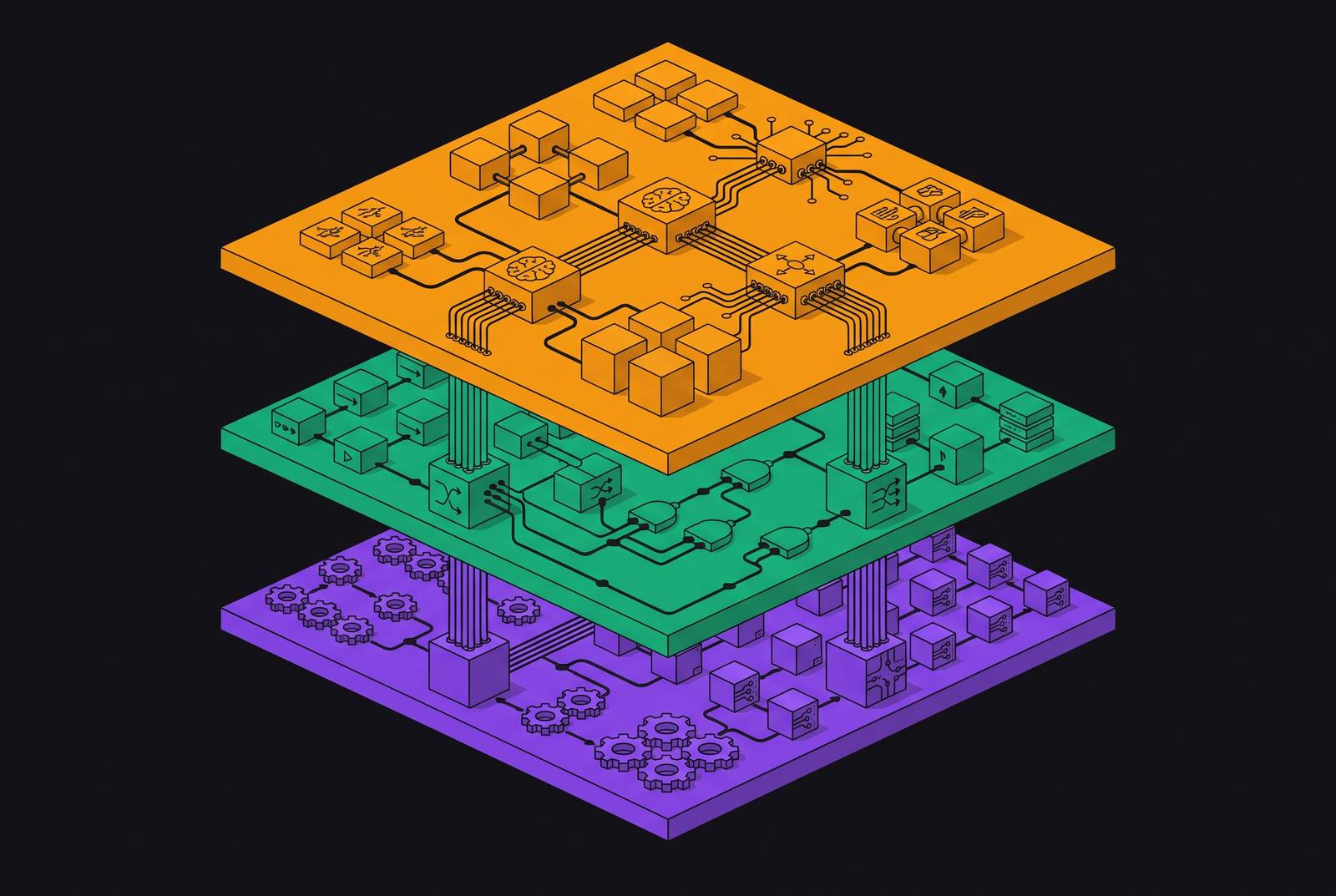
An AI orchestration layer is middleware that coordinates models, agents, data pipelines, APIs, and infrastructure to complete business workflows. It sits between the AI compute layer, where models and agents execute, and the application layer, where people interact with AI-powered tools. Its reach includes ML models, LLMs, databases, SaaS applications, vector databases, and compute infrastructure.
That position distinguishes orchestration from several adjacent technologies. ETL and data pipelines move and transform data, but do not coordinate agent behavior. MLOps manages model training, versioning, and deployment. RPA follows predefined scripts. Agent frameworks provide building blocks, but those blocks on their own do not govern work across the business or coordinate it across systems.
Orchestration coordinates these tools into an end-to-end process. Unlike fixed IF/THEN automation, it can use context to select a model or agent at runtime and escalate exceptions for review. It still has to follow policy and get the required approvals when making those choices. The terminology separates three different choices. A layer names the architectural position, a platform implements it, and a framework supplies a developer toolkit for building its logic.
The five mechanical jobs the orchestration layer does during a live workflow
Consider an invoice arriving by email. The orchestration platform extracts the document and routes it to a model for classification and data extraction. It then validates the extracted amounts against purchase orders in the ERP and flags discrepancies before any payment action. Each handoff belongs to the same governed workflow. The system knows where the invoice stands rather than treating each tool call as an unrelated request.
That path follows five mechanical jobs, namely trigger, planning, execution, validation, and delivery. The incoming email triggers work, while planning determines which tools to invoke and in what sequence. Execution makes the calls against models, data sources, and APIs. Validation places quality gates and human approval before high-stakes actions. Delivery returns the result with an audit trail, so completion includes both the output and a record of the process.
Five underlying components make those jobs possible. Integration hooks and data pipelines connect model endpoints, databases, and applications through APIs, function calling, and webhooks. For retrieval-augmented generation, or RAG, they coordinate document retrieval, relevance ranking, context assembly, and routing to the LLM. Without that coordination, context can be incomplete or inconsistent. Automation and scheduling then control progression through fixed directed acyclic graphs, event triggers, retries, or iterative agent loops.
State and memory management prevent business details from disappearing at a handoff. Monitoring and observability expose performance, errors, and workflow history so operators can explain what happened. Governance controls enforce access, policy, compliance reporting, and approval gates before action. Without these controls, a tool call that works as intended can still take a business action it has no permission to take. Retries, review checkpoints, and audit trails therefore belong in the workflow design.
How multi-agent architectures change what the orchestration layer must handle
A customer onboarding process may involve document processing, compliance verification, CRM updates, customer communication, and quality assurance agents. Each has a bounded role, but their work depends on decisions made elsewhere. The orchestration layer must assign tasks, sequence dependencies, transfer context, manage approvals, and handle exceptions across all five. More agents create more than extra tool calls. They introduce opportunities for duplicated actions, conflicting decisions, and failures that affect dependent work.
The customer service and billing deadlock illustrates the difference. A handoff mechanism merely allows the agents to exchange a ticket. Coordination must also determine responsibility and how the case progresses, including when an exception needs escalation. Shared workflow state lets the system preserve what has already happened instead of making each agent reconstruct the case from partial information.
Agent arrangement also changes where failures concentrate. The 2024–2025 generation largely used hub-and-spoke architectures, with a single orchestration point coordinating the agents. That gives coordination a central location, but it also concentrates dependency on that hub. A multi-agent design therefore needs to address failure isolation as well as task allocation. The workflow needs to keep going safely when one component fails, as well as let every agent communicate.
Memory and persistent state: what the orchestration layer must provide that agents cannot provide for themselves
A large context window is not persistent memory. Without a storage layer, the context from a conversation does not stay available as business knowledge after the session ends. Infrastructure for persistent memory becomes critical when work spans several sessions or days. The system must preserve both the current workflow position and the business context needed later.
Short-term, or working, memory is thread-scoped and tracks an ongoing workflow or conversation. LangGraph uses checkpointers to persist graph state within a session. Long-term memory has a different scope, persisting across sessions in namespaces beyond a single thread ID. It lets an agent retain context about work done for a customer last week. Both forms are needed when a process pauses and later resumes.
Protocols do not remove this storage responsibility either. The Model Context Protocol defines structured interfaces for tool invocation, while its 2026-07-28 revision makes the protocol core stateless. Cross-session memory belongs at the application or data layer. The emerging Agent-to-Agent protocol supports delegation, capability discovery, and structured messages without requiring agents to expose their internal memory. Communication between agents is therefore not the same as shared memory.
Persistent state also supports a different operating model. Combined with scheduling, it allows agents to retain business context and act beyond the immediate conversation. That cuts down on repeated prompting and the loss of information that causes mistakes later. Purpose-built agent infrastructure treats persistence as a first-class concern. Treating session state only as a transport detail leaves the business workflow without the durable context it needs.
The five business workflow categories where orchestrated multi-agent systems deliver the clearest operational gains
Customer service is a clear fit because resolution spans several tasks and often several sessions. Agents can classify requests, retrieve knowledge, draft replies, escalate complex cases, and update support systems. Orchestration connects those actions to the same case and tracks its resolution status. Context continuity is the central requirement here. Without it, a useful first reply can still lead to an unresolved case or a later response that ignores earlier work.
When fraud and customer risk models use different snapshots, their scores can conflict for reasons unrelated to model quality. Orchestration provides a governed sequence in which each step receives the correct snapshot. This supports validation before a business decision proceeds. Models can still disagree even with those checks in place.
Sales and revenue operations face a sequencing problem. Lead qualification, account research, opportunity analysis, CRM management, proposal generation, and forecasting span tools that need related business context. Orchestration can control how that context moves from step to step so each agent has more than its own separate view. Integration and state management do the essential work. They connect an agent’s output to the process that needs it next.
Pocket FM built Sherlock, an AI SRE agent operating inside Slack, with 200+ tool integrations across Kubernetes, metrics, logs, traces, cloud APIs, and codebases. Sherlock selects tools and analyzes results iteratively to produce root cause analysis and remediation steps or a direct PR. The workflow’s execution layer must support further investigation as new evidence changes what the agent needs to inspect.
Supply chain and knowledge management workflows need retrieval across multiple knowledge bases. Independent agents can produce contradictory answers when their sources have different update cycles. Orchestration brings retrieval, relevance ranking, and context assembly together in a RAG process so separate tools do not build views that conflict. Source coordination is the key requirement here. Better results depend on how the knowledge inputs are managed, and more fluent answers alone cannot deliver them.
What makes an orchestration layer fail in production: the three design traps practitioners hit first
The first trap is bolted-on governance. When approval checks, retries, and audit trails arrive after the workflow has been built, runtime paths can bypass the intended controls. The symptom is a process that appears governed but can act outside its review boundaries. Policy gates and reliability mechanisms need to be built into execution before the system can take high-stakes actions.
The second trap is treating memory as an agent-level concern. An agent relying only on its current context can lose continuity when sessions close or work changes hands. Repeated questions and decisions that contradict earlier steps are useful diagnostic signs. A larger prompt is not durable storage. The fix is infrastructure-provided checkpointing and cross-session memory that preserve the workflow’s business context.
The third trap is tool and agent sprawl. Each automation adds another integration and potential governance gap until the organization has systems it cannot observe or manage as a whole. This is the pattern described as “agentic chaos.” The practical response is to consolidate agent design, testing, deployment, monitoring, and governance rather than assemble a separate toolchain for every workflow. A useful diagnostic question is whether the path from a customer trigger to a finished result can be visualized. If it cannot, the organization cannot reliably judge where control is missing.
What AI infrastructure should a company choose to automate business operations?
The lesson for buyers is to evaluate architecture before feature breadth. The runtime should enforce policy, identity, isolation, audit, and rollback controls rather than depend on each application to recreate them. An agentic operating system, in this sense, is a policy-controlled execution environment for bounded agent actions. It is not simply a place to host models. Operators need to control what agents can do as they read context and call tools.
Stateful execution is the next requirement to examine. Infrastructure should provide short-term checkpoints for in-flight workflows and long-term memory across sessions, scoped to namespaces. Coordination should also be composable. With dynamic task graphs, capability manifests, and graceful degradation, agents can coordinate without every handoff having to pass through the same component.
Adoption also depends on how quickly people can begin and where they encounter agents. Low-friction developer onboarding avoids concentrating orchestration knowledge in a small team behind a lengthy integration project. Support for existing interfaces, including Slack, the CLI, and SMS, lets agents appear where work already happens. A dedicated portal should not be the only route. For a small business without a technical team, these criteria remain useful, although they do not establish that a platform can be deployed without technical help.
Purpose-built agent runtimes fit where these requirements need to be provided together. General-purpose processes, threads, files, and sockets were not designed around adaptive agent workflows, so adapting them leaves coordination responsibilities to additional infrastructure. Buyers need to check that the execution environment provides durable state, enforces policy, and controls how work is coordinated across the business process they intend to run. Those properties distinguish infrastructure for running operations from tools that demonstrate isolated AI capability.