Business AI Use Cases With the Fastest Proven ROI
Companies should start with high-volume repetitive work where costs are measurable.

The business AI use cases with the fastest proven ROI share a pattern, namely high volumes of repetitive decisions governed by complex but learnable rules, with costs that can be measured before and after deployment. Customer service, document processing, and administrative automation are the clearest places to start. The choice is not simply which AI tool to buy, but which workflow fits that pattern and what infrastructure will sustain it.
Why most AI investments stall and what the fast ones have in common
McKinsey’s report published August 25, 2026, found that most respondents still attributed no positive EBIT impact to AI. That gap sets up the central question. If companies have access to the same models, why do some turn them into productive operations while others remain in expensive experiments?
Model quality alone cannot explain the difference. More depends on which problem a company chooses, whether its data is ready, and how carefully it deploys the model. A capable model attached to a poorly chosen process has no clear route to payback. A narrower deployment can have one when it addresses repeated work with a known cost and an observable result.
The structural profile that predicts fast ROI
The fastest-returning workflows combine repetition with judgment that can be learned. Their volume is high enough that modest savings on each transaction accumulate into a meaningful total. Their rules are too intricate for simple robotic process automation, or RPA, but stable enough for a model to apply consistently. Repetition alone is not the whole opportunity.
Handle time, recruiter hours, document processing time, and incident recovery time give teams a way to compare the old process with the new one. Without the baseline, good performance can remain an unproven impression. Measurement has to precede the deployment.
A finance process with little volume may be a weaker candidate than a support workflow with frequent, predictable requests. Conversely, an enormous workload may still be unsuitable if its rules cannot be applied consistently.
Customer service automation: the fastest payback window in practice
Contact centers already track the ingredients of their cost baseline, including handle time and headcount. They also receive large numbers of requests that follow routine decision trees. Password resets, order status, billing questions, and basic troubleshooting all fit this pattern. Each contact that gets resolved is a unit of work that can be measured.
Alice Labs reports that optimized Tier 1 support deployments resolve a high share of contacts without help from a person. That qualification is important because a well-scoped deployment is not the same as wholesale replacement of support staff. Klarna’s rehiring story exposes that boundary. It challenges the assumption that success on routine contacts proves suitability for the entire service function.
There is also a return between full automation and fully manual work. Alice Labs reports that agent-assist AI reduces average handle time by surfacing relevant knowledge base articles and suggested responses for human agents. The contact still reaches a person. Yet people can spend less time searching and drafting, so the deployment can pay off without assuming that an automated decision tree can meet every customer need.
Finance and document processing: where the structural profile is most concentrated
Invoice matching, reconciliation, regulatory reporting, and contract extraction call for the same kinds of decisions over and over, even as the documents change in format and content. Rigid automation struggles with that variation. AI can make sense of those changes while applying the same rules, which helps explain why finance so often brings fast returns.
Document processing illustrates the distinction between repetition and uniformity. An invoice may arrive as a PDF, a scanned document, or an email attachment, using a vendor’s own template. The format changes, but the need to extract structured data remains. Alice Labs reports large processing-time reductions from automating that extraction. The return comes from cutting the work people do to interpret documents as well as moving files between systems.
Alice Labs reports that automated reconciliation, variance flagging, and narrative generation cut close cycles by a great deal across its enterprise clients. Those tasks have a shared rhythm. They recur, consume staff time, and produce outputs whose completion can be measured.
Rather than only accelerating a scheduled task, AI can monitor transaction data for anomalies that reviewers would miss at high volume. That shifts the benefit from time saved toward loss avoided. It also connects finance to fraud detection, where the scale of review becomes central to the business case.
Software development and IT operations: where AI ROI compounds over time
Developer workflows fit the structural profile for a different reason. The cost of developer time is well documented, and the code tasks and incident patterns that come up again and again have rules a model can learn. Shipped output and the time taken to recover from incidents provide clear success metrics. Alice Labs reports that coding assistants have led to measured gains in output, with most of those gains in boilerplate, testing, and documentation.
Minutes saved do not tell the whole story. The significance of those minutes depends on whether they shorten a release cycle or reduce the interruption caused by an incident. This is where technical workflows differ from a one-time document-processing gain. Faster work can improve the operating rhythm that follows it.
Agentic incident response makes that mechanism concrete. An agent can correlate logs, identify root causes, surface runbooks, and suggest fixes as pull requests. Those steps connect an alert to possible remediation without waiting for an on-call engineer to assemble the initial evidence manually.
When incidents get resolved faster, outages can be shorter and less revenue can be lost. When code review takes less time, release cycles can be shorter too. The assistant or agent should be evaluated on its effect on delivery and recovery.
HR recruitment and onboarding: the use case with the clearest time-to-value signal
Applicant screening and onboarding provisioning are high-volume, rule-governed processes, while recruiter hours and time-to-hire supply familiar baselines. The measurement burden is comparatively low. A team can judge whether work moves faster using metrics it already reports, rather than building an entirely new measurement system.
Onboarding shows how that speed can come from coordination. Once a new hire’s start date and role are confirmed, an agentic workflow can read the data, provision accounts, add the employee to the right groups and channels, assign software licenses, and post a completion checklist before the first day. That is more than answering an HR question. It is completing connected administrative steps.
Alice Labs reports that AI also reduces HR ticket volume by answering new hire questions, routing requests, and collecting documentation across large cohorts. The distinctive advantage here is transparency. Time-to-hire and recruiter effort make it easier to see when value begins, which helps separate a credible payback claim from a broad promise of productivity.
Supply chain and fraud detection: high-stakes decisions where AI's pattern recognition scales furthest
Fraud detection and supply chain optimization stretch the structural pattern to its furthest reach. Decisions arrive too quickly and in too much volume for human review at the required scale. The rules are complex and can shift, while wrong decisions are costly. Speed alone is not enough. The system must also recognize patterns across more information than a team can review in time.
Fraud monitoring provides a direct example. AI keeps checking transactions for patterns that people would miss when there are too many to review. Because the cost of missed fraud is already tracked, the loss baseline supports a measurable business case.
Alice Labs reports that AI forecasting integrates more variables than traditional statistical methods, improving forecast accuracy and reducing overstocks and shortfalls. The same source describes supplier risk monitoring across news, financial, and logistics data at a breadth and speed human teams cannot match. Routing and scheduling tools also reduce transportation costs and improve on-time delivery in complex distribution networks.
These domains expand the meaning of automation. Some decisions could not be made by a person at the necessary scale, breadth, and speed. To get that value, a system has to keep working between requests.
Why fast ROI requires agents that persist, not tools that answer
Invoice processing, incident response, recruitment automation, and fraud monitoring all involve multiple steps, often across systems and sessions. An agent has to keep context, act on triggers, and coordinate the steps of the work. A good answer is not a completed workflow. A tool that waits for a fresh prompt cannot perform continuous monitoring or scheduled work on its own.
The context window functions as RAM, holding recent turns, a current scratchpad, and retrieved memories relevant to the task at hand. A persistent memory layer holds the rest and feeds the context window on demand. This two-tier design gives long-running work continuity beyond a single interaction.
Memory alone does not provide the whole operating layer. Scheduling supports proactive action, while coordination allows work to pass between agents and systems. An agent operating system or runtime is therefore part of the business case.
That distinction also limits the claim about agents. A single-turn task does not automatically need a persistent agent. But the multi-step, continuous workflows behind these returns cannot be judged only by the quality of an isolated response.
How teams deploy agents where the work already happens
Even a correctly scoped workflow can disappoint if people rarely use it. Deployment surfaces influence that adoption because a separate tool adds a context switch to the work. Slack, a command-line interface, and a web interface each fit a different way of working. The relevant comparison is not which surface looks most impressive, but which fits the people completing the process.
Incident response makes the choice tangible. An agent can react to a monitoring alert in the Slack channel where the on-call team already works, gathering evidence from logs, metrics, deployments, and code. The team can then start triage without gathering the evidence by hand or moving to another tool. The output arrives at the point of coordination.
Onboarding uses the same surface differently. A completion checklist posted to a Slack thread gives IT and HR shared visibility without opening another tool. The value lies in the handoff. Work performed across systems becomes visible where the people responsible for it already communicate.
With no-code deployment into Slack channels, nontechnical teams can get started without custom integration work. For developers, the corresponding pattern is a single CLI command to install the runtime and a template that supplies the starting structure.
How to use the structural pattern to identify your next deployment
The lesson for a team choosing its next deployment is to examine the process before selecting the tool. Is there enough repeated work for a small per-unit improvement to add up? Are the rules too variable for rigid automation but stable enough to learn? Is the cost baseline already tracked? Those questions establish whether a plausible opportunity is also a measurable one.
Can the agent remember context across sessions and act on triggers or a schedule when the workflow requires it? Can it coordinate across the necessary systems and appear where employees already work? These are essential selection criteria. The chosen tool needs these capabilities to sustain the process that justifies buying it.
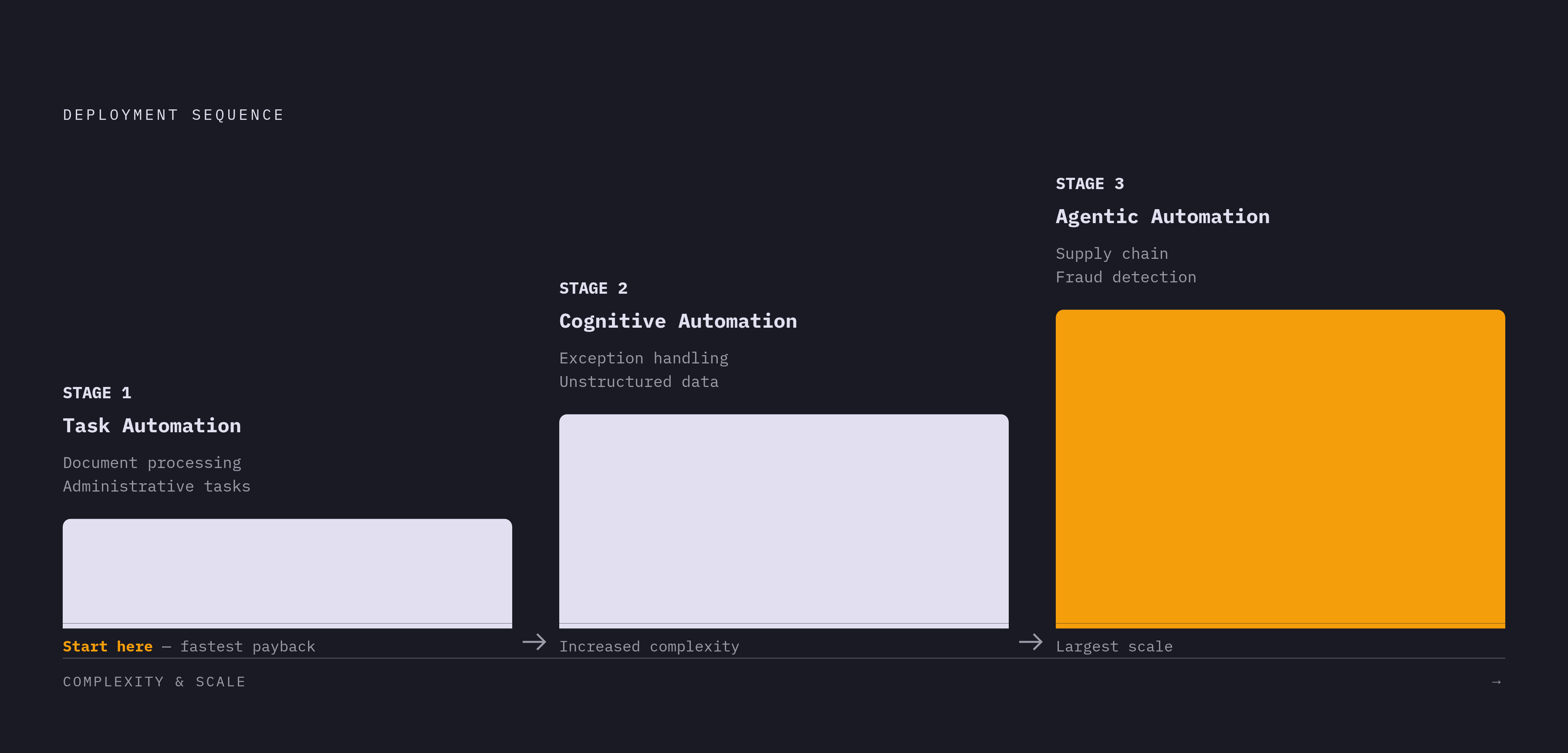
The evidence also suggests an order of deployment. Document processing and administrative automation typically offer the fastest payback because their cost baselines are clear and the replacement of manual effort is direct. Task automation on stable, structured processes comes first, followed by cognitive automation for exceptions and unstructured data, then agentic automation for complex, multi-system workflows. Supply chain and fraud detection offer larger-scale opportunities, but their operational demands are different.
A team that understands its own volumes, rules, costs, and workflow requirements can identify the next credible deployment without waiting for another case study to name its department.