Wiring AI Into Business Systems so It Executes Work Across Every Function
Persistent state, tools, scheduling, and coordination are what let AI finish work.
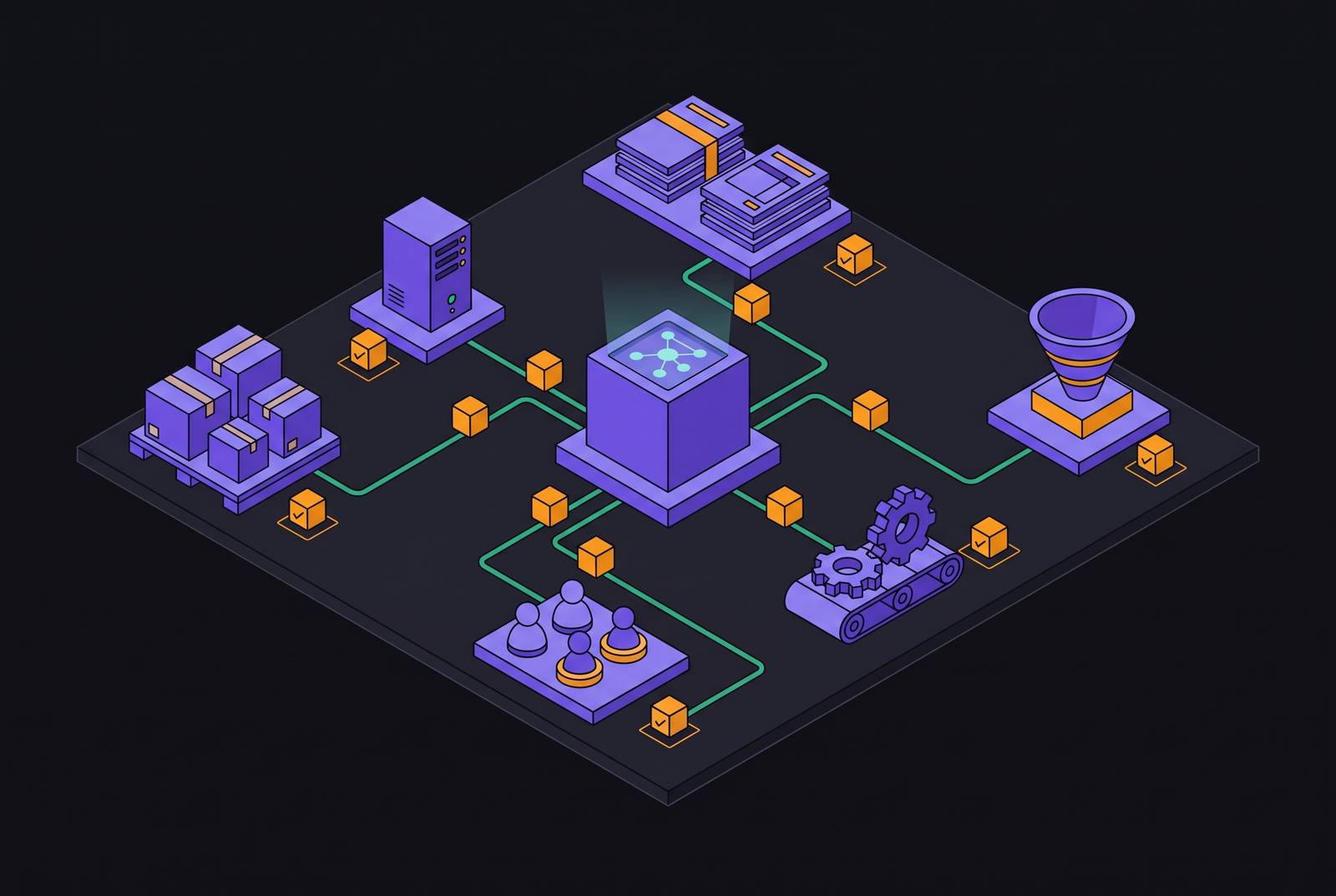
Business AI that completes work needs more than a model connected to company data. It needs persistent state, tool access, scheduling, and coordination across systems, with governance built into execution. Wiring AI into business systems therefore requires infrastructure, and the right platform depends on the work the agent must finish.
Why agents that only answer questions cannot do business work
A sales agent drafts an outreach email but cannot update the CRM, schedule a follow-up, or log what it did. The draft may be excellent. Yet a person still has to finish the workflow, remember the next step, and connect the result to the customer record. The agent has produced useful text without taking responsibility for the work.
That gap explains the limits of deployments where a model receives a prompt and returns a response for someone else to act on. When the system receives an outcome, it must work toward that outcome across steps, change its plan as needed, and keep context until the work is done. A purely reactive system cannot initiate the next action or preserve state between sessions on its own. Those abilities have to come from the architecture around the model.
What "execution" actually requires architecturally
Four capabilities form a practical audit of an execution stack. Persistent state answers whether the agent can retain context across sessions and task steps. Tool access answers whether it can read and write in CRMs, ERPs, databases, and communication platforms. Both are necessary, but neither initiates work.
Scheduling starts the work through timers, signals, and threshold conditions. Cross-system coordination then allows specialized agents to share context and hand off outputs without losing the state of the larger task. The audit tests whether these capabilities work together. An agent that can update a record but cannot resume tomorrow still leaves an unfinished workflow behind.
This is the distinction between scripting steps and delegating outcomes. A script follows a set sequence, while an agent decides how to reach a goal within set limits. The model needs a dependable way to remember decisions, reach systems, start work, and pass responsibility onward.
How the Model Context Protocol became the universal tool rail connecting agents to business systems
Custom integrations create a combinatorial problem when every agent needs its own connector to every business system. The Model Context Protocol, or MCP, replaces that pattern with a shared interface. A server only needs to be built once to work with every MCP-compatible client. In architectural terms, the integration count falls from N × M to N + M.
The standard connects models to external tools, data sources, and services. Official or community servers cover platforms including Slack, GitHub, Salesforce, Stripe, HubSpot, Shopify, Notion, Linear, Sentry, Figma, and Cloudflare. The stateless specification released on 2026-07-28 also allows MCP servers to run behind standard HTTP load balancers. That makes the connection layer easier to deploy at production scale.
Tool schemas consume space in the model’s context window, so attaching many servers can leave less room for the task itself while increasing tool-selection errors and latency. More access is not always more capability. A coding agent with a small cluster of development tools, or an HR assistant with HRIS and payroll servers, keeps its choices relevant to its role.
Tool access also differs from agent communication. MCP standardizes connections to tools and data, while Google’s Agent-to-Agent protocol, or A2A, standardizes communication between agents. A multi-agent system in production usually needs both.
Why persistent memory is the difference between a capable agent and a reliable one
Consider a finance reconciliation agent that loses its exception list when its context is shortened. Or consider a support agent asking a customer a question they already answered last week. Neither failure requires weak reasoning. Both arise because information needed for the next decision did not survive into the next working context.
Context management governs what enters the model’s window for each inference, while memory management preserves knowledge across sessions. The critical boundary is context compaction, when the harness shortens context to stay within model limits. Without an explicit memory layer, what the agent has learned can be lost at that point.
A virtual context approach separates working context from external storage and moves information between them automatically. Long-term memory through a vector database can keep what an organization knows beyond a single session. But storage alone does not establish trust. Summaries can omit critical details, long histories can distract the model, and persistent records can preserve incorrect or adversarially injected information.
Reliability therefore depends on whether the system manages what to store, retrieve, update, compress, and forget. Memory needs selection as well as retention. Otherwise, a mechanism intended to preserve useful context can also preserve the mistakes that undermine later work.
Scheduling and event-driven triggers as the mechanism that makes agents proactive
An agent waiting for a prompt cannot independently handle an overnight reconciliation or a weekend alert. The work may be understood, but nothing starts it. Scheduling turns the agent from an on-demand responder into a participant that can be on call and initiate work within defined boundaries. This is the practical meaning of an agent acting as part of a workforce.
Scheduled runs include nightly reconciliation and weekly pipeline health checks. Threshold crossings include an invoice overdue past a defined window or inventory below a reorder point, while system events include a new support ticket, a code push, or an alert firing.
Starting automatically does not mean finishing without human involvement. The formal MCP extension for long-running Tasks supports mid-task input through an input_required state and tasks/update. A procurement agent can therefore pause for sign-off and resume when that input arrives. The important distinction is continuity, because a workflow can remain active even when its next step depends on a person.
How multi-agent coordination extends execution across department boundaries
An order exception can require supply chain replanning, a customer communication, and finance approval. These are connected decisions, but they require different tools and knowledge. Giving one agent everything expands its context and tool surface. Dividing the work among specialists makes the boundaries explicit instead.
In that pattern, a supply chain agent handles its part of the exception, a customer communication agent handles the message, and a finance approval agent handles the financial decision. An orchestrator assigns tasks while a coordination layer shares context. The same decomposition applies to detection, analysis, recommendation, execution, and monitoring. Outputs can then be checked across agents before the larger workflow advances.
The hardest boundary is often the handoff itself. If one agent passes only a summary, details needed for a downstream decision can disappear without an obvious failure. Shared memory and explicit output contracts address that risk by making the handoff more than a conversational exchange. The next agent needs the relevant state.
Kore.ai’s platform guide says a unified control plane is needed to bring specialized agents together under shared governance. That control plane connects departmental execution without requiring every specialist to become a generalist.
Where agentic execution is delivering measurable operational results by function
The documented uses in 2026 are narrower than the promise of an autonomous digital workforce. They nevertheless show a recurring architecture across different functions. The useful comparison is by workflow. State, tools, scheduling, and coordination are used in different combinations to suit the work.
In IT operations, an AI SRE agent reasons across code changes, alerts, telemetry, and incident history to investigate and remediate within governed boundaries. A two-stage architecture first narrows the search through heuristic retrieval, code ownership signals, and runtime code graph traversal, then uses an LLM-based ranker to identify the root cause. This pattern moves root-cause analysis from hours to minutes. Recording AI provenance in a commit trailer or PR field lets teams correlate AI-assisted changes with outcomes.
Exception handling is at the heart of finance work. Agents can query financial databases for invoice processing, expense categorization, monthly close reconciliation, variance analysis, and regulatory report generation. Routine transactions proceed autonomously, while policy breaches or low-confidence cases go to human controllers. Persistent state supports continuity as unresolved exceptions move through review.
Customer service depends more visibly on decomposition. Specialized agents handle intent detection, order queries, refund approvals, and response drafting. Tool access supplies the order information, while coordination connects that information to the approval and response. Memory preserves the context needed to avoid making the customer repeat earlier answers.
Supply chain execution starts with continuous monitoring. Agents track inventory and shipments, detect disruption signals from news and supplier feeds, and act on potential delivery delays. Their actions can include rerouting orders or triggering purchase orders, with people involved at the exception level. Event-driven invocation starts work when conditions change, without waiting for a person to ask at regular intervals.
Sales uses the same trigger principle more narrowly. Exception-monitoring agents flag deals that have been stuck in a pipeline stage longer than a set threshold. They then escalate to a person or take a defined action. Compared with outreach drafting, this pattern addresses the neglected interval between interactions, when a deal needs attention but nobody has prompted the agent.
The governance and security requirements that production deployments cannot skip
Broader tool access and automatic invocation increase the reach of both useful actions and mistakes. A misconfiguration or compromised instruction can affect more than a single answer. Governance therefore belongs inside the execution architecture. It defines which actions can proceed, under what conditions, and when responsibility returns to a person.
The platform guide identifies audit logs, permissions frameworks, context-aware risk scoring, compliance reporting, and guardrails as production requirements. Human-in-the-loop controls make those boundaries operational for high-stakes actions, ambiguous situations, and low-confidence decisions. Escalation is a designed path. A workflow needs to know when autonomy ends as clearly as it knows when work begins.
Persistent memory adds a security surface because incorrect or adversarially injected information can survive across sessions. Multi-agent coordination adds another, since a handoff can cross a policy boundary without a person knowing. Shared context must therefore include permissions, policy state, and task data. Otherwise, the receiving agent may inherit the work without inheriting its limits.
The practical response is governance enforced at runtime, with instrumentation that makes decisions auditable afterward. Deployment-time checks cannot substitute for policies applied when an action occurs. Teams that establish enforceable boundaries from the outset have a stronger basis for extending agent permissions.
What should an AI platform provide to automate business operations?
General-purpose cloud primitives do not, by themselves, provide the execution model described here. Request-scoped compute is different from a stateful agent pursuing a goal across events, pauses, and handoffs. The gap is the combined provision of memory, protocol-based tool access, scheduling, orchestration, and runtime governance.
The 2026 infrastructure options fall into three broad groups. Managed hyperscaler runtimes include AWS Bedrock AgentCore, Google Gemini Enterprise Agent Platform (Agent Runtime), and Azure AI Foundry Agent Service. Framework-native platforms serve teams building from open-source, while sandbox and serverless runtimes include Modal, Daytona, Fly.io Machines, and Cloudflare Agents. These groups meet different needs, so no single ranking fits them all.
The practical selection rule follows the workload. MicroVM sandboxes suit code-executing agents, durable-execution platforms suit long-running autonomous agents, and hyperscaler runtimes suit enterprises with strict governance requirements. Runtime choice is therefore an architectural decision. Its consequences extend to how the agent retains state, recovers from errors, and operates within policy.
For a small business without a technical team, how much work it takes to connect the tools is especially telling. A platform that needs weeks of assembly before connecting the first tool presents a different proposition from one operational in minutes. Low-friction onboarding is useful, but it cannot replace the capabilities needed after the demonstration. Evaluate whether the platform supplies a coherent operating layer for ongoing work or leaves the business to assemble and govern that layer itself.