The Orchestration Roadmap That Turns AI Point Solutions Into a Growth Engine
Four infrastructure stages let AI agents share context and compound their impact.
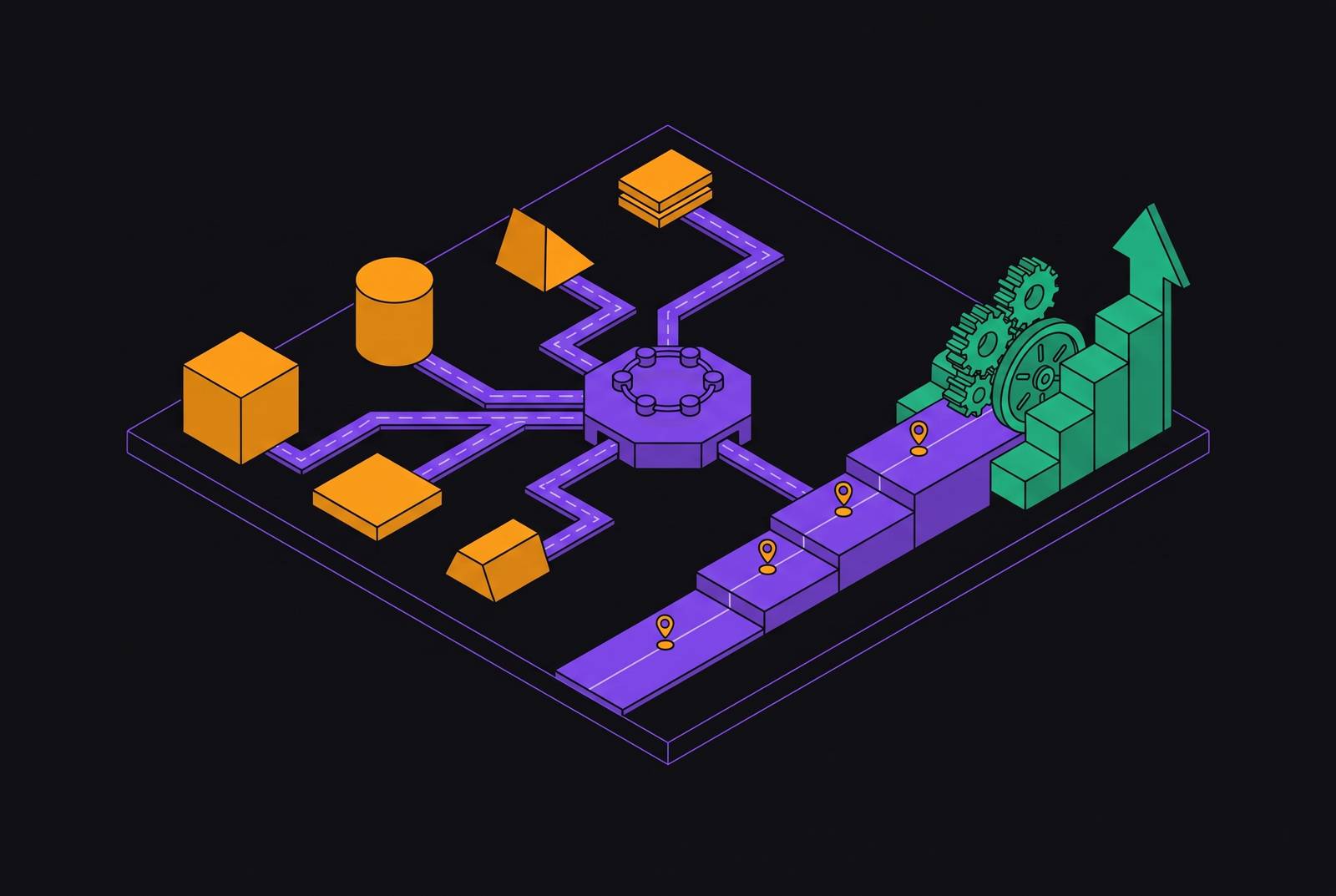
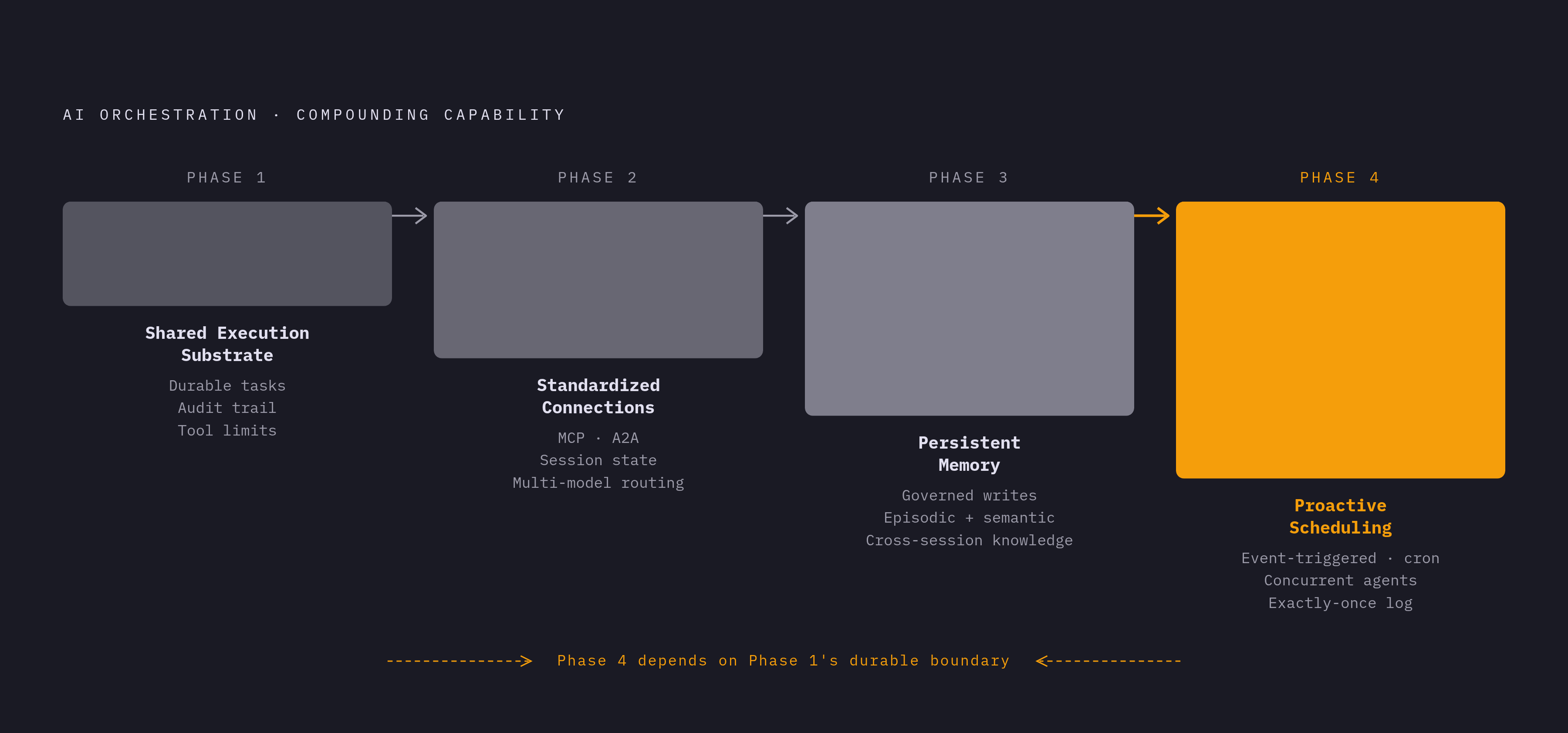
Business AI becomes a growth engine when agents share context, retain governed memory, and act on events or schedules. The orchestration roadmap is therefore an infrastructure decision. Its four stages are shared execution, standardized connections, persistent memory, and proactive scheduling, with each stage building on the controls established before it.
Why stitching AI tools together doesn't compound — and orchestration does
Consider a team with three or four AI tools running at the same time. A coding assistant helps developers, a summarization tool shortens reading, and another agent handles a separate workflow. Each saves time within its own task. Yet the team has plateaued because the tools maintain separate inputs, outputs, and context. The other tools cannot use what one learns, and context they could draw on is lost between sessions.
Adding another tool can help with one task without changing how the tools work together. The distinction is between additive AI, which offers more isolated help, and compounding AI, which makes prior work available to future work. This is not simply a question of model quality. Even a capable model starts at a disadvantage when it cannot use the organization's earlier decisions or the intermediate results another agent has already produced.
Satya Nadella articulated this shift at Davos as “harness engineering.” The company's intellectual property increasingly sits in how it combines models, applies context, and embeds its own knowledge. Instead of asking only which assistant performs a task best, a team must ask what infrastructure lets that work contribute to a larger system.
Many agentic projects risk failing before they can work at scale because they are unreliable or their returns are unclear. Investment in governance, integration, and compliance helps decide whether a pilot gets past that point. The path forward begins beneath the agents themselves, with an execution layer that can preserve state and govern actions before the team expands what agents are allowed to do.
What infrastructure does a company need to automate business operations with AI?
An agent is not just another request-response application. It can pursue a goal across many steps, choose tools dynamically, and change its behavior in response to feedback. A task may stay open while it waits for an external event or for a person to approve it. General-purpose cloud infrastructure can host the software, but hosting alone does not give agents the controls they need to work this way.
The shortlist of runtime responsibilities includes scheduling, context and memory management, tool and capability registries, policy enforcement, and observability. Each answers a different operational question. When can the agent run, what can it remember, which tools can it invoke, and whose authority permits the action? Afterward, the system must make a consequential action reconstructable rather than leave its cause buried in an opaque interaction.
The AgentKernel paper argues that controls inside the agent's own process boundary cannot provide mandatory enforcement. Agents encounter untrusted content, write persistent memory, and invoke privileged tools, so the boundary between information and authority needs protection outside their own reasoning. The paper calls for non-bypassable services for identity, input mediation, memory governance, and execution control. These are architectural responsibilities.
A framework decides what an agent does. The runtime determines where and how it executes, including how state survives and how authority is enforced. Managed hyperscaler runtimes, framework-native platforms, and sandbox/serverless runtimes represent different infrastructure categories. For a small business without a technical team, this distinction also explains why buying an assistant does not by itself establish an autonomous operational layer.
Phase one: establishing a shared execution substrate before adding more agents
In week one, the developer's milestone is a first managed agent process and a first durable task. Installing a development tool may begin the work, but it is not evidence that the substrate is ready. The process needs an identity known to the runtime, lifecycle control, and an audit trail. Otherwise, it remains an ad hoc script that happens to call a model.
The Agent libOS paper from Tsinghua University defines a more demanding foundation. It describes persistent AgentProcess instances with process-local object memory namespaces, declarative capabilities, syscall-mediated tool invocation, hierarchical resource accounting, and durable task supervision with fail-closed recovery. Those terms describe concrete boundaries around execution. The runtime knows which process is acting, mediates its tool calls, accounts for resources, and prevents recovery from silently bypassing controls.
Durability provides the first practical test of that foundation. An agent must be able to suspend for approval or an external event and resume where it stopped. A single synchronous call cannot support that workflow. Centralized, platform-agnostic conversation state also lets a task begin in Slack, continue by email, and resume in a web interface using the same identity, history, workflow state, and relevant context.
Tool access also needs clear limits from the start. The recommended pattern is to classify the turn, make only the relevant tools available, and enforce a deterministic done-checker instead of binding every tool and trusting the agent to hold back. This limits the blast radius of a misconfigured tool. Shared memory, multi-agent coordination, and autonomous scheduling come later, once this individual execution boundary is stable enough to support them.
Phase two: connecting agents to shared context through standardized protocols
Once individual agents can execute under reliable controls, they can connect to shared resources and delegate work. Model Context Protocol, or MCP, from Anthropic standardizes access to external tools, databases, and APIs. Agent-to-Agent Protocol, or A2A, from Google supports discovery, communication, and delegation between agents from different vendors. MCP connects an agent to resources, while A2A connects it to other agents.
Using both lets a team build connections without writing a separate custom integration for every handoff. Yet connectivity alone does not establish coordination. What happens when the receiving agent knows the request but not the work already completed? Shared session state closes that gap by preserving the current task, invoked tools, and intermediate results in the runtime for the next agent.
That common context supports multi-model routing by complexity, cost, and latency. Frontier models can handle complex reasoning, mid-tier models can do standard tasks, and smaller models can do work that needs to run often. The “Plan-and-Execute” pattern depends on this division of work. Without shared state, however, the arrangement is only a sequence of isolated calls, with context lost between them.
The libOS paper describes typed Git as a substrate for agent state. A reasoning trace stored in a repository can be replayed, diffed, and handed to another agent as structured material it can reason from. That is more useful than a disconnected log. This phase concerns continuity within the task, and long-term organizational knowledge requires a separate decision about what survives after the task ends.
Phase three: building persistent agent memory that compounds organizational knowledge
Persistent memory begins with a governed write. The agent saves selected state to durable storage, retrieves relevant records in a later session, and places only those records into the current context window. The runtime governs what is selected and relevant. This gives a later task access to useful prior work without treating every previous interaction as equally trustworthy or worth retrieving.
Different kinds of memory serve different purposes. Episodic memory records what happened, including task history, intermediate results, and decisions, for retrieval by recency and relevance. Semantic memory distills patterns, preferences, and domain facts that can apply across tasks. Explicit instruction files, such as CLAUDE.md and MEMORY.md, preserve goals, constraints, and operating parameters across sessions regardless of accumulated episodes.
Past experience can inform a new task without replacing the instructions that define how the agent should operate. It also explains the compounding mechanism. Work completed today supplies relevant knowledge for later sessions and other agents, reducing the need for people to re-enter the same context each time.
But who decides what becomes part of that history? An erroneous or malicious memory entry can influence later work repeatedly, even after someone corrects the current answer. Cross-session memory poisoning has been shown to work as an attack vector through instructions hidden in external content. Correcting a response is not the same as surgically removing the poisoned episode that helped produce it.
AgentKernel frames this as an information-flow-control problem requiring enforcement at the runtime boundary. The write path must govern what an agent may persist, under which conditions, and with what authority. Persistent memory therefore creates both the opportunity and the obligation.
Phase four: scheduling agents to act on events and time rather than waiting to be invoked
Memory changes what agents know, but not when they work. An agent that still needs a fresh prompt for every task stays reactive, however much history it has to draw on. The Agent Operating Systems specification treats scheduling as a core runtime responsibility with memory management and capability registries. This phase activates that responsibility so work can begin on a schedule or in response to an event.
Durable suspension and resumption provide one pattern. An agent posts an approval request, suspends with zero compute running, and resumes when the human responds. The Workflow DevKit pattern supports that continuity where an ordinary request-bound serverless function would time out. Phase one established the durable task boundary, and phase four uses it as part of an ongoing operational workflow.
A commit, incident alert, or database change can initiate a workflow while the runtime maintains the subscription and agent identity. Data reconciliation that runs nightly and reports made weekly instead start on a cron-style schedule. For batch work, the runtime is responsible for exactly-once execution, fail-closed recovery on timeout, and an audit of what ran and changed.
Scheduling also enables specialists to work concurrently on one task. A security agent, a correctness agent, an architecture agent checking compliance, and a test-coverage agent can run in parallel, with an adversarial critic challenging findings below a confidence threshold before they surface. Their outputs still need coordination. Concurrency is useful because the runtime manages the processes and their results.
Event-sourced state makes every action an auditable event in an append-only log, supporting replay, audit, and gates on self-improvement. The log supplies these properties independently of the agent's reasoning. With all four phases in place, scheduled work can use governed tools, draw on prior knowledge, coordinate specialists, and leave work that future tasks can build on.
What the compounded system looks like and where the roadmap goes wrong in practice
The completed system changes the unit of automation from an isolated interaction to an ongoing workflow. A task can cross channels, pass between agents, pause for approval, and resume without requiring a person to reconstruct its context. Authority remains attached to managed processes. Growth comes from this continuity.
The strongest objection is whether teams can reach that state reliably. Many pilots stall before they make a difference, and adding more infrastructure does not ensure a return. Memory added before write governance can preserve untrusted instructions, while more agents added before shared state create handoffs without continuity.
Cost is another part of the same problem. A majority of firms overshoot AI-agent budgets, making financial governance an execution concern. Resource accounting belongs in the initial substrate, and model routing later provides a way to match work to complexity, cost, and latency. Neither substitutes for reliable execution, but both belong inside the architecture that supports it.
Business AI platforms should be evaluated by their runtime guarantees. Identity, durable tasks, governed tool access, shared state, memory controls, scheduling, and reconstructable actions are the relevant criteria at their respective phases. For organizations of every size, expanded autonomy requires this stable foundation to avoid merely expanding an experiment's exposure.
If only an answer survives, the next task begins with little advantage. If governed state, knowledge that later tasks can use, and an auditable record are kept, the organization has something future work can build on.