How Orchestration Architecture Determines Enterprise AI Platform ROI
Orchestration architecture, not model choice, drives enterprise AI platform returns.
Business AI for workflow automation is a system that connects model reasoning to business tools, persistent state, policy checks, and human oversight. “How Orchestration Architecture Determines Enterprise AI Platform ROI” explains why those connections increasingly determine returns more than model selection does. For companies choosing AI tools, the strongest comparison is therefore not which model sounds smartest, but which platform can run a complete workflow reliably.
Why the model selection era is ending and what replaced it
Many enterprise teams still frame AI investment as a tournament between frontier models. That framing misses an important distinction between model capability and the capability a deployed system actually delivers. Ndzomga’s 2026 research examined 33 agent scaffolds across more than 70 model configurations and found that absolute score prediction degraded when scaffolds changed, while rank-order prediction remained stable. Model rankings were relatively stable, but scores were not reliably comparable across scaffolds.
This does not mean every model is equivalent. Model benchmarks alone cannot explain how systems perform in production. Google Cloud’s 2026 AI agent trends report describes an “agent leap” from individual prompts to workflows spanning delegated tasks, policy checks, and human escalation. As boards demand evidence of ROI before broad rollout, that chain of work must deliver a dependable result.
What orchestration actually means in production — and what it is not
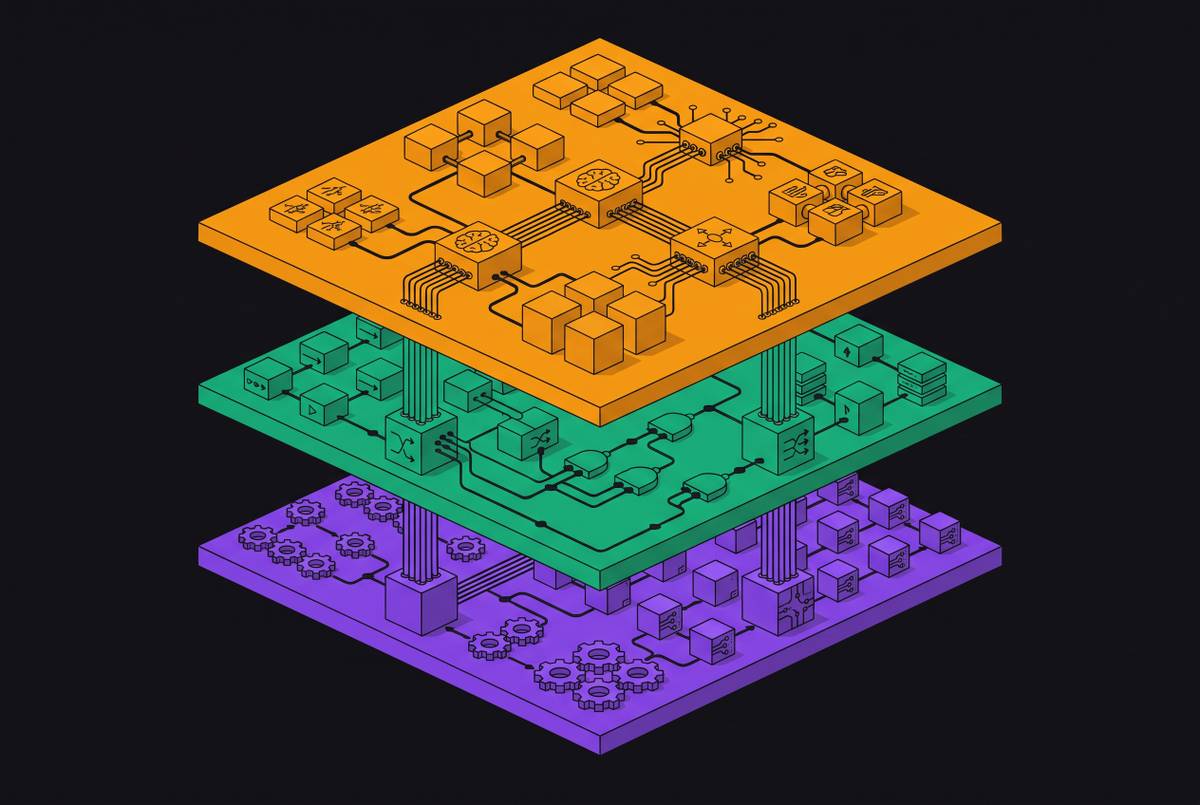
Orchestration is the engineering that maintains state across steps, validates tools before execution, separates planning from action, recovers from failures, and preserves memory across sessions. It is not simply another prompt wrapped around a model. Graph-based stateful orchestration represents reasoning steps as nodes and transitions as edges, making execution paths replayable, debuggable, and auditable. Deterministic workflow engines paired with LLM reasoning nodes assign retries, idempotency, logging, and recovery to the engine, leaving interpretation, planning, and decisions to the model. Hierarchical planner-executor-supervisor designs add monitoring during execution so that a supervisor can assess reasoning traces and tool outputs before failures cascade.
The evidence for that last pattern needs care. MALMM research explored specialized planning and execution agents under a supervising agent in long-horizon robotic manipulation. That work supports the architectural pattern but does not prove that it brings business returns. The practical distinction remains straightforward. A chat agent generates text, while an orchestrated agent can evaluate, approve, and escalate within a structured workflow.
Agents resemble processes, and orchestration acts as the scheduler. Context and persistent memory act as disk, tools and connectors work like drivers, and identity controls set permissions. Observability and audit logs serve the role of system logs. This is why an agent operating layer is more than a convenient interface around model access.
The three interoperability decisions that determine whether agents work together or stay siloed
Coordinating several agents is harder than designing one because every additional relationship creates another place where context, responsibility, or execution can break down. Enterprise workflows also span more work than a single agent can reasonably own. The coordination layer must therefore be part of how the production system is designed. Three decisions shape it, namely the agent-to-tool protocol, the agent-to-agent protocol, and the topology connecting the agents.
Anthropic developed and open-sourced the Model Context Protocol, or MCP, for the vertical connection between agents and tools. It structures the context exchanged at that boundary and supports coherence between reasoning and tool use. Agent2Agent, or A2A, addresses horizontal coordination, including how agents find and communicate with one another. Neither replaces the other. Tool access does not by itself establish a working relationship between agents, and agent communication does not resolve how each participant accesses its tools and context.
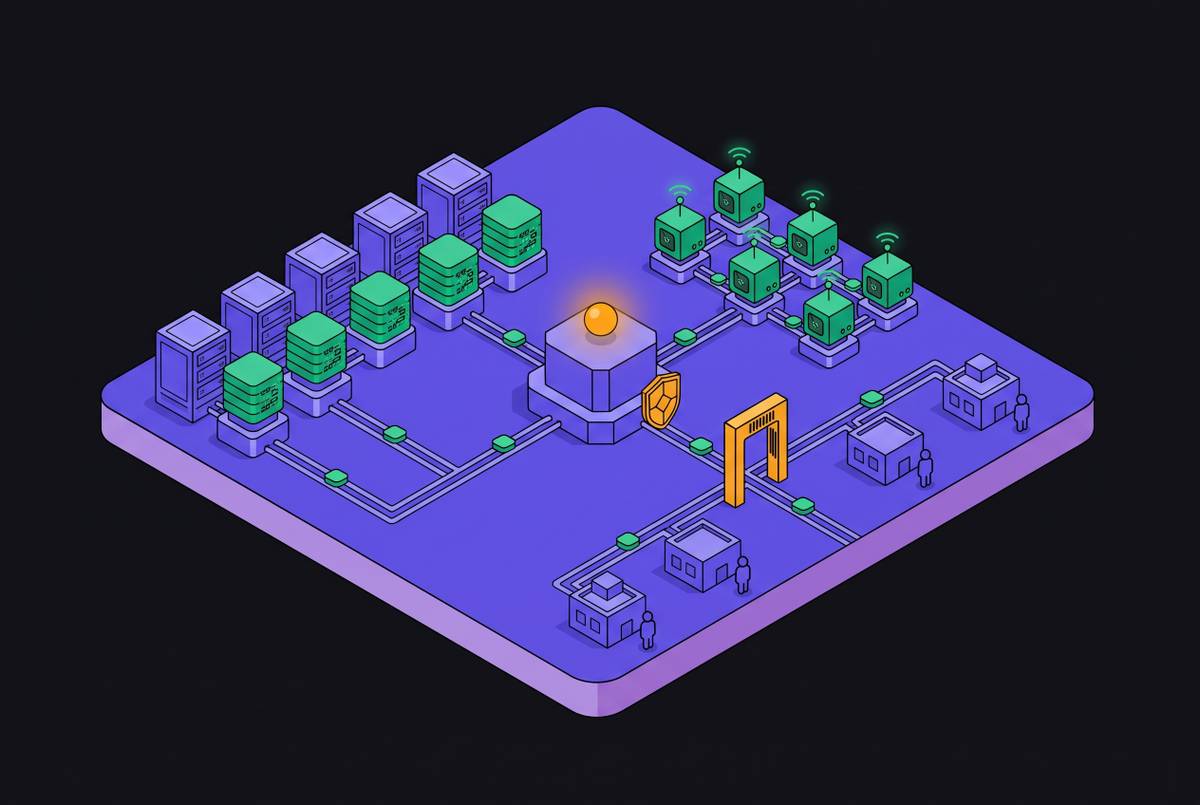
Topology shapes how those relationships work under load. A hub-and-spoke design gives a central orchestrator control over interactions, simplifying consistency and debugging but creating a potential bottleneck. A mesh lets agents communicate directly and route around failures, which makes the system more resilient but harder to observe. A hybrid uses central strategic coordination with local mesh execution where both compliance and scale are important. Yet none of these choices resolves memory portability across systems, which remains distinct from tool interoperability and requires explicit planning.
How memory architecture becomes a production ROI variable, not just a technical detail
An agent can have access to the right tool and still lack the context needed to use it well. Memory is therefore a production design decision to make before a pilot works. The architecture distinguishes episodic, semantic, and procedural memory rather than treating persistence as one undifferentiated store. Episodic memory keeps a record of interactions across steps and sessions so that reasoning stays coherent through a long workflow. Procedural memory preserves successful task patterns for reuse in later execution.
Persistence alone is not enough, either. An agent that remembers context but cannot act on a schedule still falls short of the proactive system many operational workflows require. Together, persistence and proactivity mark a practical threshold between a conversational tool and production infrastructure. Underbuilding memory can weaken the quality of the whole workflow, even when its individual model responses look strong.
Memory also introduces a speed trade-off. Centralized memory supports consistency but adds round-trip latency, which can be unsuitable for sub-second responses. Distributed shared memory with periodic synchronization gives agents local state for speed and shared context for coherence. If prior context remains opaque, an auditor cannot adequately examine the basis for an agent’s actions, making memory design inseparable from governance.
Why governance embedded at design time is cheaper and more reliable than governance retrofitted after deployment
Retrofitting governance is expensive because it changes how actions happen. A system without behavioral baselining or policy enforcement in its orchestration layer lacks the control points needed for reliable oversight. Adding a filter to its final answer does not reconstruct those missing boundaries. The economic choice is therefore between building controls into the workflow and altering that workflow after deployment. Governance belongs in the architecture from the start.
The ToolSafe pattern places policy validation between planning and tool execution, so an agent cannot act until the proposed action passes checks. The PSG-Agent pattern tracks how risk builds up across multi-turn interactions. A single-turn filter cannot catch every risk that grows over a series of turns. Human checkpoints complement both patterns by assigning high-risk decisions, exceptions, and accountability to designed escalation points. Human involvement serves as a control mechanism.
Regulation adds a deadline to this engineering argument. The European Parliament’s research service gives August 2, 2026 as the EU AI Act’s general date of application, rather than the date when every provision becomes effective. The Digital Omnibus defers relevant high-risk obligations, including those covering hiring and credit scoring, to December 2, 2027. These classifications bring audit, transparency, and human oversight requirements. For affected deployments, postponing architectural controls creates both retrofit costs and regulatory exposure.
What production deployments at Danfoss, Dow, Commonwealth Bank, and Barclays show about where ROI actually comes from
Google Cloud’s Danfoss case study describes inbound customer sales-order processing in which agents handle approximately 80% of transactional decisions autonomously and reduce response time from days to near real-time. The work is connected to enterprise systems. Agents follow a set process to evaluate, approve, and escalate orders, going beyond drafting a response. The return comes from changing how an order moves through the business.
Dow makes the division between reasoning and execution more concrete. Microsoft’s account describes an autonomous freight-invoice agent built on Microsoft Copilot Studio that monitors incoming email for attached invoices. The workflow extracts invoice data, validates it against internal systems, and routes exceptions, supporting auditing and anomaly detection. Interpretation is only one part of that job. The orchestration layer connects that interpretation to the checks and handoffs needed for finance operations.
Commonwealth Bank also has to monitor activity at scale. The bank’s official newsroom describes fraud protection systems that watch for signals across transactions, card and online payments, and interactions with digital banking channels. That scope makes stateful monitoring an important architectural question, rather than a question about a single generated answer. The available description does not establish the bank’s precise memory design or coordination topology.
Barclays has to coordinate agents across work that helps employees get more done. Its deployment reaches a very large share of the workforce and spans document analysis, financial research, internal knowledge retrieval, and email drafting. Breadth changes the infrastructure requirement. Coordinating those activities requires enterprise-grade connections and controls. Across these examples, the business task defines the orchestration requirement, while model selection addresses only one component of delivery.
The pilot-to-production gap and what the architecture explains about who crosses it
A pilot can show that a model interprets a request without showing that the surrounding workflow survives retries, preserves context, or enforces permissions. Those are different tests. When production introduces longer tasks and more handoffs, missing controls become operational weaknesses that need immediate attention. This gives the pilot-to-production gap an architectural explanation without requiring every failure to have the same cause.
A deployment that produces useful text but leaves validation, recovery, and routing unresolved has not completed the business process. A system with structured handoffs and designed escalation can connect model output to operational work.
This is a reason to distinguish necessary inputs such as model quality, budget, and executive support from the mechanisms that turn them into returns. Better reasoning does not replace persistent state, and a larger rollout does not repair missing policy boundaries. Investment concentrated on fine-tuning and benchmark competition can consequently leave the production bottleneck untouched. The strongest architectural explanation is that high-return deployments engineer the whole workflow rather than stopping at its most impressive reasoning step.
The architectural decisions that distinguish a high-return deployment from a stalled pilot
For a senior engineer or architect auditing a deployment, the practical starting point is to examine its first production workflow. Does it already include state machines, retry logic, and tool governance, or are those deferred until later? Scaffold before scaling. Check whether the reasoning engine and orchestration engine have separate responsibilities. Interpretation and planning belong with the model, while retries, idempotency, logging, and recovery belong with the workflow engine.
The audit should then check where control over coordination sits. Hub-and-spoke fits work with strict compliance needs where consistency and auditability come first, while mesh or hybrid designs provide availability and fault tolerance but differ in how much they cost to observe. Protocols deserve the same deliberate treatment. MCP and A2A should be infrastructure dependencies rather than late integration patches because tool coherence and agent coordination solve separate problems. Neither should be mistaken for a complete solution to cross-system memory portability.
The audit should distinguish episodic, semantic, and procedural memory rather than accept persistence as a sufficient description. It should also check where policy checks sit between planning and tool execution, how risk is tracked across interactions, and where human escalation sits within the workflow. These are concrete inspection points. If the only visible control is a final-output filter, the earlier governance problem remains unresolved.
Finally, platform selection should follow those requirements. The relevant comparison is whether the underlying infrastructure provides a purpose-built runtime, persistent state management, tool governance, identity and permissions, and observability. A business without a technical team can still use those criteria to choose what to buy, but they do not show that implementation will take no effort. The operating system analogy resolves into a question about what runs beneath the agents. Purpose-built agent operating systems earn their place when they supply that foundation, rather than leaving production controls to be assembled after the agents are running.