Proactivity as a Runtime Primitive Versus a Bolted-On Polling Loop
Agent runtimes need event-driven primitives, not polling loops.
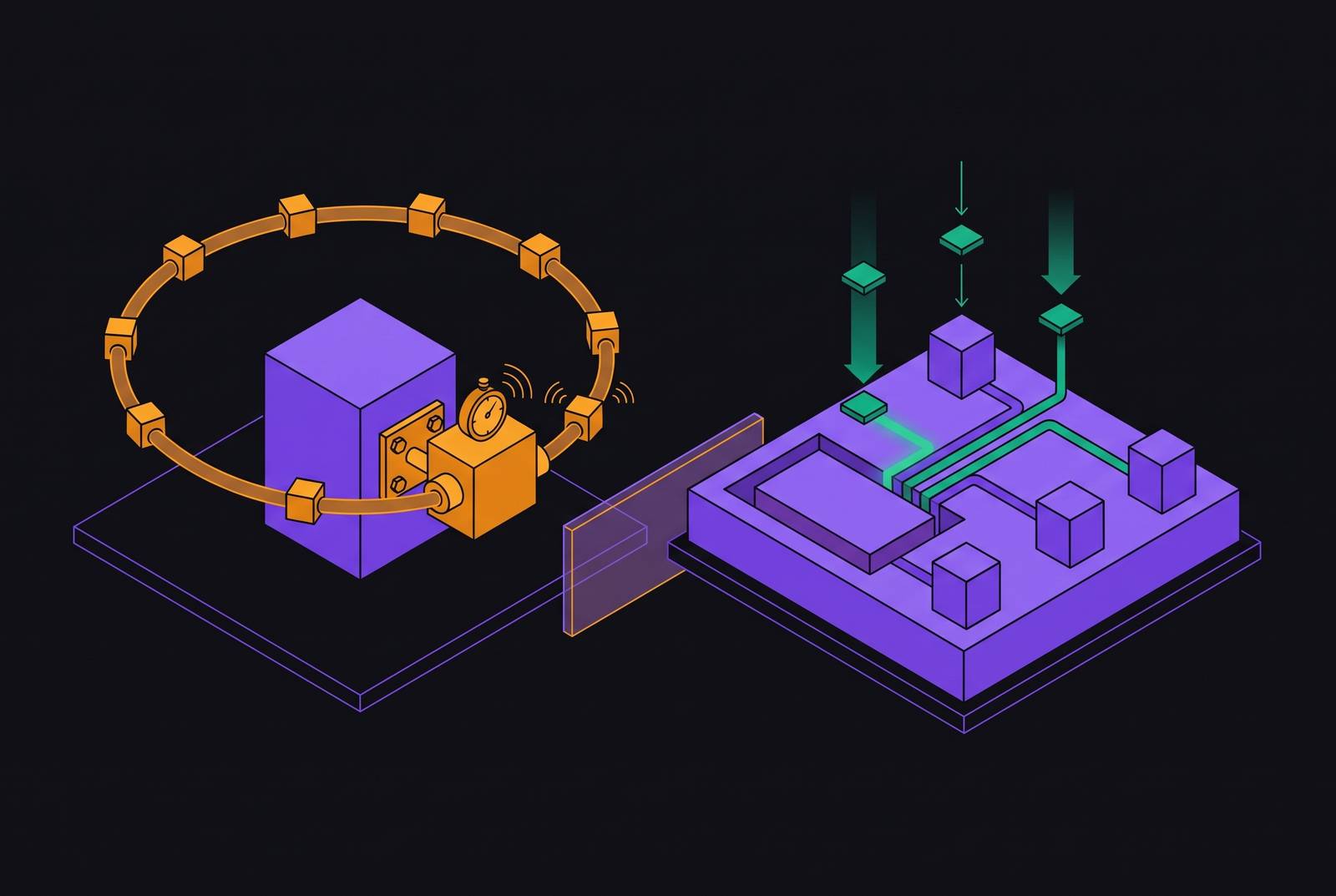
Persistent and scheduled autonomous agents at scale need a runtime that owns wakeups, persistent context, authority checks, and decision-level audit records. A schedule alone supplies none of that. Proactivity is a property of the execution layer beneath an agent.
Why the question "what wakes an agent up?" is an architectural one
The loop fires, and the agent wakes into silence. It checks an external system, finds nothing new, and goes back to sleep. The invocation consumed compute, touched another system, and generated log entries. Before the agent has made a decision, its infrastructure has already decided that the passage of time deserves its attention.
That is the defining commitment of polling. A polling agent wakes at a fixed interval, while an event-driven agent wakes when a relevant state transition occurs. One ties activity to the clock, while the other ties it to a change that can justify action. Shortening the interval changes how often the agent asks the same question while leaving its cause for asking unchanged.
Schedules can still say when work is due. That schedule can enter a runtime that also governs state and action, or start application code that must assemble those controls itself. What wakes the agent is therefore inseparable from what it knows and what it may do next.
What repurposed infrastructure actually imposes on an agent trying to act proactively
A polling architecture must provide enough capacity for the work that arrives at each tick, even when many invocations will find nothing to do. At the same time, a change that occurs between checks must wait for a later invocation. Tightening the interval reduces that wait but increases the frequency of empty checks, eventually approaching continuous execution.
Both follow from the same choice to make elapsed time stand in for relevant change. An interval can trade waiting against activity, but it cannot remove that trade-off. Adding a webhook can change how an invocation starts, yet it does not by itself connect activation to persistent context, permission checks, or a record of why the resulting action was allowed. A different entrance is not a different execution boundary.
A polling loop can produce a regular rhythm of traces whether the agent acted or merely checked. A reviewer then needs deeper inspection to distinguish useful work from empty activity and reconstruct the basis of a decision. DEMM-Bench measures whether runtime records can reconstruct decision-level properties, including authority, policy, and decision basis. It found that trace-present and schema-present baselines overclaim on 75% of cases, showing why the presence of a log cannot stand in for sufficient evidence.
Security and oversight sharpen the problem further. Each polling invocation exercises credentials and permissions, so needless invocations also create needless opportunities for exposure. The EU AI Act mandates human oversight for high-risk systems, which raises a separate question about where a verified human checkpoint belongs. If the schedule starts execution but approval is managed elsewhere, the application must reconcile timely action with waiting for a person. A shorter polling interval does not create a governed pause.
The costs are therefore evidence of a deeper mismatch. Infrastructure that knows how to start a process does not necessarily know how to authorize an agent’s next step, preserve its reasoning context, or explain its decision afterward. Application code can try to bring those tasks together. But then the agent’s governability depends on that added machinery.
What a runtime designed for agents actually provides at the trigger layer
An agent-oriented runtime treats a change as something it can govern. In an event-driven substrate, signals, decisions, and actions pass through immutable events. The runtime delivers each change as an object that is typed, logged, and policy-checked. That makes the wakeup a named occurrence with an authority boundary.
The placement of that boundary is essential. The Epi-Logic framework distinguishes validity conditions that can be checked during execution from correctness that may become clear only afterward. An agent’s eventual success cannot always be known before it acts, but the conditions under which it may act can be tested. The runtime is the point where those tests can govern execution before an external side effect occurs. An application-level scheduler does not, by itself, provide that control.
The Agent libOS framing makes this distinction concrete. It treats tools as libc-like wrappers while placing authority in runtime primitives. Filesystem access, sleeps, human approval, and external side effects are checked at primitive boundaries under explicit capabilities and policy. This design makes governance part of the operation being performed.
Primitives including spawn, pause, resume, checkpoint, and terminate let a runtime suspend an agent until a real event arrives, then resume it with its state. An agent can wait without using compute to check again and again. Human approval can also belong within that lifecycle rather than sitting outside it as an awkward exception. The agent’s ability to stop safely becomes part of its ability to act autonomously.
AgentSpec, presented at the 2026 IEEE/ACM International Conference on Software Engineering, formalizes customizable runtime enforcement as a first-class construct. When triggers and constraints share the execution boundary, an audit record can be indexed to the event that caused work and the policy that governed it. That is a stronger foundation than a heartbeat log, although the record must still contain enough evidence to explain the decision.
Why proactivity without persistent state is just a faster polling loop
A meaningful event answers why an agent woke up. It does not, by itself, explain what happened before. An agent that receives a change but has no memory of earlier actions is reactive with lower latency. Acting before being asked requires a lasting model of the situation, including enough history to judge whether another action is warranted. Session-scoped context cannot keep that history once the session is gone.
Event sourcing brings the trigger and its context together. When business events are stored in an append-only log, the event that wakes an agent also becomes evidence it can reason over. Earlier events provide the history against which the new change can be understood. The runtime already knows what changed and can deliver that delta. The agent no longer has to reconstruct every wakeup by asking a mutable external store what might have happened.
That does not mean all remembered context remains valid. The Epi-Logic framework identifies schema mismatch as a failure class in which an agent uses an interpretive frame that no longer applies. Output-quality measures capture this only partly, because a plausible answer can still rest on an outdated understanding. Persistent context provides the substrate against which that understanding can be checked. Memory must support revision.
The Scroll context manager separates model-directed use of context from the machinery that preserves it. Its persistent Session Environment supports explicit operations through which the model retrieves and computes over externalized state, while the harness provides deterministic storage, execution, and recovery. The model decides how to use context, but persistence is not left to an ephemeral context window or improvised application bookkeeping.
Persistence also needs an authority boundary of its own. A malicious instruction from an external source can get into memory and affect later sessions, so a single exposure can last. Explicit write governance gives the runtime a place to control that channel. Triggering and memory therefore belong together for more than convenience, because both determine what evidence the agent receives and what it is allowed to do with it. An agent that cannot remember why it last acted must rebuild that context before it can judge whether to act again.
The governance bodies and protocol efforts that are encoding this architecture as a requirement
NIST launched an AI Agent Standards Initiative through its Center for AI Standards and Innovation in 2026. That brings agent architecture into the work on standards, where choices once left solely to application design preferences are now being considered. The initiative raises the stakes of decisions about state, control, and evidence.
The 2026 MCP roadmap points toward server-initiated events through channels, subscriptions, and webhooks. These remain aspirational roadmap items in draft or ideating status. Even so, the roadmap points toward event-driven interfaces becoming composable across runtimes. A design built entirely around repeated queries may need to change as those interfaces mature.
The EU AI Act adds a different kind of pressure because it has human oversight requirements for high-risk systems. Those requirements make it important to show where a person can intervene and how execution respects that intervention, without universally requiring polling to be abandoned. A runtime with governed pauses and typed, policy-checked events gives teams a place to put those controls. Undifferentiated heartbeat logs cannot explain them on their own.
DEMM-Bench found that ledger-present baselines still overclaim on 50% of cases, so adding a ledger is not enough either. The relevant test is whether records reconstruct the properties of a particular decision, rather than whether a familiar evidence container exists. Event-driven execution is therefore not an automatic certificate of compliance. Its advantage is that it provides a natural point to bind the event, authority, policy, and decision basis into an inspectable record.
Work on protocols is moving toward richer event interfaces, while work on governance is calling for evidence that explains actions. Teams that separate those concerns may later have to reconnect them across an already deployed system.
What builders must ask about their runtime before writing their first agent trigger
For builders choosing infrastructure, the first question is who owns activation. Does the runtime govern the trigger, or does application code schedule its own wakeups and assemble authority checks afterward? The distinction applies to scheduled work as well as external events. A schedule can say when work becomes due, but the runtime must still determine how that wakeup enters the agent’s controlled lifecycle. A clock is not an authority boundary.
The next question concerns what arrives with the wakeup. Does the runtime deliver a typed, policy-checked event with persistent context, or must the agent query external systems to discover why it was invoked? Teams planning hundreds of long-running agents also need to ask whether state lasts between steps through storage and recovery managed by the runtime. Otherwise, reliable continuity becomes a separate persistence project.
Teams also need to check how waiting works before deployment begins. Does the runtime provide pause, resume, and checkpoint primitives that preserve state without burning compute between events? Can human approval participate in that lifecycle? These questions distinguish a suspended agent from a process repeatedly checking whether it may continue.
Memory and evidence complete the assessment of the runtime. Does persistent context have explicit write governance, and can the runtime inspect the operations that change it? Can its records explain the authority, policy, and evidence behind a particular action? Scheduling, memory, and logging need to be assessed together because these properties are linked. A purpose-built agent runtime earns its place by enforcing that connection before actions reach the outside world, when validity can still be checked.
Sources
- Epi-Logic: A Conceptual Framework for Epistemic Runtime Control, Schema Validity Checking, and Controlled Accommodation in Autonomous AI Agents
- DEMM-Bench: A Cross-Regime Benchmark for Agent-Runtime Governance-Evidence Sufficiency
- Agent libOS: A Runtime Substrate for Capability-Controlled Self-Evolving LLM Agents