Failure Recovery and Mid-Task Resumption Patterns for Agents Running Across Time Zones
Agents running overnight need persistent state, failure classification, and safe resumption logic.
Persistent and scheduled autonomous agents need more than a model that can finish a long task. OpenAI’s workspace agents have cloud-based scheduling and cross-session memory, while Temporal and LangGraph add layers that work together for custom durable execution. Across time zones, the decisive requirement is a runtime that preserves state, classifies failures, and checks whether resumption is safe before continuing.
Why overnight agents fail where single-session agents don't
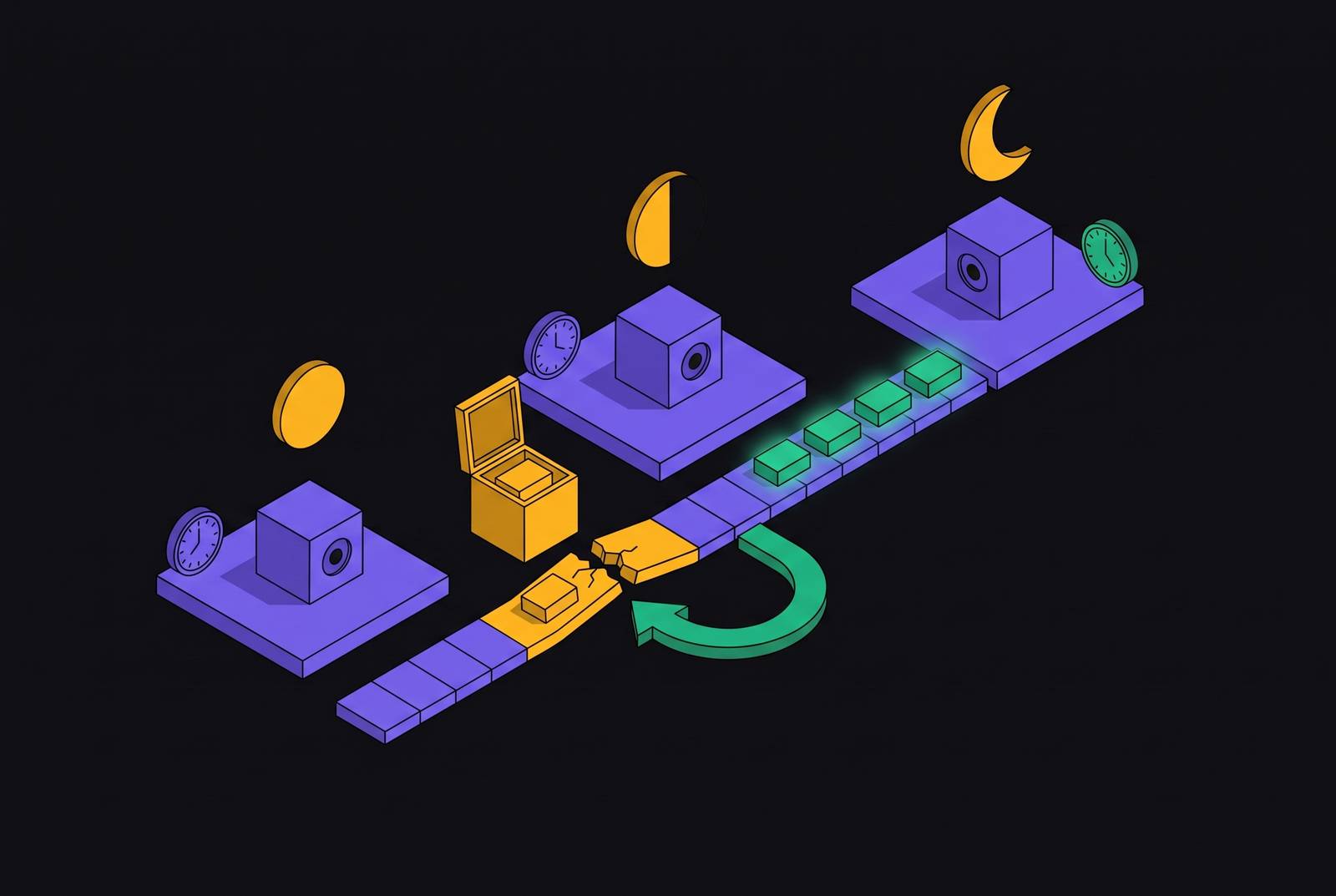
An agent dispatched at the end of the workday in one time zone may need to resume during the early hours in another, with nobody watching the dashboard. If it stops midway, the incoming shift inherits an unfinished task. Someone must reconstruct what happened and what remains safe to do. The interruption has become a coordination failure. Its cost falls on both the system that stopped and the next human in the relay.
A single-session agent often has someone nearby who can spot a failed tool call or steer it away from a mistaken approach. Overnight execution removes that informal recovery layer while giving failures more time to compound. ResearchGym found a gap between occasional success and dependable task completion, including long-horizon problems with resource management and context limits. Yet multi-day sessions with persistent memory remain largely unmeasured. Shorter evaluations therefore offer limited assurance about the unattended runs where time-zone asynchrony is most punishing.
How agents fail silently rather than loudly
An LLM has no memory between API calls unless the surrounding system supplies it. A workflow can therefore lose its place without producing a clear crash. The model may still generate a plausible next step, even though it no longer has an earlier finding or constraint. For long-running agents, memory must be an explicit layer.
Partial completion makes this harder to detect and repair. Suppose an agent sends an email and then crashes before its saved state shows that it sent it. Restarting the task may send the email again, while abandoning it leaves the remaining work unfinished. Neither response follows safely from the visible error alone. Scale AI’s Model or Harness? An Interaction-Centric Taxonomy for Localizing Agent Failures explains that similar outcomes can originate in the model, the harness, or the environment, with a different repair needed for each.
The append-only log as the foundation of crash recovery
The first recovery prescription is to persist the append-only message log. That log is the agent’s state, recording what it tried, what it found, and the approach it was following. Without it, a restart begins a fresh attempt. Even with the same original request, the new run cannot reliably tell which work is unfinished and which work it has already explored. Crash recovery begins with preserving the history needed to continue.
The episodic log serves a different purpose from long-term semantic memory. The former preserves the course of execution, while the latter stores knowledge that can be retrieved without loading the whole history into context. Those roles should not be confused. A useful summary may help the agent reason, but it does not replace the execution record needed to investigate an interruption. Likewise, even when every message is saved, some may have no place in the next model call.
The practical boundary is framework-specific. Agent SDKs handle sessions differently, so a resume strategy cannot be assumed to transfer unchanged between them. Recovery depends on both the framework and its configured storage. The goal is to reconstruct enough context for productive continuation.
Classifying failures before choosing a recovery response
A timeout does not mean the plan is wrong. Treating it as a planning failure can launch a costly loop in which the model repeatedly proposes near-identical approaches to an unchanged problem. Scale AI’s taxonomy illustrates this with two frontier models facing an identical transient error. One abandons the task, while the other retries and completes it. Recovery policy belongs in the harness.
Transient errors, including timeouts and rate limits, call for retry with backoff and jitter. Permanent errors, including bad input or a missing resource, call for a fallback. Critical errors, including a budget overrun or destructive side effect, require saved state and human escalation. An expired OAuth token belongs with infrastructure transients, where token refresh and retry address the cause without inventing a new plan.
Every tool call should be inside the recovery loop. Otherwise, one misclassified error can cascade through the remaining steps of an overnight task. Repeated replanning can become more expensive than the original failure, while moving the agent no closer to resolving it. Classification is therefore both a reliability control and a limit on wasted recovery work.
What infrastructure lets long-running agents resume without rebuilding persistence?
Temporal is the durable orchestration layer beneath an agent framework. It is not LLM-specific, and its role is to coordinate long-running, failure-prone processes across systems. LangGraph addresses checkpointing within the agent framework itself. These are complementary layers. The useful comparison is whether a team needs durable process coordination, persisted agent state, or both.
LangGraph stabilized its checkpointing API with its 1.0 release on October 22, 2025, and its checkpoint package received a 4.0 major revision in January 2026. Its production pattern uses BaseCheckpointSaver, concretely PostgresSaver or RedisSaver, with PostgreSQL or Redis storage. That supports resumption after restarts without replaying the entire conversation. Checkpoint contents still require deliberate engineering. Scale AI’s taxonomy describes an earlier user instruction disappearing through context compaction in a long-running Claude Code session, showing how persisted execution can still lose a governing constraint.
Amazon Bedrock AgentCore Runtime represents a different architectural approach through microVM isolation. That distinction separates execution isolation from the question of what task state survives. AstronOS, a 2026 research system, gives tasks persistent identities and versioned formal state across sessions and executors. Its comparison of five complete state-handoff strategies provides a research baseline for evaluating what checkpoints preserve and how execution continues.
Context bloat as a structural limit on multi-day tasks
Durable storage does not prevent an agent’s working context from filling up. Tool results, reasoning traces, and intermediate outputs accumulate faster than they are retired. Anthropic described “dreaming” at its Code with Claude developer conference in May 2026 as an offline answer to this problem. Between sessions, the agent rewrites its memory store, consolidating traces into long-term recall and pruning material it judges unimportant.
Anthropic’s 100-turn web search evaluation showed that context editing enabled workflows that otherwise failed through context exhaustion, while substantially reducing token consumption. Combining context editing with a memory tool further improved performance over baseline. Semantic vector memory supports this separation by externalizing codebase facts, prior findings, and domain knowledge. However, it helps only when the agent is designed to write and retrieve that knowledge.
The time-zone handoff offers a natural consolidation window. The quiet period between one shift’s handoff and the next shift’s start can accommodate memory work outside active execution. This connects context management to the operating schedule rather than treating it as an emergency response to a full window. The next session can resume with useful recall.
The rollback safety problem when faithful checkpoint restoration creates new failures
A checkpoint restores internal state. If a payment was captured after that checkpoint, restoring the earlier state does not undo the payment. Generating the request again can trigger another action in the outside world. The same risk holds for sent email and delivered webhooks, which may already have set other actions in motion.
The 2026 study Safe to Resume? Breaking Execution Continuity of Agent Execution via Rollback shows security violations that include unauthorized mail forwarding and double payment. A restored execution may combine states, assumptions, and external effects that never coexisted in any valid history. ACRFence names adversarial exploitation of this mismatch “semantic rollback attacks.” These findings challenge careless restoration.
Recovery policy must distinguish actions by their irreversibility. A database record can be corrected, but a sent email cannot be unsent. A captured payment needs a reversal, while a partner may already have acted on a delivered webhook. In the overnight scenario, an action fired at 2am may be repeated after a 7am restoration without anyone recognizing the duplicate.
Conditional resumption logic and how to decide whether to continue
A plan-diff step resolves this tension by comparing the checkpoint’s intended state with the actual state of external systems. Before resuming, the runtime determines which effects have already occurred and which steps are safe to replay, skip, or hand off. Restoration is only the starting point. The decision to continue depends on both the state the agent remembers and evidence about the world it will re-enter.
Different changes require different continuations. A downstream timeout calls for retry, while an upstream API schema change can invalidate the plan and require replanning from the last clean checkpoint. Both paths must keep an explicit record of authorization scope, budget limits, and the target system. If degraded context or a changed environment leaves too little confidence to proceed, the agent should save state and escalate. Cycle detection should also stop a resumed plan before it runs if it too closely matches one that has already failed.
AstronOS makes this decision layer explicit through formal state handoff, specifying how each step receives information, produces a result, and updates task state. That provides evidence that resumption rules can be versioned. In production reliability engineering, the reliability-agent pattern gives automated remediation its own role in running the system. It acts as the stand-in for the absent human, while unresolved or unsafe cases still require escalation.
Scheduling, timezone-aware dispatch, and observable trace design
Timezone-aware dispatch needs a clear schedule that requires a standardized date and time format so the local time leaves no room for doubt. Scheduling and persistence then become separate buying criteria. OpenAI’s workspace agents, launched April 22, 2026, are shared cloud agents that integrate into Slack and Salesforce, retain information across sessions, and wake autonomously for future work. That packages cross-session persistence as a product feature. It differs from assembling an orchestration spine and checkpoint store for a custom runtime.
Anthropic Claude Tag in Slack, described in June 2026, supports ambient monitoring that proactively flags relevant updates and inactive threads. It separately supports asynchronous tasks running over hours or days. These capabilities address proactive work, but autonomous execution removes direct human verification from intermediate stages. A scheduled wake-up does not itself establish safe recovery. The operational question remains what happens after partial completion or an unnoticed interruption.
The OpenTelemetry GenAI Special Interest Group has been developing conventions for a parent invoke_agent span with child chat and execute_tool spans. As of mid-2026, all gen_ai.* conventions remain in Development status. LangGraph does not natively emit OpenTelemetry spans or provide built-in checkpoint integration, so exposing metadata such as langgraph_checkpoint_ns requires custom instrumentation. Remediation needs its own trace, causally linked to the triggering span. This lets the incoming shift distinguish the original failure from the recovery attempt without reading the entire conversation.
Designing the agent runtime for tasks that must finish without you
Make recovery part of execution from the beginning. Teams should checkpoint at every boundary where an action has effects outside the agent, because an interruption there can leave internal state and external effects out of sync. The runtime then needs to connect its persisted history, failure classification, memory management, and conditional resumption rules. A durable process can preserve an unsafe plan, just as a capable model can lose the state needed to finish.
Cognizant reports a multiagent intranet serving hundreds of thousands of employees, while Tata Steel describes unified agentic AI across its global value chain. In these settings, agents run inside workflows where another person or system depends on what they do. For persistent and scheduled autonomous agents at scale, the decisive platform criterion is therefore what survives interruption and what governs continuation. The runtime must make an unattended failure recoverable before the next shift inherits it.