Runtime Selection Criteria for Fleets of Schedule-Driven Agents With Shared Memory
How to evaluate runtimes for coordinated fleets of scheduled agents sharing memory.
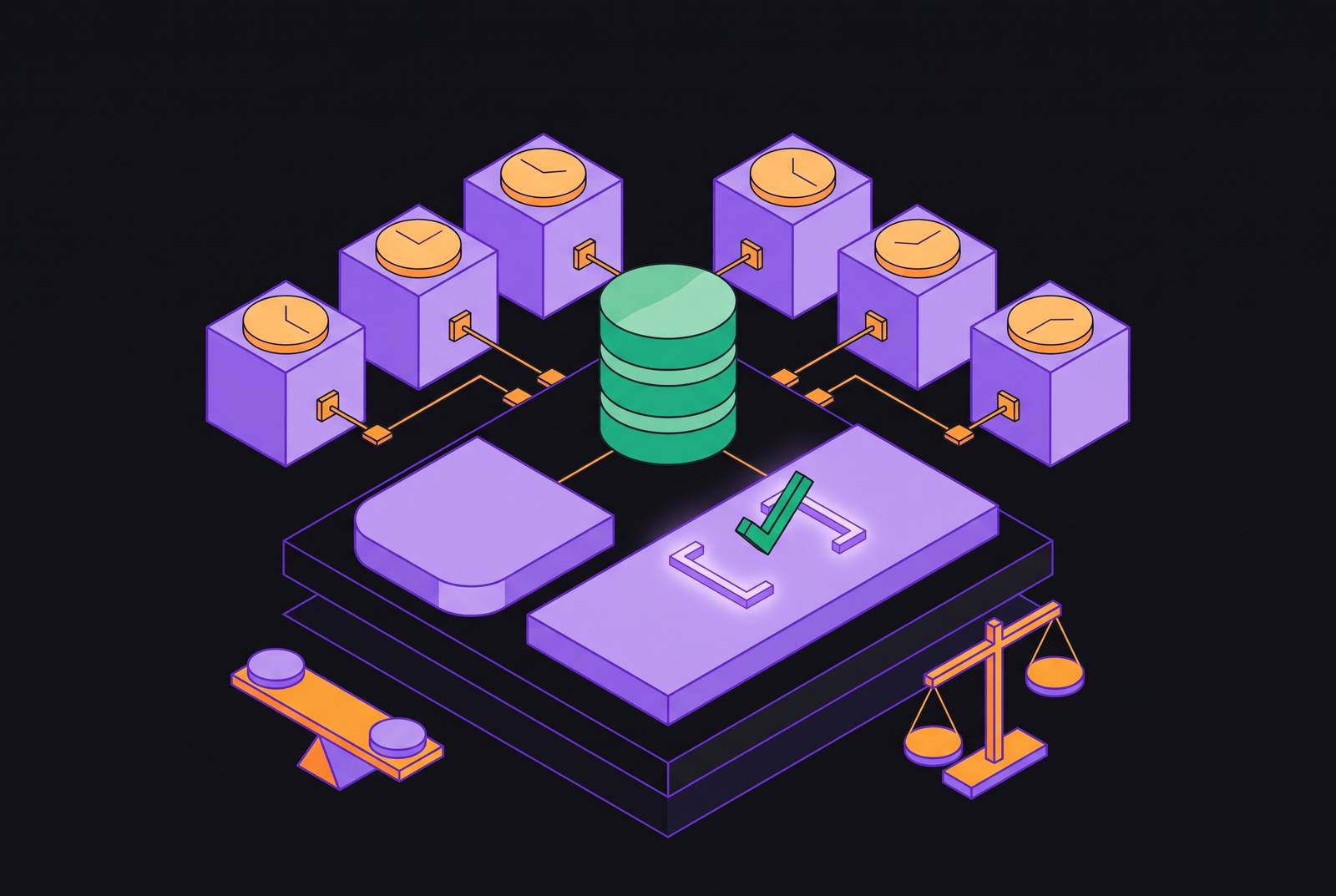
Persistent and scheduled autonomous agents at scale need a runtime that coordinates shared memory, defines scheduled invocation guarantees, and preserves state across interruptions. When choosing a runtime, start with isolation and memory governance, then test scheduling and durability before checking how deployment and security fit. These filters apply in order rather than carrying equal weight, because gaps in coordination can force a rewrite of the whole fleet.
Why the runtime choice is different when agents share memory and run on schedules
It worked in the demo. A single scheduled agent woke up, got its context, did its task, and saved the result. Yet the same design can fail at ten agents because each now reads and writes shared state on an independent schedule. Stale reads, conflicting writes, and missed schedules under load are not simply slower versions of the original task. They show that the agents need coordination the demo never tested.
That difference changes what the runtime must provide. Single-agent, on-demand runtimes optimize for conversational continuity and semantic recall, which can serve one agent, one user, and one session. A scheduled fleet instead depends on the runtime as its coordination substrate. Failures in that shared foundation can propagate beyond the run that caused them, so a general-purpose feature comparison is not enough.
The four failure modes that shared memory introduces in scheduled fleets
Unauthorized leakage occurs when an agent retrieves memory it was not authorized to see because retrieval has no enforced scope. In a multi-role fleet, this is a correctness and compliance failure. Stale propagation is a different breach of trust. An agent acts on a fact that another agent has already superseded, while the older version remains available as though it were current.
Contradiction persistence happens when agents write conflicting facts and both stay in memory with no way to resolve the conflict. Subsequent agents may then act on whichever fact they retrieve first. Provenance collapse removes the chain back to the originating write when an agent uses a derived fact. The result cannot be traced to its source. For agents that build on one another’s outputs hourly, that breaks the basis for debugging and auditing.
Independent schedules amplify all four failure modes. A stale read or missed write need not cause an immediate error in the agent responsible for it. Instead, the effect may be visible hours or days later in another agent’s output. That delay separates the visible failure from its origin. Tests of a runtime therefore have to check how the shared memory layer works as well as whether each agent finishes its own task.
Why evaluating criteria in a fixed order matters more than scoring them equally
Evaluation starts by testing whether a missing capability can be added without re-architecting the fleet. Isolation and memory governance fail that retrofit test, while observability and pricing model pass it. These are not equivalent selection risks. A convenient development experience cannot compensate for a runtime that leaves concurrent memory access to individual agents.
This makes evaluation order a design decision. Check isolation and memory architecture before orchestration depth, and check orchestration before the deployment model. Otherwise, a strong score on recoverable features can conceal a disqualifying gap in the foundation. Convenience and cost should be compared only among runtimes whose architecture fits.
Could a team start simply and migrate later? In a shared-memory fleet, the memory architecture is established on day one, and every agent’s coordination logic depends on it. Moving that architecture means more than replacing an execution service. It can require rewriting how the fleet exchanges and interprets state. The ordered framework moves that discovery to selection time, when a different choice remains cheaper than a rewrite.
Isolation model — why execution boundaries are the first filter, not a security afterthought
For agents that execute self-generated or external code, the runtime needs isolation to enforce the fleet’s boundaries at all. Production runtimes use three broad tiers. Hardware-level microVMs give each session its own kernel, application-kernel sandboxes intercept syscalls in software, and plain containers share the host kernel. Those distinctions determine what a misconfigured or compromised agent can reach.
Agents need isolated environments when they run shell commands, install packages, read files, or make network requests. Without that boundary, an agent may get straight to the host system, another agent’s infrastructure, or the shared memory store. Governance through an API does little to protect the fleet if execution gives an agent a way around it.
A microVM provides the strongest boundary, but a start measured in seconds consumes a meaningful part of a one-minute scheduling window. The trade-off belongs in the initial evaluation. Execution and memory boundaries are linked for the same reason. An agent that can read memory stores through the filesystem can bypass the restrictions that the memory API applies.
How can scheduled agents remember past context without rebuilding persistence?
No one agent sees the fleet’s full write history. Memory governance must therefore be a runtime primitive. Scoped retrieval limits reads to authorized memory. Temporal supersession makes newer writes replace older facts in a queryable way, preventing contradictions from accumulating. Provenance tracking keeps a record of which agent wrote each fact and when, so later use can be traced back to that write.
Can the cron context actually access memory tools? The runtime must define that access before a design assumes scheduled agents can inject memory. If it cannot, the orchestration pattern is broken from the start, even when memory tools work in other execution contexts.
Durability complements those access and consistency rules. An agent running for hours needs to resume from its last checkpoint after a crash rather than restart and re-read stale memory from before its previous write landed. Persistence for each agent does not give the whole fleet a consistency model. One agent’s auto-save can still leave another reading stale state.
In a ten-agent fleet that runs hourly, this can work well. Each agent pulls data, transforms it, and puts out results, using only shared memory to talk to the others. With auto-load and auto-save hooks in the runtime, agents no longer need their own persistence logic. The runtime handles coordination that would otherwise require explicit inter-agent messaging, while the agents remain focused on their tasks.
Scheduled invocation guarantees — what “runs on a schedule” actually requires from a runtime
A cron trigger does not define invocation guarantees. Runtimes may all offer scheduled execution while differing in delivery semantics, missed-fire behavior, and concurrency under load. Does a missed trigger fire late, or get lost without a warning? If a previous run takes too long, does the next run queue, get skipped, or execute concurrently? These questions must be resolved during selection.
What the scheduler knows about state matters just as much. Can it defer a run when the previous one has not checkpointed? When several agents fire in the same window, their shared-memory reads and writes connect scheduling directly to the memory concurrency model. Treating the two as independent systems can produce correct individual runs and an inconsistent shared store.
Idle cost adds a separate practical constraint. Keeping agents alive as long-running processes between scheduled runs means paying for compute while they do no work. Scale-to-zero is the right default for sparse or irregular schedules, provided cold-start latency fits within the scheduling window. That condition brings the evaluation back to isolation. A runtime must satisfy the timing requirement without weakening the execution boundary chosen in the first filter.
Self-hostability and sovereignty — the deployment questions that close off options permanently
After the coordination requirements come the deployment constraints. These are not architectural prerequisites in the same way as isolation, but sovereignty can still be a binary requirement that closes off a runtime permanently. Sovereignty requires running the orchestration loop on the team’s own infrastructure, beyond self-hosting a sandbox or inference endpoint.
AWS Bedrock AgentCore illustrates why that distinction is necessary. Its runtime operates in AWS regions on AWS-managed infrastructure, while its gateway can reach on-premises tools through PrivateLink or Direct Connect. Its deployment model rules it out when the requirement is to run the orchestration loop on-premises or in an air-gapped deployment, while leaving its fit elsewhere open.
The exit-ramp test addresses a related dependency. Declarative agent definitions in version control, including YAML, HCL, or CRDs, are portable in a way that configurations held in a vendor UI or proprietary imperative SDK are not. For shared-memory fleets, that test extends beyond agent definitions to the memory store. A self-hosted loop with a managed cloud memory bank provides only partial sovereignty. The fleet’s shared state still depends on the memory provider’s availability, pricing, and data residency policies.
Security blast radius in a fleet — why agent runtime security is a fleet-level problem, not a per-agent one
A compromised agent’s reach does not end with its execution environment. In a shared-memory fleet, it extends to agents that later read what it wrote. The shared store creates the propagation path. Runtime security must therefore account for downstream readers as well as the permissions and behavior of the agent that first encountered malicious content.
Scheduled data pulls make that risk concrete. A poisoned document ingested at 2 a.m. can introduce indirect prompt injection, while MCP tool outputs can place malicious instructions into shared memory. Later agents may find those instructions in shared memory in the course of their work. Independent schedules separate ingestion from downstream use.
Credential isolation complements memory governance. Tool secrets must stay out of the LLM context because the model is the most untrusted process in the stack. For a fleet, credentials must also be isolated per agent and kept out of shared memory. The runtime sets the effective blast radius through execution permissions, network reach, and secret access. Weak isolation combined with no per-MCP-server sandboxing can expose every agent to the tool surface available to the rest of the fleet.
Applying the framework — what the evaluation sequence produces in practice
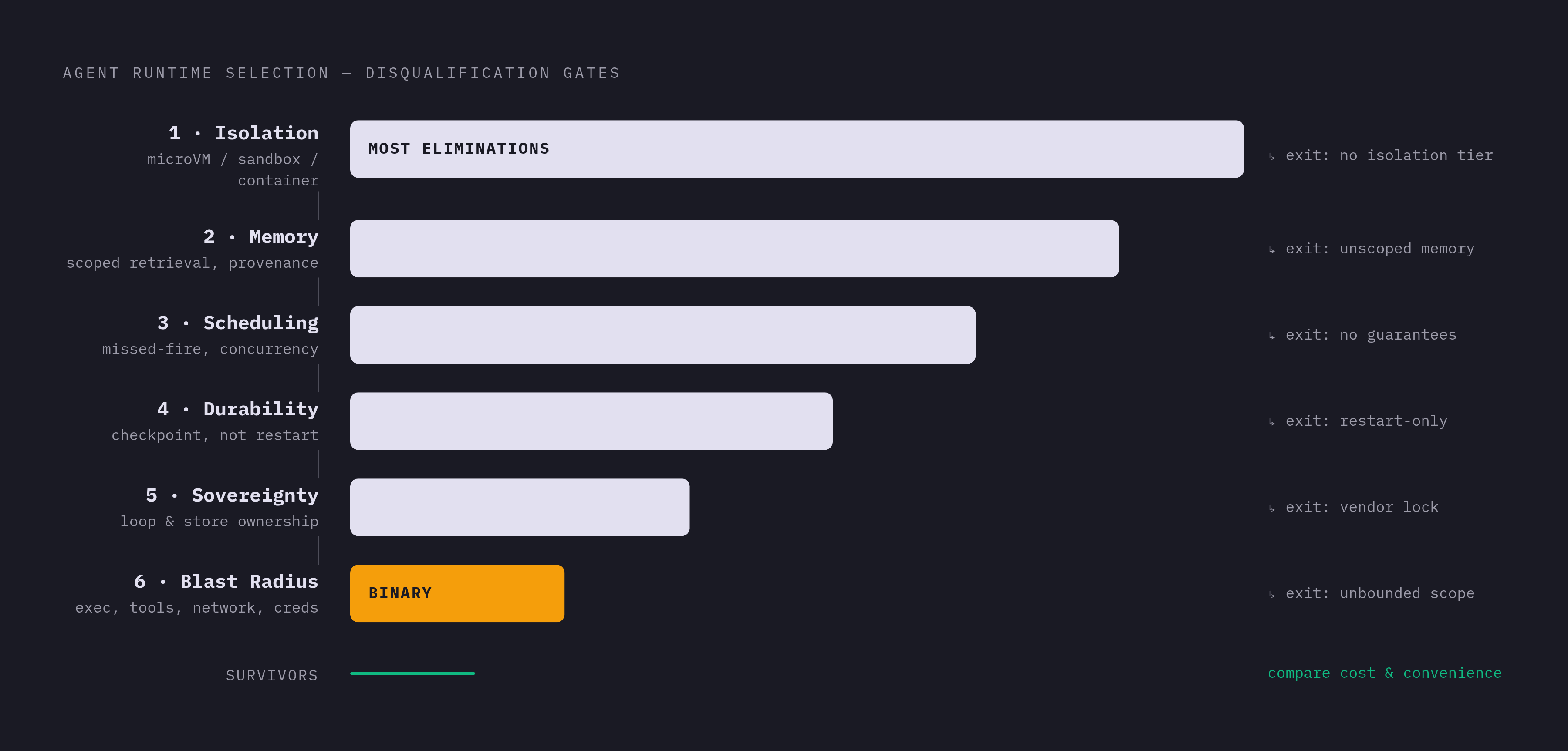
The framework produces a shortlist through disqualification before comparison. Its sequence is isolation, memory governance, scheduling guarantees, state durability, sovereignty, and blast radius, with durability examined together with memory and then tested against scheduling behavior. For code-executing agents, a runtime without microVM-level or equivalent isolation leaves the shortlist at the first step.
Memory governance applies the next filter. A runtime that treats memory solely as an application concern, without scoped retrieval, temporal supersession, and provenance, is removed. This step typically eliminates the most candidates. Scheduling then removes runtimes that cannot specify missed-fire behavior and concurrency semantics for overlapping runs. “Has cron support” is not a sufficient answer.
The surviving candidates must also support durable recovery rather than restarting long-running work from the beginning. Sovereignty then filters for the required location and ownership of both the orchestration loop and shared state. Tests of blast radius check whether execution, tools, networks, and credentials stay within their bounds across the fleet. Only then can convenience and other recoverable features distinguish acceptable choices. The framework provides a method for selecting runtimes.
Teams that reverse this order risk discovering missing governance only after their shared-memory architecture is established. By then, each additional agent depends on the coordination design that needs replacing. A runtime must enable hundreds of agents to share state, recover their work, and wake on independent schedules without making the fleet’s correctness an application-level responsibility.