Rollout Sequencing for AI Across a Five-Engineer Team That Has No Platform Lead
A five-person team gets a three-phase plan that spreads AI ownership.
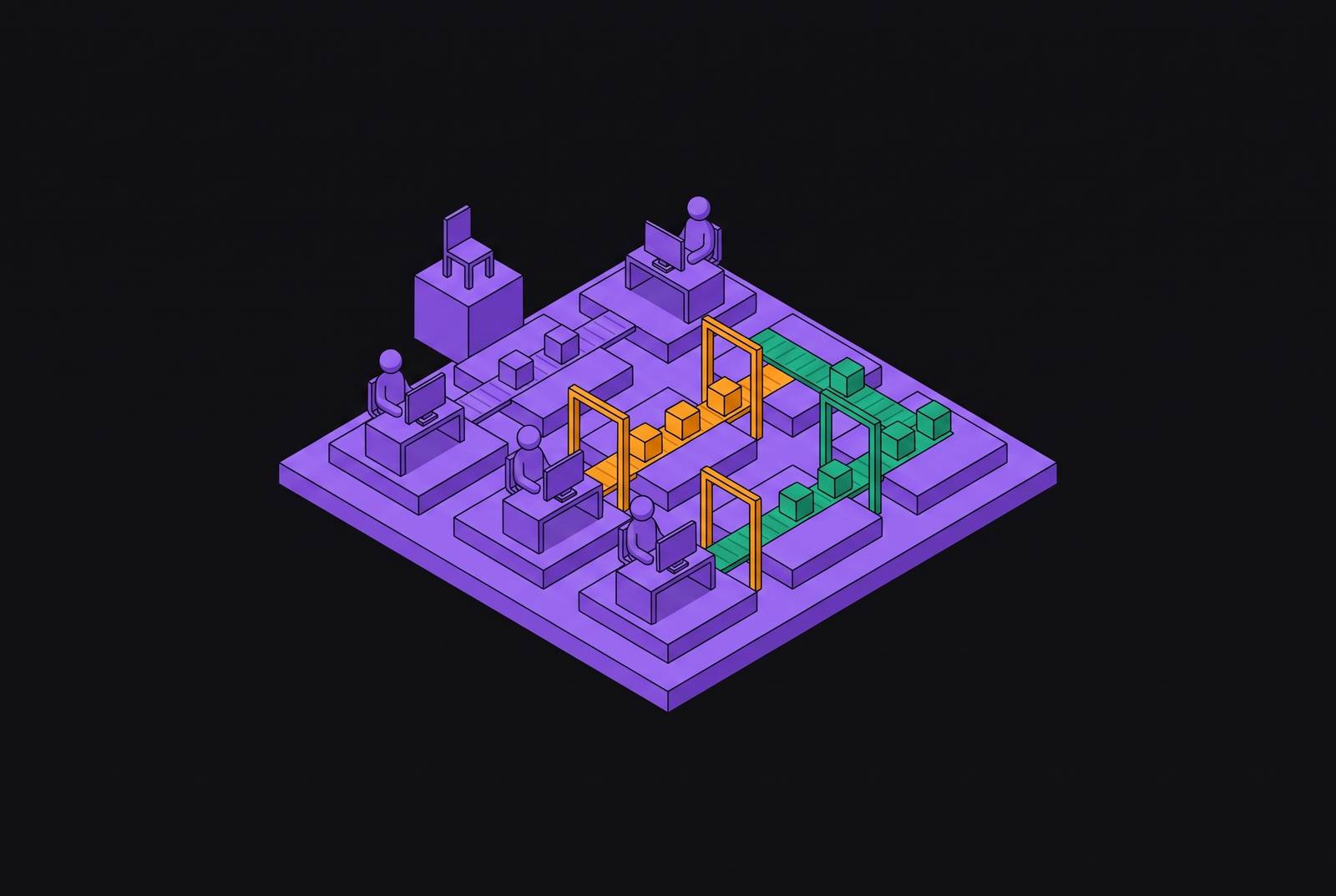
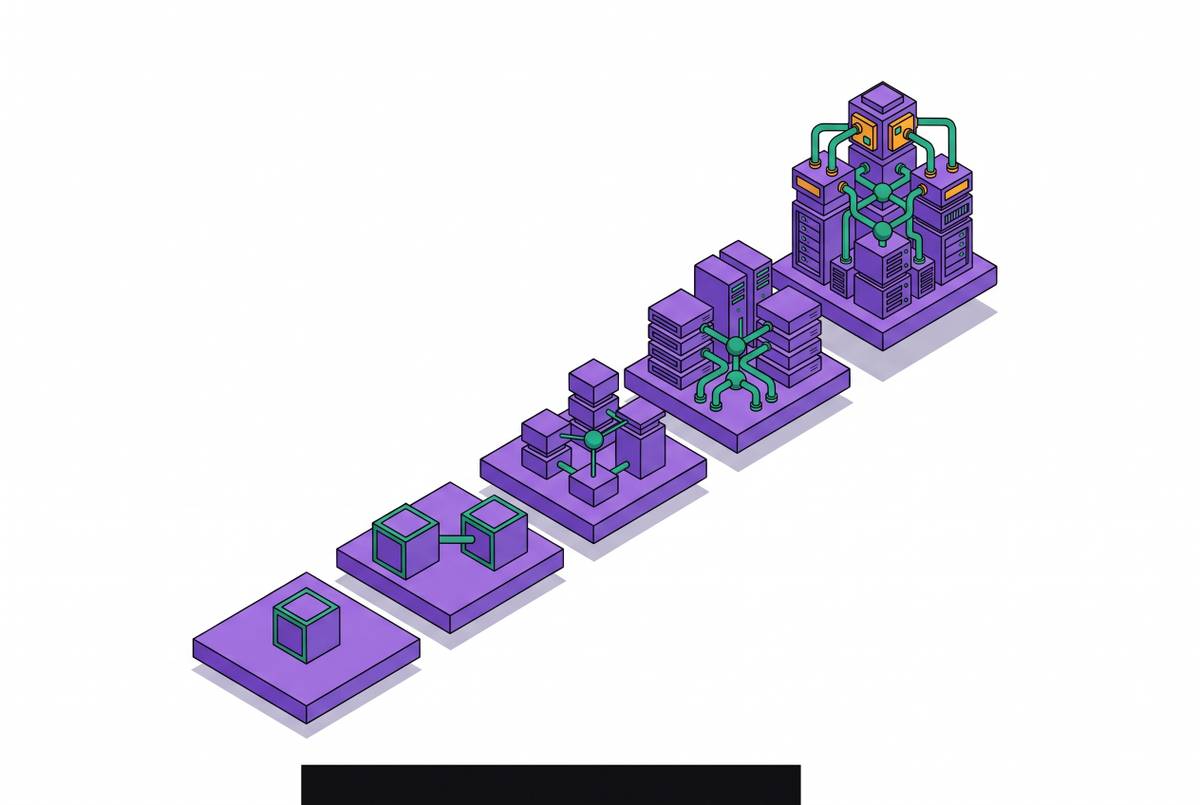
For a five-engineer team without a platform lead, AI rollout works best in three phases, starting with contained individual tasks, moving to shared tooling conventions, and only then adding persistent agent infrastructure. Claude Code, Cursor's agent mode, and Codex CLI are starting options that need no shared infrastructure. The decisive choice is the sequence, so that ownership grows across the team rather than defaulting to whoever installed the first tool.
Why a five-engineer team without a platform lead is a real and common situation, not a gap to fill
On a five-engineer team, the person who sets up AI tooling can become its owner without anyone deciding that this is their job. There is no platform lead accountable for evaluating tools, enforcing conventions, or choosing what comes next. Yet someone still has to do that work. In 2026, this is a practical constraint small engineering teams can work within as adoption begins.
The debt is easy to miss at first. A team that feels comfortable in month one may discover in month four that three engineers use three coding agents with no shared context. Adding another tool then requires someone to understand all of them. The response is not to appoint a platform lead by fiat, but to make each phase leave behind something usable, such as a convention, a shared tool, or a runbook. These artifacts let the next phase build on shared knowledge independently of one person's availability.
Where AI rollouts actually stall on small teams
A useful agent can still become an abandoned pilot. Tool access and agents may already work, while orchestration, governance, and observability remain improvised. Those terms sound grand for five people, but the underlying questions are plain. What did the agent do, why did it fail, and can anyone reproduce the good run? Without answers, the agent remains optional because nobody trusts it enough to depend on it.
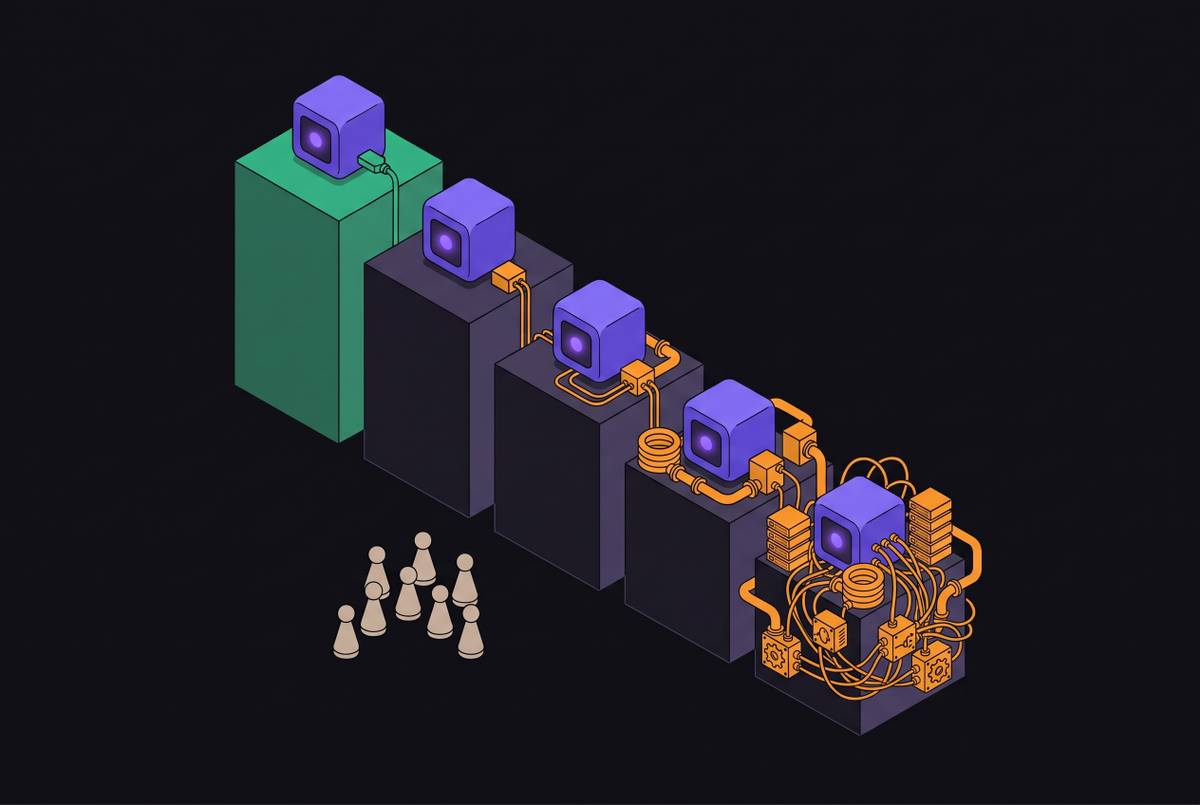
Three patterns explain how that gap develops. Ownership by loudness makes the first tool's advocate responsible for a platform they have neither the mandate nor the time to maintain. Phase compression takes the team straight into scheduling, multi-agent coordination, and shared memory before anyone knows how to use each tool. Governance as retrofit leaves access rules and audit requirements until the system is already load-bearing. These are coordination and architecture failures.
A team should move forward when it understands the current layer's behavior and failure modes.
Phase one: individual productivity gains, chosen deliberately rather than accumulated by habit
Choose tasks where failure is visible and contained before tasks where failure is silent or consequential. Code review, test generation, and log analysis fit because a person can inspect the output before a wrong answer propagates. They can be useful without persistent state or cross-system access. That keeps the first phase focused on learning what the tools do reliably.
Claude Code, Cursor's agent mode, and Codex CLI are examples of coding harnesses that support this work at the CLI or IDE level. The team can use any of them without building shared infrastructure first. Start with a single-agent tool loop, often called ReAct, in which one agent reasons iteratively and uses tools. Multiple agents are not a prerequisite for useful work.
Which assistant is best for a startup with fewer than ten employees? At this stage, the decision should turn on approved tasks, visible failures, and a baseline the team can compare. The team should agree on a short list of tools and uses before installations accumulate. A fifteen-minute talk and a note in a shared doc are enough. For a limited budget, this also addresses the problem of shadow subscriptions without pretending that the available notes establish a price winner.
What to leave behind at the end of phase one: conventions, not documentation
Five people using AI differently is not yet team adoption. The useful artifact is a small set of conventions that engineers actually follow, covering approved tools, in-scope tasks, and what a good output looks like for each task. A README section, wiki page, or pinned Slack message can hold that agreement. The distinction is not whether anything gets written down.
Prompt hygiene deserves particular attention because it shapes what engineers can learn from one another. The team should agree on what context to include by default, leave out secrets and production credentials, and flag outputs that a person had to spend a lot of work fixing. Otherwise, results that look equally good may hide big differences in how much people had to fix. Shared conventions make those differences discussable without requiring one person to inspect every session.
This is also the team's first governance posture. The initial rules can be plain, including no agent write access to production, logging shared-system actions to a channel everyone can see, and keeping agent credentials out of personal environments. These rules establish boundaries before agents become harder to supervise. They also give phase two rules to build on, so the team has less work to do to bring five people's private habits into line.
Phase two: shared tooling conventions and the emergence of a lightweight agent stack
Phase two begins when stable individual use exposes shared problems. An engineer starts debugging in a CLI agent, another continues the incident in a Slack-based agent, and neither session has access to what the other learned. This is context loss across surfaces. The next step is to centralize conversation state in a shared location for user identity, session history, current workflow state, and relevant context. It does not yet call for a complicated memory architecture.
Slack can provide a natural coordination surface for this phase. Agents deployed there are visible to the team, and their outputs are logged in a channel by default. That visibility helps, but it does not settle how work moves between agents and tools. The core decision is whether to buy or build orchestration.
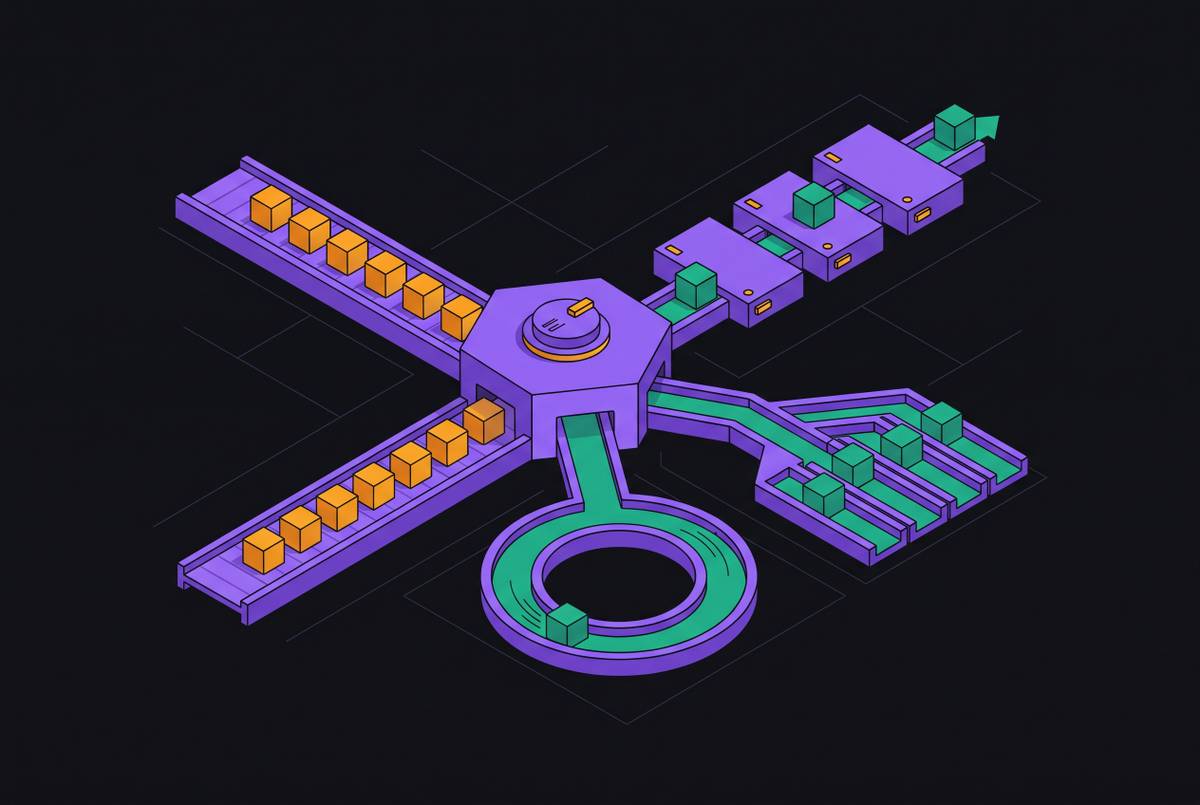
For a team without a platform lead, buying is usually the right choice when agents mainly drive SaaS tools the team does not own. In practice, that means selecting an existing orchestration layer and learning to configure it, rather than writing a router, retry logic, audit trail, and scheduler. Building becomes justified when agents run inside the team's codebase, state management is unusual, or compliance requires auditable deterministic steps in a diff.
Provider SDKs suit teams already committed to one model provider. They offer low-friction onboarding but tie the team to one model family. That tradeoff is reasonable when portability is not the immediate requirement.
Graph-based orchestration offers portability and auditability at the cost of more setup. It fits agents inside the product, complex state, or a mix of deterministic and model-driven steps. LangGraph has durable execution, streaming, human-in-the-loop, and persistence.
No framework is viable for genuinely simple, single-step tasks. It is not a phase-two strategy for shared coordination.
Evaluation must develop with that shared tooling. The tiers should be fast checks on every pull request, nightly regression suites that use an LLM to judge how good the output is, and continuous production monitoring to check for performance drift. Even the first tier creates a feedback loop. It gives the team a basis for judging changes before persistent infrastructure increases their consequences.
How agent patterns should be sequenced, not just selected
Can the steps be listed in advance? If so, use a workflow pattern such as chaining, routing, or parallelization. A single-agent tool loop remains appropriate through much of phase two. Escalate to orchestrator-workers only when a model must decompose the task, and reserve open-ended agent loops for genuinely unpredictable work. Complexity should answer a demonstrated need.
A supervisor or foreman pattern becomes useful when stable individual agents need coordination across domains. One orchestrator delegates to specialists. For structured multi-step work in phase three, plan-and-execute adds an explicit plan and review checkpoints where actual progress is compared with that plan and the plan is revised. Reflection lets an agent check and revise its own output before showing it. That can improve high-stakes outputs, but it adds latency.
Human-in-the-loop gates are a phase-two governance decision because consequential actions need defined thresholds for human judgment. What may the agent do alone, and when must a person decide? Scheduled agents and agents with memory need especially clear answers because the gap between authorized and actual behavior can grow silently over time. More autonomy without escalation thresholds makes a system harder to debug.
Phase three: agent infrastructure with governance designed in, not bolted on
Phase three needs people who can use their own tools reliably, shared conventions, evaluation that works, and an orchestration layer the team understands and can debug. Agents now retain state, act on schedules, and coordinate across systems. As a result, rules that previously depended on a person watching must become constraints on execution.
Runtime governance means checking policy where an action happens. AgenticRei from UMBC, with a co-author from MIT CSAIL, addresses governance beyond flat allow-or-deny decisions, including obligations after actions, precedence when rules conflict, and conditions under which obligations may be waived. What may each agent do, what is prohibited, and what must it report afterward? The rules should be enforced outside the LLM by a deterministic layer the team can read and modify.
CISA and NSA guidance recommends per-invocation policy evaluation. The Ethical Hyper-Velocity architecture paper describes why retrospective auditing is insufficient for this job. When policy checks take days, agents that work at machine speed can take many actions before anyone reviews them. Auditing remains useful, but it cannot substitute for enforcement at execution.
Memory gives the team more choices to make and does not make the system more reliable on its own. Working memory is the context window, episodic memory holds recent session history, semantic memory holds domain and codebase facts, and procedural memory contains skills, rules, and behavioral instructions encoded in weights and code. Each serves a different role. Summaries can omit critical details, long histories can distract the model, and persistent memory can preserve incorrect or malicious information. The system therefore needs ways to decide what to store, retrieve, update, compress, and forget.
The team should keep execution infrastructure as simple as it keeps orchestration. For a small Linux production pilot, a standard Ubuntu LTS or Debian stable VM is the low-risk default because of fast patching, documented images, and team familiarity. Purpose-built agentic Linux images add an operational surface that is premature for most five-person teams. Execution sandboxing, however, is a basic requirement for agents with write access to real systems. Giving each agent its own process view, network stack, and resource budget limits the environment in which it can act.
How operational knowledge accumulates across the team without a designated owner
Phase one gives engineers an understanding of their tools' strengths and limits. Phase two should leave at least two engineers able to explain the orchestration layer and its failures. Phase three should produce a shared mental model of tools, orchestration, governance, and memory, with people understanding adjacent layers well enough to debug across them. No single person needs to know every detail.
The runbook becomes the practical ownership artifact. It should record what the agent can do, what it cannot do, what happens when it fails, and how to restart it safely. Whoever encounters a new failure mode should update it. The test is whether another engineer can use that record without finding the person who originally set everything up.
The team should choose a platform that helps people share what they know. A purpose-built agent operating system can cut the work of coordination, scheduling, and auditing, while retrofitting general-purpose cloud tooling can leave the hard parts to whoever understands the retrofit. That does not justify skipping the earlier phases or adopting unfamiliar infrastructure prematurely. The choice should follow what the team is ready to operate.